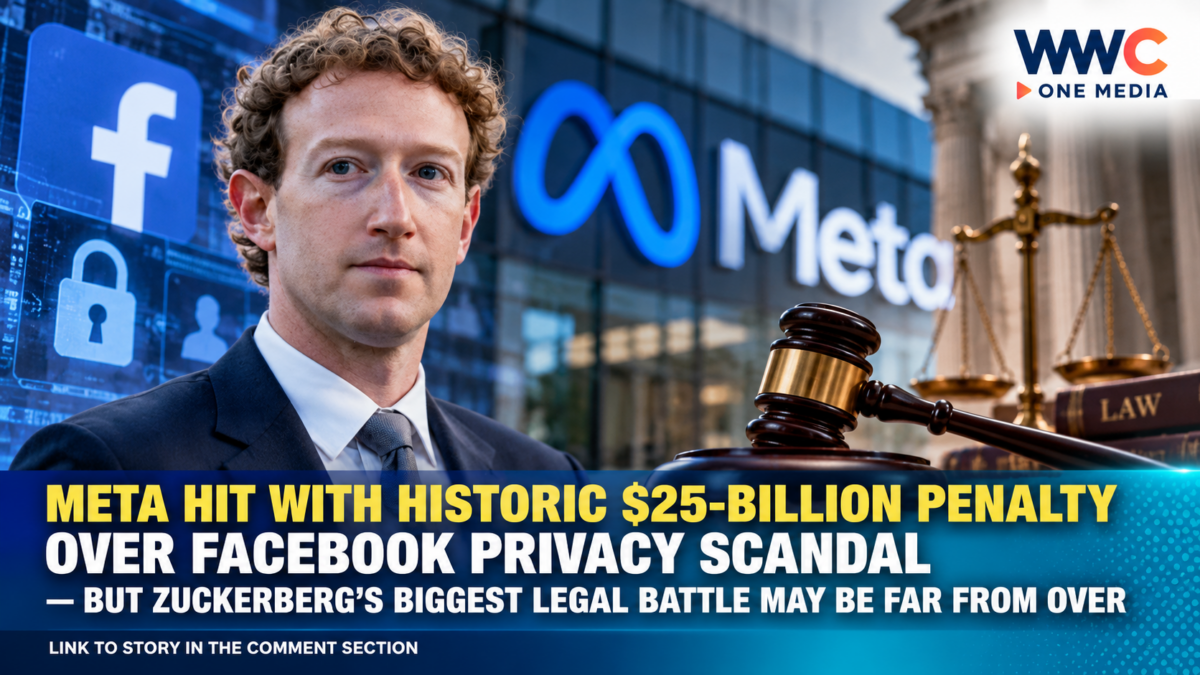
SANTA FE, NEW MEXICO — October 22, 2026 — Meta Platforms, the parent company of Facebook, Instagram and WhatsApp, has been ordered to pay a staggering US$25 billion in penalties after a New Mexico court found that the technology giant systematically misled consumers about how their personal information was handled.
The landmark ruling, issued Wednesday, October 21, by state District Court Judge Francis Mathew, represents one of the largest financial penalties imposed against a corporation in American legal history.
The case traces its origins to the notorious Cambridge Analytica scandal, which exposed how personal information belonging to tens of millions of Facebook users was improperly obtained and used for political profiling.
The decision delivers another major legal setback for Meta and CEO Mark Zuckerberg as the company faces growing pressure over data privacy, consumer protection and the safety of its social media platforms.
However, the legal battle is far from finished.
Meta has rejected the ruling and announced plans to appeal, setting up another potentially consequential court fight over Big Tech accountability.
Judge Reduces Potential $219-Billion Penalty to $25 Billion
The court’s decision followed a September 25 jury verdict finding that Meta had violated New Mexico’s consumer protection laws more than 43 million times.
Jurors determined that 26 of 29 public statements made by Meta and its executives were misleading.
These statements concerned Facebook’s privacy protections, access to personal data, and policies addressing harmful content.
Under New Mexico law, violations can carry penalties of up to $5,000 each.
Applying the maximum statutory amount to the violations could have produced a penalty exceeding $219 billion.
Judge Mathew ultimately reduced the award to $25 billion.
The court concluded that Facebook’s misleading communications were not isolated mistakes but part of a broader pattern involving how the platform represented its business practices to the public.
For New Mexico Attorney General Raúl Torrez, the judgment represents a major victory in the state’s effort to hold powerful technology companies accountable.
Torrez described the ruling as historic and said it sent a strong message to Silicon Valley about the consequences of misleading consumers.
Cambridge Analytica Scandal Returns to the Spotlight
The lawsuit is rooted in one of Facebook’s most damaging privacy controversies.
Cambridge Analytica, a British political consulting company involved in Donald Trump’s 2016 presidential election campaign, obtained information associated with as many as 87 million Facebook users without their informed consent.
The data was collected through a personality quiz application called “thisisyourdigitallife.”
Although approximately 270,000 people installed the application, Facebook’s systems at the time also allowed information associated with their friends to be collected.
The resulting dataset was used in political profiling and targeted advertising activities.
The scandal became public in 2018 and raised serious concerns about whether social media users genuinely understood how their personal information could be accessed by third parties.
Facebook had learned of Cambridge Analytica’s acquisition of data years earlier, but the broader public controversy emerged after investigative reporting and whistleblower disclosures.
The New Mexico litigation later focused on whether Meta misled users about its privacy practices and the safeguards supposedly protecting their information.
What the New Mexico Jury Found
The state’s lawsuit, filed in 2021, accused Meta of presenting misleading assurances about privacy controls, third-party access to user information and the company’s handling of harmful content.
Prosecutors argued that Meta knew outside developers had extensive access to personal data while continuing to promote the platform as providing meaningful user control.
The jury ultimately agreed that numerous company statements violated state consumer protection law.
The legal findings went beyond whether Cambridge Analytica obtained information improperly.
They examined whether Facebook itself had misrepresented the operation of its platform and the risks faced by consumers.
This distinction is important because it places responsibility on the company’s own statements and business practices, not simply the actions of an outside political consulting firm.
The $25-billion award is a civil penalty payable to New Mexico, not an automatic compensation fund for every Facebook user affected worldwide.
Meta Fights Back: Company Calls Ruling a Threat to Free Speech
Meta has strongly rejected the court’s conclusions.
The company’s chief legal officer, C.J. Mahoney, argued that the decision would make operating a business in New Mexico extraordinarily difficult.
Meta described the state’s legal approach as a “tax on speech,” contending that the case effectively penalizes the company over the rules governing what people may say online.
The technology giant maintains that the penalties are excessive and that it expects to prevail on appeal.
In earlier court filings, Meta had argued for a substantially smaller penalty of approximately $3.45 billion.
The company also disputed allegations that consumers had been proven to suffer the kind of deception claimed by the state.
With an appeal planned, the $25-billion judgment should not be treated as money already paid or as a final, unchallengeable legal outcome.
Meta’s Legal Problems Extend Beyond Cambridge Analytica
The New Mexico ruling arrives during a period of unusually intense legal scrutiny for the parent company of Facebook and Instagram.
Earlier in 2026, a separate New Mexico proceeding involving allegations of harm to children resulted in a $375-million jury penalty.
A subsequent ruling directed Meta to contribute an additional $567 million toward a state fund addressing teen mental health and to implement protective measures for young users.
Separately, Meta reached multistate agreements concerning allegations over privacy, youth safety and addictive platform design.
These cases are legally distinct from the Cambridge Analytica litigation, but together they demonstrate the growing financial and regulatory consequences confronting major social media companies.
The findings and settlements also reflect a broader shift in how governments and courts are examining the responsibilities of online platforms.
Could the $25-Billion Ruling Change Big Tech?
The case could influence future legal arguments over corporate disclosures, privacy protections and statements made by technology executives.
Social media companies generate substantial commercial value from user engagement and advertising systems that depend on collecting and processing information.
That business model has created recurring disputes over transparency, consent and the appropriate limits of data access.
A penalty of this magnitude could encourage regulators and consumer advocates to pursue stronger enforcement where companies are alleged to have misled the public.
However, the eventual impact will depend heavily on whether the judgment survives Meta’s appeal and how reviewing courts interpret the legal and constitutional issues.
The ruling does not automatically establish a new worldwide standard for penalties against technology companies.
What Does This Mean for Facebook Users in the Philippines and Asia?
The New Mexico decision does not directly change Facebook’s rules or impose a new privacy law in the Philippines.
Nevertheless, the controversy highlights issues that matter to social media users and businesses across Asia.
These include how platforms collect personal information, what access third-party applications receive, how transparently companies explain privacy settings, and whether users have meaningful control over their data.
For businesses relying heavily on Facebook and Instagram advertising, the case is also a reminder of the importance of legitimate consent, transparent data handling and compliance with applicable privacy regulations.
In the Philippines, organizations processing personal information remain subject to the Data Privacy Act of 2012 and relevant guidance from the National Privacy Commission.
There is no evidence from this ruling alone that Filipino Facebook users will receive direct compensation or that Facebook services in the Philippines face imminent restrictions.
What Happens Next?
Meta’s planned appeal is now the central development to watch.
A reviewing court could uphold the penalty, reduce it, overturn aspects of the decision or return issues for further proceedings.
The dispute could also intensify scrutiny of how much financial liability a technology company may face for repeated misleading statements under state consumer protection laws.
For New Mexico, the ruling marks a major legal victory, although the collection of the full award remains subject to the outcome of further proceedings.
For Meta, it represents an enormous potential financial liability and another serious challenge to its public assurances about data privacy.
The biggest question is no longer whether Facebook’s Cambridge Analytica scandal damaged public trust. It is whether a $25-billion court judgment will survive appeal — and whether this could become a turning point in the battle to hold Big Tech accountable.