
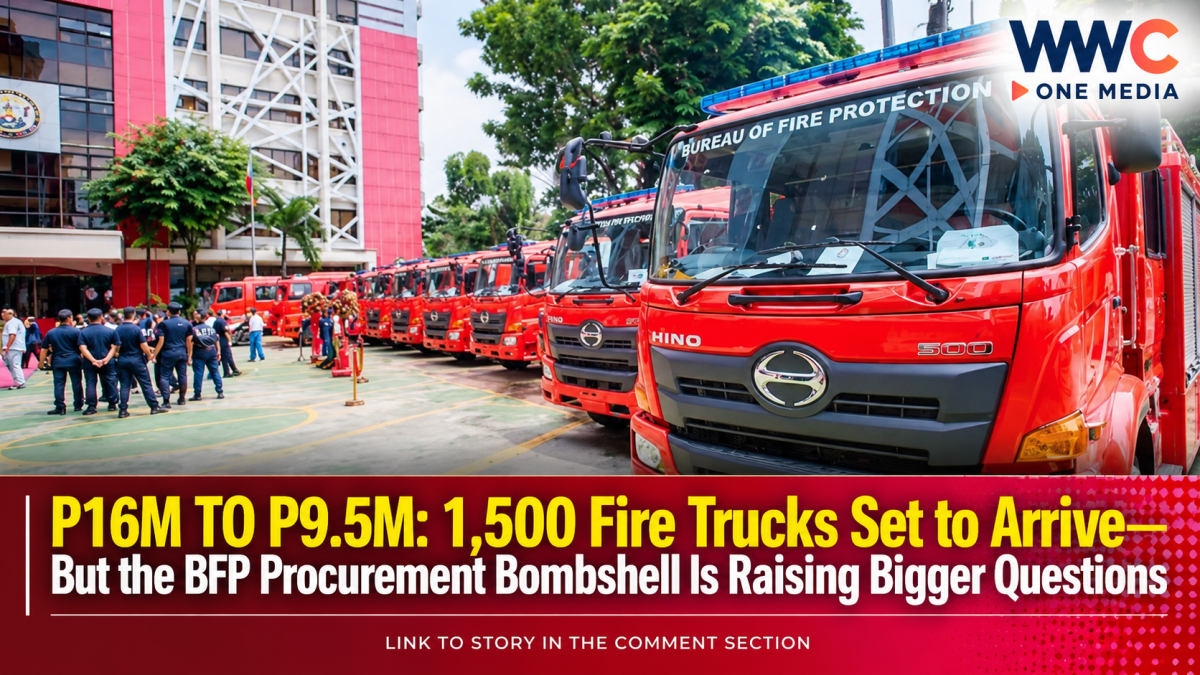
The Philippine government is moving to address a nationwide shortage of firefighting vehicles through a new government-to-government procurement arrangement with South Korea—but the plan comes amid serious allegations of corruption and inflated prices in previous Bureau of Fire Protection (BFP) purchases.
Interior Secretary Jonvic Remulla said the country currently faces a backlog of about 1,500 fire trucks, with the first 150 South Korean units expected to begin arriving in January 2027. The government says the new arrangement is designed to remove middlemen and substantially lower procurement costs.
From P16 million to P9.5 million?
Remulla said the government previously paid around P16 million for a fire truck, but under the new arrangement, comparable units could be acquired for approximately P9.5 million.
He said the three-year supply agreement covering more than 1,500 trucks could generate savings of around 40 percent compared with previous procurement costs.
The proposed savings are significant because the government is dealing with thousands of communities that need adequate firefighting equipment.
But the price gap has also raised a much bigger question:
Why were some BFP fire trucks allegedly so expensive in the first place?
Alleged corruption at the center of the controversy
Remulla has accused officials involved in previous BFP procurement of irregularities and excessive markups.
In the latest remarks reported by Panay News, he alleged that a former BFP chief sought P5 million for every fire truck purchased by the bureau. The allegation remains an accusation and is subject to investigation and due process.
The allegations are part of a broader DILG crackdown.
Earlier this year, the department announced complaints against dozens of current and former BFP officials over alleged irregularities in fire-truck procurement from 2018 to 2024. The Philippine News Agency reported that 45 officials were initially identified in the complaints, while GMA later reported that the number of officials facing Ombudsman cases had reached 49.
The accusations include alleged manipulation of procurement processes and suspicious increases in the prices of fire trucks.
GMA reported that Remulla cited a fire truck whose price allegedly increased from around P5 million in 2015 to P10 million in 2018 and P15 million in 2021.
Why South Korea?
The proposed solution is a government-to-government procurement model, with the Philippines working directly with South Korean government institutions rather than relying on traditional intermediary arrangements.
In August, Inquirer reported that the DILG was already working on a government-to-government transaction for 1,500 fire trucks from South Korea. At that time, officials said the process was being coordinated with South Korea’s National Fire Agency, Korea Fire Institute and Korea Trade-Investment Promotion Agency, which would help evaluate potential suppliers based on Philippine technical requirements.
The latest announcement indicates that the agreement has progressed, with deliveries expected to begin in January 2027. PNA reported that the arrangement involves 150 units per month, according to Remulla.
But there is an important timeline discrepancy
Earlier reporting described the procurement as a four-year transaction, while the latest announcement from Remulla describes a three-year supply agreement.
That distinction matters, so the safest wording is that the government is pursuing a long-term government-to-government supply arrangement covering more than 1,500 trucks, with the latest DILG statement saying the agreement will run for three years.
Where does BFP’s money come from?
The fire-truck controversy is also tied to the way the BFP is funded.
Under Republic Act No. 11589, the BFP Modernization Trust Fund receives, among other sources, the bureau’s 80% share of taxes, fees and fines collected under the Fire Code, as well as appropriations and other authorized funding sources.
In 2024, the Department of Budget and Management released P2.88 billion for the BFP’s acquisition of 154 fire trucks, three collapsed-structure-and-rescue trucks and 132 ambulances. The funding came from the BFP’s share of Fire Code revenues.
This makes the procurement controversy particularly sensitive: the equipment is supposed to strengthen the country’s emergency-response system, while the money ultimately supports a public safety function.
The shortage is not simply about numbers
The BFP’s own records show that equipment availability has been an ongoing challenge.
Its 2023 annual report listed 2,961 BFP-owned fire trucks, of which 2,697 were serviceable, 232 were unserviceable and 32 were under repair. Local government units also had 621 fire trucks, with 520 listed as serviceable.
That means simply announcing another 1,500 vehicles will not solve the problem overnight.
Fire stations need trained personnel, maintenance, spare parts, water supply, accessible roads and functioning emergency communications to make those trucks effective.
The race now begins
The government says the new procurement strategy could simultaneously attack two problems: the fire-truck shortage and the procurement-cost controversy.
If the promised savings materialize, billions of pesos could potentially be freed for additional equipment and modernization.
But the government still has to prove that the new process will be transparent and that the lower price will not compromise the quality, safety and reliability of the vehicles.
And that is where the biggest test begins.
The Philippines is not simply buying trucks.
It is attempting to rebuild public confidence in the system responsible for putting those trucks on the road.
The first 150 Korean fire trucks are expected in January 2027. Whether they arrive on time—and whether the new procurement model really delivers the promised savings—could determine whether this becomes a genuine BFP turnaround or simply another chapter in the country’s long-running firetruck controversy.




Leave a Reply