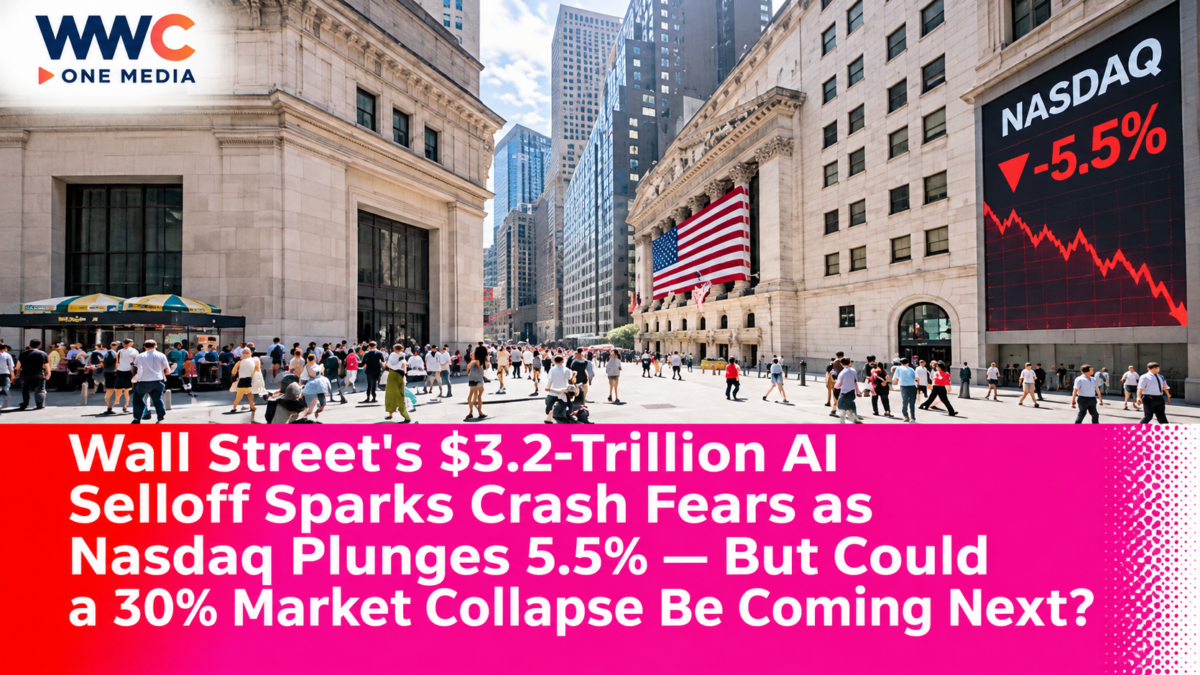
NEW YORK / LONDON / MANILA — Wall Street’s artificial intelligence boom is facing one of its most dangerous tests yet, after a brutal technology-stock selloff wiped an estimated US$3.2 trillion from US equity-market value and raised fears that the investment frenzy powering the global economy could be approaching a breaking point.
The Nasdaq Composite plunged approximately 5.5% on Thursday, November 5, while the S&P 500 tumbled 4.4%, as investors rushed to sell shares in semiconductor manufacturers, AI infrastructure developers and other companies associated with the enormous expansion of artificial intelligence.
The selling followed the November 3 US midterm elections, when Democratic victories raised the prospect of tougher restrictions on energy-intensive data centres.
But politics was only part of the story.
Behind the market turmoil lies a much larger financial question.
Have investors committed too much money to artificial intelligence before proving that the technology can generate sufficient profits?
In a November 7 Financial Times commentary republished by Channel News Asia, financial columnist Katie Martin warned that the latest wave of selling could be more significant than previous AI-related market corrections.
The concern is not whether artificial intelligence works.
It is whether the companies financing the AI revolution can justify extraordinary valuations, mounting debt and increasingly interconnected investment arrangements.
And one research firm’s worst-case scenario suggests that a full-scale collapse could potentially erase at least 30% of US stock-market value while generating up to US$200 billion in credit losses.
That is a stress scenario, not a confirmed forecast.
Nevertheless, it highlights why Wall Street’s confidence is being tested.
Nasdaq Plunges as Investors Question the AI Boom
The latest selloff intensified on Thursday, November 5.
According to the Associated Press, the Nasdaq Composite dropped approximately 5.5%, pushing the technology-heavy index deeper into correction territory.
The S&P 500 fell 4.4%, while the Dow Jones Industrial Average declined approximately 3.4%.
The declines reflected a broad retreat from assets associated with artificial intelligence.
Nvidia, whose processors have become central to AI infrastructure, fell 9.3%.
Advanced Micro Devices plunged 17.3%.
GE Vernova, which supplies power-generation and electrical infrastructure, declined 7.5%.
The losses demonstrated that investors were reassessing more than individual software companies.
They were questioning businesses throughout the infrastructure chain supporting AI development.
That includes semiconductor manufacturers, specialist cloud providers, data-centre operators and electricity-equipment suppliers.
The selling was particularly severe among companies whose valuations depend heavily on continued growth in AI infrastructure spending.
Friday, November 6, brought a partial recovery, but it did not erase the week’s losses.
According to subsequent Financial Times reporting, the Nasdaq-100 finished the week approximately 4.9% lower.
The situation illustrates how quickly market sentiment can change.
A technology sector that recently appeared almost unstoppable is now confronting uncomfortable questions about valuations, debt and long-term profitability.
A US$3.2-Trillion Warning: Why Wall Street Is Suddenly Nervous
The estimated US$3.2-trillion decline in American equity-market value represented one of the most dramatic market reactions to growing doubts about AI-related investment.
But it is important to understand what that figure means.
Market capitalization measures the value of outstanding shares based on prevailing market prices.
A decline in capitalization does not mean that the same amount of cash has physically disappeared from corporate bank accounts.
Nor does it mean every shareholder realized a loss through selling.
Instead, it reflects the reduction in market value investors assigned to publicly traded companies.
Nevertheless, the scale matters.
Many of the world’s largest investment funds, pension portfolios and retirement accounts hold substantial positions in US technology stocks.
When those shares decline sharply, the effects can extend far beyond Silicon Valley.
As previously reported by WWC ONE MEDIA in its coverage of the US$3.2-trillion Wall Street AI selloff, investors have begun examining whether the market’s extraordinary enthusiasm for AI infrastructure has moved ahead of the financial returns companies can reasonably deliver.
That distinction could determine whether the latest decline proves temporary or becomes part of a deeper market correction.
CoreWeave’s 70% Collapse Shows the Danger of Leveraged AI Expansion
One of the clearest warning signs comes from CoreWeave.
The Nvidia-backed cloud computing company has become a prominent example of the AI infrastructure industry’s enormous financing requirements.
CoreWeave operates specialized computing infrastructure used by companies developing and running artificial intelligence applications.
But expanding that business requires substantial upfront spending.
Advanced processors are expensive.
Data centres require electricity, cooling systems and networking equipment.
New facilities must often be financed before customers begin generating revenue from them.
According to Katie Martin’s Financial Times commentary, CoreWeave shares fell 10% on November 5 alone.
That brought their decline from a May peak to approximately 70%.
The collapse highlights how vulnerable heavily valued infrastructure businesses can become when investors begin questioning future growth.
A company may have significant customer contracts yet still face difficulties financing the facilities required to fulfill them.
As WWC ONE MEDIA previously examined in its investigation of CoreWeave’s mounting liabilities and financing pressures, the company has attracted scrutiny over the enormous capital requirements of its business model.
However, a steep share-price decline does not automatically mean bankruptcy is imminent.
CoreWeave’s ability to manage its obligations depends on factors including financing arrangements, customer payments, operating performance and available liquidity.
The broader concern is whether multiple companies across the AI sector could face similar pressures at the same time.
The Hidden Danger: AI Companies Are Investing in One Another
Perhaps the most important financial warning comes from the Bank for International Settlements.
In an October 1, 2026, bulletin titled Circular relationships among AI firms, BIS researchers examined investment arrangements involving artificial intelligence companies between 2021 and 2025.
Their findings were striking.
Approximately 28.7% of AI firms’ outgoing investment value went into other AI companies.
Meanwhile, 55.2% of incoming investment into AI firms originated from other AI firms.
Of the investments involving AI companies on both sides, 46.4% by value also involved firms with commercial supplier-customer relationships.
The findings reveal a highly interconnected financial ecosystem.
In some arrangements, a company may invest in another business that also purchases its products or services.
Such relationships can make commercial sense.
A chip manufacturer may invest in a cloud provider to help secure future demand.
A technology company may finance an infrastructure partner to ensure access to computing capacity.
But these structures can also make it harder to determine how much demand ultimately comes from independent customers.
If investment and purchasing commitments depend heavily on one another, financial problems affecting one company could spread to its partners.
Importantly, circular financing does not automatically mean fraud, fictitious revenue or improper accounting.
The BIS researchers identified legitimate economic reasons for these arrangements while warning that they can increase opacity and financial-system vulnerabilities.
As WWC ONE MEDIA explored in its examination of the financial links connecting AI giants, the concern is that investors may underestimate how much financial risk is concentrated within interconnected companies.
The US Midterm Elections May Have Changed the AI Investment Equation
The November 3 US midterm elections introduced another major source of uncertainty.
Democrats secured control of both chambers of Congress, while candidates campaigning against large data-centre developments gained support in several communities.
The immediate market response was positive.
On November 4, the Dow Jones Industrial Average surged more than 1,500 points as investors welcomed a decisive election result and anticipated changes in Washington’s political direction.
But optimism faded rapidly.
The election also demonstrated growing public resistance to massive computing facilities.
Some communities have complained about electricity requirements, water consumption, land use and infrastructure costs associated with AI development.
A political shift toward stricter permitting could increase construction costs and delay projects.
For technology companies with substantial cash reserves, those delays may be manageable.
For developers relying heavily on borrowed funds, they can be much more damaging.
Interest expenses may continue accumulating while projects await approval.
And if customers cannot access the promised computing capacity on schedule, expected revenue may be delayed.
The resulting financial pressure could extend beyond the original developer to lenders, suppliers and other investors.
Why Local Opposition Could Become a Global AI Problem
Data-centre opposition is no longer confined to isolated communities.
Residents and environmental groups across multiple regions are questioning whether local electricity and water systems can support enormous new computing facilities.
As WWC ONE MEDIA previously reported on the international backlash against AI data centres, proposed developments have encountered permitting disputes, environmental concerns and political resistance.
The issue extends beyond environmental protection.
Some communities want technology companies to cover the full cost of electricity-grid upgrades rather than passing those expenses to ordinary consumers.
Others are concerned about water demand during drought conditions.
In a November 7 commentary, Katie Martin highlighted the possibility that political resistance could become a significant obstacle for developers.
Citadel Securities strategist Frank Flight argued that some projects may move to locations with more favorable regulations.
However, relocation is not necessarily simple.
Developers must obtain land, electricity connections, permits and financing.
Those requirements take time.
For highly leveraged projects, delays can create serious financial complications.
Still, stronger regulation does not automatically mean that all planned AI infrastructure will be cancelled.
Some developments may proceed in different locations or under revised conditions.
The eventual financial effects will depend on how governments implement restrictions and how companies respond.
Could the AI Bubble Become Another Dot-Com Crash?
The comparison with the dot-com bubble is becoming increasingly common.
During the late 1990s, investors poured money into internet businesses, expecting the technology to transform commerce and communication.
Many of those predictions about the internet’s long-term importance proved correct.
But numerous companies had been assigned valuations that their actual earnings could not support.
When investor expectations changed, technology stocks collapsed.
The Nasdaq Composite lost approximately 78% of its value between its March 2000 peak and October 2002 trough.
The lesson is not that new technology lacks value.
It is that a powerful technological revolution can coexist with excessive financial speculation.
Artificial intelligence may transform healthcare, education, finance, manufacturing and other industries.
But that does not guarantee that every AI infrastructure investment will become profitable.
Some businesses may emerge as major long-term winners.
Others may struggle with debt, overcapacity or intense competition.
And companies that benefit from AI adoption may not necessarily be the same businesses financing today’s enormous infrastructure buildout.
The dot-com comparison is useful as a warning, not proof that history will repeat itself.
Could US Stocks Really Crash Another 30%?
The most alarming scenario cited by the Financial Times came from Dario Perkins of economic research firm TS Lombard.
In October, Perkins outlined a possible severe downturn involving AI-related investments.
Under his worst-case scenario, US equities could fall by at least 30%.
The downturn could also generate as much as US$200 billion in credit losses and a wave of technology-related debt defaults.
Those figures describe a hypothetical stress scenario.
They are not an official projection of what the stock market will do.
The outcome would depend on many factors, including financing conditions, corporate earnings, investor behavior and economic policy.
A severe decline in technology shares could spread through major stock-market indexes because large AI-related companies account for a substantial portion of their market capitalization.
Financial institutions exposed to technology lending could also face increased risk.
But other scenarios remain possible.
AI demand could remain strong enough to support infrastructure investment.
Technology stocks could stabilize after valuations adjust.
Or markets could experience a prolonged period of volatility without a full-scale crash.
The important point is that downside risks are substantial enough to warrant serious attention.
Big Tech Is Not the Same as Every AI Infrastructure Developer
One important distinction is that major diversified technology companies often have financial resources unavailable to smaller infrastructure businesses.
Microsoft, Alphabet, Amazon and Meta operate established businesses that generate significant revenue and cash flow.
Those activities can help finance their investment in AI.
Specialized infrastructure developers may depend more heavily on debt, external investors and future customer commitments.
That difference can affect resilience during periods of market stress.
If demand slows, diversified companies may be able to adjust capital spending while continuing to generate income from existing operations.
A highly leveraged developer may have fewer options.
Bloomberg’s November 6 reporting highlighted how investors increasingly distinguished between established technology groups and companies directly exposed to financing the AI buildout.
The market’s reassessment therefore does not necessarily imply that every technology stock will perform similarly.
The risks vary depending on balance-sheet strength, profitability, customer concentration and future spending commitments.
Wall Street’s AI Dependence Is Becoming a Financial Stability Concern
The broader issue is how much of the market’s recent performance has depended on artificial intelligence.
Large technology companies have become major contributors to US equity-index returns.
Their influence also extends into global investment portfolios.
When a relatively small group of companies accounts for a large portion of an index, sharp price movements can affect investors holding supposedly diversified funds.
The Guardian reported that the seven largest US technology names commonly grouped as the Magnificent Seven represent more than one-third of the S&P 500.
That concentration increases the importance of their earnings and valuations.
It also means that concerns about AI infrastructure can affect pension funds, retirement savings and international investors.
The risk is not limited to people who directly own shares in Nvidia or specialist AI companies.
However, portfolio exposure varies.
Not every investment fund has the same technology weighting, and non-US markets may perform differently depending on local economic conditions.
What Could Stop the AI Selloff?
Several developments could help stabilize financial markets.
The first would be stronger evidence that AI investment is generating sustainable revenue and profits.
Investors want to see that expensive infrastructure is being used productively.
They also want companies to demonstrate that cash flow can support future spending.
A second factor would be greater clarity about data-centre permitting and energy policy.
If governments establish predictable development rules, companies may be better able to estimate construction costs and project schedules.
A third factor involves financing conditions.
Lower borrowing costs could ease pressure on companies funding expansion through debt.
Finally, geopolitical developments remain important.
The Financial Times commentary highlighted the economic consequences of the Iran war, including oil prices and inflation.
A reduction in geopolitical tensions could support broader market confidence.
But none of these developments guarantees a sustained recovery.
Markets could stabilize while still assigning lower valuations to AI-related companies than during the height of the boom.
Not Every Wall Street Expert Believes the AI Boom Is Over
The bearish interpretation is not universally accepted.
Some analysts argue that the market is experiencing a necessary correction after years of extraordinary gains.
UBS Global Wealth Management’s chief investment officer Mark Haefele indicated that the longer-term AI investment cycle could remain intact despite the recent volatility.
Other analysts emphasize that demand for cloud computing, advanced processors and business automation has not disappeared.
That distinction matters.
The commercial adoption of AI may continue even if some companies struggle financially.
A stock-market correction could eliminate unrealistic expectations while allowing stronger businesses to expand.
The November 8 Financial Times analysis also noted that better-than-expected US job growth and projects already under construction could support the economy.
Meanwhile, some investors believe data-centre restrictions may slow expansion rather than stop it altogether.
These arguments suggest that a deep crash is not inevitable.
The central uncertainty is whether future earnings can grow quickly enough to justify current investment and valuations.
Why Filipino and Asian Investors Should Pay Attention
The US technology selloff has implications for investors throughout Asia.
Asian semiconductor manufacturers and electronics suppliers participate in global AI supply chains.
Financial markets in South Korea and Taiwan are particularly sensitive to changes in expectations for advanced chips.
Singapore and Malaysia have also attracted significant investment connected to data centres and computing infrastructure.
For the Philippines, the effects could be indirect but meaningful.
A prolonged slowdown in AI infrastructure spending could influence electronics demand, investment decisions and financial-market sentiment.
Filipino investors holding US technology shares, international equity funds or technology-heavy ETFs may also experience volatility.
However, the effects will depend on individual portfolio exposures and broader market developments.
A decline in US AI stocks does not automatically predict a corresponding decline in the Philippine Stock Exchange Index.
Currencies, interest rates, domestic earnings and economic policy can also influence local markets.
Where Are Investors Looking for Alternatives?
The recent selloff has encouraged investors to examine companies outside the most crowded AI trades.
Government bonds have attracted attention as some investors seek assets that may perform differently during equity-market volatility.
Others are looking at businesses with revenue streams less directly dependent on AI infrastructure spending.
As WWC ONE MEDIA reported in its November 8 coverage of five Goldman Sachs stock ideas, the investment bank has highlighted opportunities in defence, financial services, hotels and travel.
But diversification does not eliminate investment risk.
Non-technology companies can also decline during broad market downturns.
Government bonds carry interest-rate and other risks.
And no investment is guaranteed to protect capital during a financial crisis.
The key lesson is that investors should distinguish between a company’s long-term business potential and the valuation reflected in its share price.
What Investors Should Watch Next
The coming weeks could be particularly important for determining whether the AI selloff deepens.
Corporate earnings will reveal whether revenue growth is keeping pace with infrastructure spending.
Balance-sheet disclosures will show whether companies are becoming more dependent on borrowing.
Data-centre developers will need to demonstrate progress on construction, permits and electricity connections.
Investors will also monitor signs of financial stress in corporate bonds and private-credit markets.
Another important measure will be the performance of companies outside the technology sector.
If losses remain concentrated in expensive AI infrastructure shares, the market may be experiencing a sector-specific repricing.
If selling spreads through banks, industrial companies, consumer businesses and other sectors, concerns about a broader economic downturn could intensify.
A sharp one-day decline is not sufficient evidence to establish which path markets will follow.
The Bottom Line: Artificial Intelligence May Survive Even if the AI Stock Boom Does Not
Wall Street’s latest selloff has exposed the financial risks surrounding one of the most ambitious technology investment cycles in history.
An estimated US$3.2 trillion in equity-market value was erased during the November 5 rout.
The Nasdaq Composite fell approximately 5.5%.
CoreWeave shares had declined around 70% from their May peak.
And the Bank for International Settlements has documented substantial financial links among companies operating within the AI industry.
The November 3 US midterms introduced additional uncertainty through the possibility of tougher data-centre regulations.
But the most important concern remains financial.
Can companies investing hundreds of billions of dollars in AI infrastructure eventually generate sufficient returns?
The answer will determine which businesses emerge stronger and which may struggle under the weight of their investments.
Katie Martin’s Financial Times commentary presents a warning that the latest decline could signal something more serious than another temporary market wobble.
Yet the future remains uncertain.
Artificial intelligence may continue developing rapidly even if the prices of AI-related stocks fall sharply.
The technology’s long-term success and the financial returns earned by today’s investors are two different questions.
And as Wall Street confronts falling technology shares, mounting financing risks and growing public resistance to data-centre construction, one question could define the next chapter of the global AI revolution: Is the market simply correcting years of excessive optimism—or could the world’s most expensive technology investment boom be approaching a financial collapse far larger than investors are prepared for?