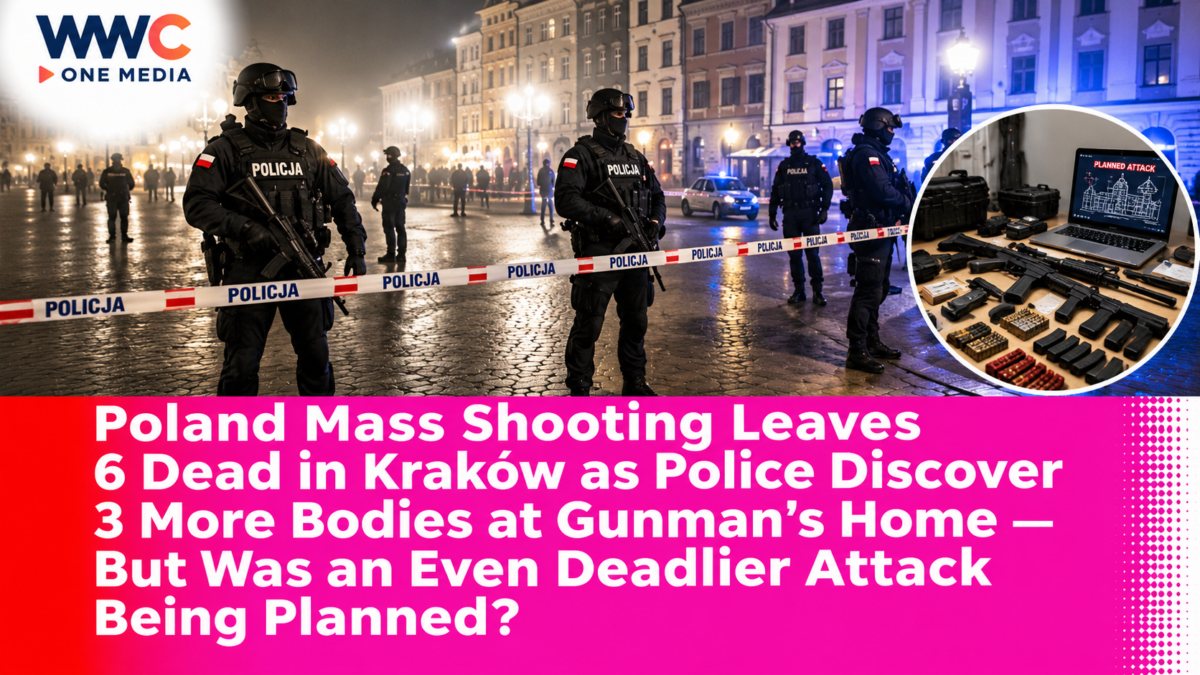
KRAKÓW, POLAND — A deadly shooting in the historic heart of one of Europe’s most popular tourist cities has left six people dead and at least 15 injured, triggering a major security investigation after Polish authorities revealed that the suspected gunman appeared to have been influenced by far-right extremist ideology.
The violence erupted on Saturday, November 7, when a 24-year-old Polish man allegedly drove into Kraków’s famous Main Market Square and opened fire on people gathered in the busy public area.
The victims included four women and two men, among them a British national.
Police officers confronted the suspect, who was armed with a semiautomatic rifle, and shot him before taking him into custody.
But the investigation took an even more disturbing turn hours later.
Three additional bodies were discovered at the suspect’s home nearly 200 kilometres from Kraków.
Polish Prime Minister Donald Tusk said the deceased were two women and one man, with strong indications that they belonged to the suspect’s immediate family.
Authorities also warned that additional weapons might be stored inside the property.
The discoveries have raised urgent questions about whether the attack involved further violence before the shooting in Kraków.
However, investigators have not yet established the circumstances of the three deaths or confirmed that the suspect intended to carry out another attack.
As Poland begins two days of national mourning, the tragedy is emerging as one of the country’s deadliest mass shootings in decades.
Gunman Opens Fire in Kraków’s Famous Main Market Square
The attack began at approximately 3pm local time on Saturday.
According to Polish authorities, the suspect drove a vehicle into Kraków’s Main Market Square, a historic landmark surrounded by restaurants, cafés, shops and tourist attractions.
Police said he began firing at people in the area.
The sudden gunfire sent visitors and residents scrambling for cover.
Witnesses described scenes of panic as people rushed into nearby businesses and attempted to escape.
One witness identified as Annette told AFP that she saw a man walking around the square and shooting at people.
Another witness, identified as Konrad, told Polish news outlet Interia that he saw gunfire coming from the driver’s side of a vehicle before fleeing toward a nearby police station.
Inside, he found other people sheltering from the violence.
The attack struck an area that normally symbolizes Kraków’s cultural heritage and international appeal.
Main Market Square is among the best-known tourist destinations in Poland.
Its historic buildings, outdoor dining areas and nearby attractions draw large numbers of international visitors throughout the year.
The shooting transformed that familiar public space into a major crime scene.
Six People Killed as Police Rush to Stop Attacker
Polish police confirmed that six people were killed in the shooting.
The victims were four women and two men.
A British citizen was among those killed, according to Polish police chief Marek Boroń.
Authorities also reported that foreign nationals were among the injured.
Reuters reported that the wounded included people from several European countries.
Portugal’s Foreign Ministry confirmed that a Portuguese woman had been injured and hospitalized.
Police officers were also among those wounded during the response.
As the emergency unfolded, armed officers confronted the suspect.
Interior Minister Marcin Kierwiński said police opened fire on the attacker approximately three minutes after receiving the first emergency report.
The suspect was wounded, detained and transported to hospital.
Kierwiński praised the responding officers, saying their rapid intervention may have prevented further deaths.
Prime Minister Donald Tusk also commended the officers who risked their lives during the operation.
Although the shooting ended quickly, the consequences were devastating.
Emergency responders faced multiple casualties, while investigators began reconstructing the suspect’s movements and the circumstances that led to the attack.
Police Discover Three More Bodies at Suspect’s Home
One of the most significant developments emerged when investigators searched a property linked to the suspected attacker.
Authorities discovered three bodies at his home in Ostrowiec Świętokrzyski, nearly 200 kilometres north of Kraków.
Prime Minister Tusk said the deceased were two women and one man.
He stated that available information strongly suggested the three were members of the suspect’s immediate family.
However, their identities and causes of death had not been conclusively established in the reporting reviewed.
Investigators treated the location as a potential additional crime scene.
Because authorities believed significant quantities of weapons might be stored inside the property, they approached the search with additional security precautions.
Tusk said a drone had been used to examine the interior of the home.
Local media reported that residents were evacuated from the building before counterterrorism officers entered.
Poland’s Internal Security Agency and Military Counterintelligence Service also became involved in supporting the investigation.
The discovery raises several critical questions.
Were the three people killed before the shooting in Kraków?
What was the relationship between the suspect and the deceased?
Were additional weapons being stored for another planned act of violence?
At this stage, authorities have not publicly established answers to all these questions.
The three additional deaths should therefore not automatically be described as confirmed victims of the Main Market Square shooting.
Suspect Allegedly Influenced by Far-Right Extremist Ideology
Polish Interior Minister Marcin Kierwiński said early investigative findings suggested that the gunman had been influenced by far-right ideology.
He described the suspect as holding extremely radical and ultranationalist views.
However, the precise motive remains under investigation.
Authorities have not established publicly whether the suspect acted because of a specific political belief, whether particular victims were deliberately targeted or whether any organization was involved.
That distinction is essential.
An apparent interest in extremist ideology does not, by itself, establish the legal motive behind a mass shooting.
Investigators must determine whether the suspect’s beliefs influenced his actions and whether the attack involved ideological planning.
The concern follows a series of violent incidents in Poland during October.
Authorities previously warned about extremist content online after several school-related stabbing incidents.
The latest shooting has intensified scrutiny of possible connections between violent ideology, online radicalization and real-world attacks.
However, investigators have not established a direct connection between the Kraków shooting and those earlier incidents.
The circumstances remain separate investigations unless evidence demonstrates otherwise.
What Weapons Did Police Recover?
Polish police said the suspected gunman was wearing military-style clothing during the attack.
According to national police spokesman Andrzej Fijołek, the attacker used an AR-15-type semiautomatic rifle.
Police also recovered additional firearms and substantial quantities of ammunition from the suspect’s vehicle.
Reuters reported that the suspect held a firearms licence.
That information has prompted questions about how the weapons were obtained and whether warning signs had been missed.
But possession of a firearms licence does not establish that every recovered weapon was legally held or that the suspect complied with all applicable regulations.
Investigators will need to examine the status and ownership of the recovered weapons.
They may also assess whether the suspect had previously attracted attention from law enforcement or security agencies.
Polish officials have not publicly established that any particular licensing failure caused the attack.
The case nevertheless has the potential to intensify debate about firearms access and public safety.
Poland’s Gun Ownership Numbers Are Rising
Poland has historically experienced relatively low levels of fatal mass shootings compared with some other countries.
However, official police figures show that firearm ownership has been increasing.
According to data cited by AFP, Polish authorities issued more than 50,000 new firearms licences in 2025.
The total number of licences reached approximately 411,000.
These figures represent a significant increase in legally licensed gun ownership.
But they do not establish a causal relationship between rising licence numbers and the Kraków shooting.
Determining whether firearm licensing rules require changes would involve examining how the suspect obtained weapons, whether authorities had relevant information about his behaviour and whether existing safeguards were followed.
Public debate could also focus on background checks, monitoring of threats and procedures for identifying people who may pose a risk.
The challenge for lawmakers is separating evidence-based reforms from assumptions made immediately after a tragedy.
Donald Tusk Calls Shooting an Act of Terrorism
Prime Minister Donald Tusk travelled to Kraków following the attack.
He described the shooting as a national tragedy and publicly praised the police response.
Tusk also characterized the violence as an act of terrorism.
The statement reflects the seriousness with which Poland’s government is treating the incident.
However, investigators must still establish the suspect’s precise motive and determine which criminal or terrorism-related offences are supported by the evidence.
Tusk said the discovery of three bodies at the suspect’s home had expanded the scope of the investigation.
Security agencies were deployed to assist police in reconstructing what happened.
The government also sought to reassure residents and international visitors that authorities were taking the incident seriously.
The tragedy has placed significant pressure on Poland’s security institutions to explain how such an attack occurred and whether warning signs could have been identified earlier.
Poland Declares Two Days of National Mourning
Polish President Karol Nawrocki announced national mourning for November 8 and 9.
The declaration reflects the scale of the tragedy and its impact on the country.
Nawrocki called for a full explanation of the circumstances surrounding the shooting and emphasized the importance of protecting public safety.
The attack has shocked a nation that has generally regarded itself as relatively safe from large-scale gun violence.
Residents and visitors gathered near the scene to express grief and solidarity.
Photographs taken by Reuters showed candles placed near the area where the shooting occurred.
The expressions of mourning highlighted the human consequences behind the casualty figures.
Six people who had been in one of Poland’s busiest public spaces lost their lives.
Others were hospitalized with injuries.
Families now face uncertainty and grief while investigators continue examining the events.
The three additional deaths discovered at the suspect’s home have deepened the tragedy.
Why the Attack Has Alarmed Europe
Kraków is one of Central Europe’s most important tourism destinations.
The former Polish capital is known for its historic centre, cultural landmarks and proximity to major heritage sites.
According to city figures cited by AFP, Kraków attracted approximately 16.2 million visitors in 2025.
The attack therefore occurred in a location where people from multiple countries regularly gather.
For European governments, violence in such a highly visible public space creates immediate concerns about public safety.
The shooting also comes amid wider debates over political extremism and radicalization across the continent.
In France, an unrelated October 23 attack in the suburbs of Paris left one person dead and five others injured, including a child.
As previously reported by WWC ONE MEDIA in its coverage of the deadly shooting in Trappes and La Verrière, French authorities opened a terrorism investigation and examined allegations that the attacker had selected victims because of their perceived backgrounds.
There is no established connection between that incident and the violence in Poland.
Nevertheless, both cases have renewed public attention to the threat posed by violent individuals and the importance of establishing motives through careful investigation.
Europe Faces Growing Questions About Online Extremism
The possible ideological dimension of the Kraków attack has heightened concerns about the spread of extremist material.
Authorities in several countries have warned that online communities can expose vulnerable individuals to content that glorifies violence.
However, online exposure alone does not establish that a person will become violent.
Investigators must distinguish between ideology, intent, planning and actual criminal conduct.
The Kraków case illustrates why that distinction matters.
Polish officials have identified possible far-right influences, but the complete motive has not been established.
Authorities may examine digital communications, online activity, personal relationships and other relevant evidence.
Similar concerns have been raised in other regions.
As WWC ONE MEDIA previously reported in its analysis of Singapore’s terrorism threat, Singaporean security authorities have warned about online self-radicalization and the evolving nature of violent extremist movements.
The situations in Singapore and Poland are not directly connected.
But they reflect a shared security challenge: identifying credible threats while protecting lawful expression and avoiding unsupported assumptions about individuals or communities.
International Leaders Condemn the Kraków Mass Shooting
The attack prompted expressions of sympathy from leaders across Europe and beyond.
Ukrainian President Volodymyr Zelenskyy offered condolences to the victims’ families and expressed solidarity with Poland.
German Chancellor Friedrich Merz also conveyed support, emphasizing the close relationship between the two countries.
European Union foreign policy chief Kaja Kallas described the shooting as a tragedy whose impact extended beyond Poland.
US Ambassador to Poland Tom Rose likewise expressed American solidarity.
These responses reflect Poland’s importance within Europe’s political and security structure.
Poland is a member of both the European Union and NATO.
It has also played a central role in supporting Ukraine since Russia’s full-scale invasion in 2022.
As WWC ONE MEDIA reported in its coverage of Poland joining Ukraine’s missile-defense coalition, Warsaw has expanded cooperation with European partners on regional security.
That defense initiative is unrelated to the Kraków shooting.
However, it illustrates Poland’s broader strategic importance and the international attention generated by major security developments within the country.
Is There Any Evidence of a Wider Conspiracy?
The discovery of additional weapons and three bodies has raised questions about the scale of the suspect’s alleged actions.
But the available information does not establish that he belonged to a larger extremist organization.
Polish police have identified one known attacker in connection with the Main Market Square shooting.
Security agencies are investigating the circumstances and examining evidence linked to the suspect.
The discovery of weapons may help investigators reconstruct his preparations.
The deaths at the residence could also provide information about events preceding the attack.
However, there is no verified conclusion that additional attackers participated or that another shooting had been scheduled.
It would therefore be premature to describe the incident as part of a coordinated conspiracy.
The evidence must determine whether the case involved an individual attacker, assistance from others or any broader ideological network.
This approach is consistent with the need for careful reporting on suspected terrorism.
As WWC ONE MEDIA examined in its report on the long-term lessons of the September 11 attacks, major acts of violence can lead to lasting political and security decisions.
Those decisions must be grounded in evidence and proportionate responses rather than assumptions.
What Happens Next in the Investigation?
Polish authorities now face several major investigative priorities.
The first is establishing the complete timeline.
Investigators must determine where the suspect was before travelling to Kraków and whether the three deaths at his residence occurred before the public shooting.
The second involves identifying the motive.
Officials have described possible far-right ideological influences, but further evidence will be needed to establish how those beliefs related to the attack.
The third concerns the recovered weapons.
Authorities must determine where they came from, whether they were legally possessed and how they were used.
The fourth priority is identifying all victims and providing accurate information to their families.
Investigators will also examine the suspect’s actions during the attack and the police response that led to his detention.
Because the suspect survived, the investigation may eventually involve questioning him, subject to his medical condition and applicable legal procedures.
Any future charges must be supported by evidence.
Until then, the alleged perpetrator remains a suspect rather than a person convicted of the offences.
The Bigger Picture: A National Tragedy With International Consequences
The Kraków shooting has become a major test of Poland’s public-safety institutions.
It occurred in a historic city that welcomes millions of visitors and rarely experiences violence on this scale.
The rapid police response may have prevented additional casualties, according to the interior minister.
But the six deaths and numerous injuries have left the nation grieving.
The discovery of three additional bodies has expanded the investigation and introduced questions that authorities have not yet answered.
Possible extremist motivations have added another layer of concern.
Yet the evidence available so far does not prove that the victims were deliberately selected for ideological reasons or that the attack involved an organized network.
For Poland’s leaders, the priority is establishing the truth while supporting those affected.
For European governments, the case highlights the continuing importance of public-space security, evidence-based threat assessment and cooperation between law enforcement agencies.
And for the victims’ families, the central concern is justice and a full explanation of what happened.
The Bottom Line: Six Killed in Kraków, Three More Bodies Found and Critical Questions Remain
Poland is mourning after a gunman opened fire in Kraków’s Main Market Square on November 7, killing six people and injuring at least 15 others.
The 24-year-old Polish suspect was wounded by responding officers and taken into custody.
Police reported recovering additional firearms and ammunition from his vehicle.
Interior Minister Marcin Kierwiński said preliminary information suggested the attacker had been influenced by far-right ideology.
But the discovery of three bodies at the suspect’s home has made the investigation considerably more complex.
Prime Minister Donald Tusk said the deceased appeared to be members of the suspect’s immediate family.
Their precise circumstances of death remain under investigation.
Authorities are now examining the suspected attacker’s movements, weapons, personal background and possible motives.
President Karol Nawrocki has announced two days of national mourning, while international leaders have expressed solidarity with Poland.
The tragedy has left a historic European city confronting questions about violence, extremist influence and public safety.
And as investigators examine the three additional deaths, recovered weapons and the suspected gunman’s background, one question remains: Was the Kraków massacre the final act of a wider sequence of violence—or could authorities uncover evidence of an even more dangerous plan that was stopped before it unfolded?