
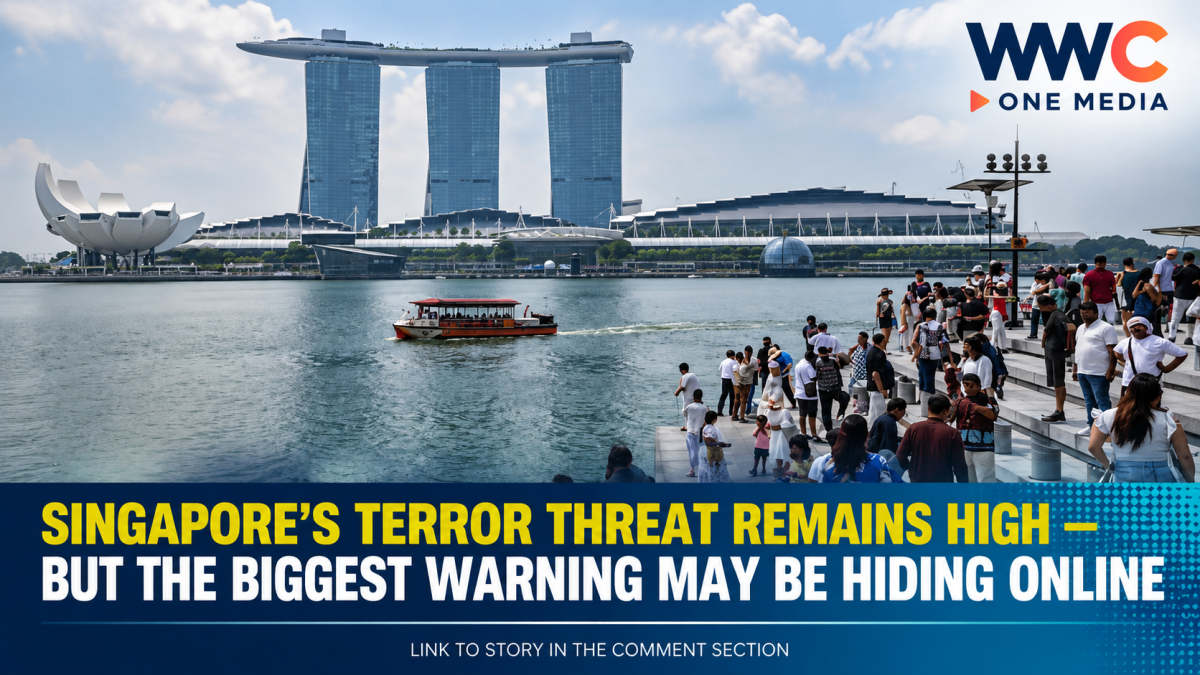
SINGAPORE — Singapore’s terrorism threat remains high, but authorities say there is currently no specific or credible intelligence of an imminent terrorist attack in the country.
The warning comes as the Internal Security Department (ISD) says the nature of terrorism and violent extremism is changing rapidly — with self-radicalisation online, increasingly young individuals and emerging forms of composite extremism becoming major concerns.
The latest assessment, released on Sept. 10, says Singapore remains an attractive potential target because of its perceived ties with Western countries, iconic locations and position as a secular, multicultural society.
But authorities are emphasizing something beyond police work and security measures:
The fight against radicalisation increasingly begins inside homes, schools, online communities and ordinary conversations.
No imminent attack — but the threat is still serious
ISD’s 2026 Singapore Terrorism Threat Assessment Report makes an important distinction.
There is no specific or credible intelligence indicating an imminent terrorist attack against Singapore.
That does not mean the threat has disappeared.
ISD says Singapore and its interests remain attractive targets for terrorist elements, while ongoing conflicts in the Middle East can act as triggers for radicalisation and increase the risk of attacks beyond conflict zones.
Islamist terrorism remains the primary concern, but authorities are also increasingly watching far-right extremism, nihilistic violent extremism and other online subcultures.
Self-radicalisation is now a central concern
The latest assessment identifies self-radicalisation as the key driver of Singapore’s domestic terrorism threat.
Of eight Singaporeans dealt with under the Internal Security Act since July 2025, seven were self-radicalised, according to ISD’s assessment as reported by CNA.
Five of the eight were supporters of Islamic State, and all five had initially encountered pro-Islamic State material through social media.
The significance is that radicalisation no longer necessarily requires a person to physically meet a terrorist organisation or be recruited through a traditional network.
A person can encounter extremist material online, repeatedly consume it, become increasingly isolated inside an ideological echo chamber and eventually develop increasingly extreme beliefs.
The youth warning is becoming harder to ignore
Perhaps the most alarming development is the age of some people being radicalised.
Six of the eight Singaporeans dealt with under the ISA over the past year were under 21.
ISD said the number of youth ISA cases has nearly quadrupled — from four cases between 2017 and 2021 to 15 cases from 2022 onward.
Even more concerning, four 14-year-olds have been issued with ISA orders since June 2024, making them the youngest individuals dealt with under the law for such cases.
Three of the Islamic State supporters dealt with over the past year were youths who had planned Singapore attacks inspired by the group’s ideology.
Why online spaces matter so much
Authorities say social media, online communities and gaming platforms have increasingly featured in youth radicalisation cases.
Extremist material can be encountered through social-media feeds, online communities or algorithmic recommendations.
Repeated exposure can reinforce extremist beliefs and create ideological echo chambers, ISD said.
The concern extends beyond simply watching extremist propaganda.
ISD has warned that some youths have used online games to simulate terrorist attacks or mass shootings. Repeated exposure to graphic violence in such environments can potentially normalize violence and lower psychological barriers to harming others.
This is why Singapore’s response is increasingly focused not only on removing dangerous content but also on digital literacy, critical thinking, family intervention and early reporting.
A new form of extremism is emerging
Another major concern is what authorities call Composite Violent Extremism, or CoVE.
Previously described by authorities as “salad bar” extremism, CoVE involves individuals assembling elements from multiple extremist ideologies into a highly personalized worldview.
Those beliefs can include seemingly contradictory strands of Islamist extremism, far-right ideology, misogynistic “incel” narratives and grievance-driven content.
MHA says two youths were issued Restriction Orders in the past year after becoming radicalised through CoVE.
The authorities have consequently been adapting rehabilitation programmes to address not only ideological misconceptions but also personal vulnerabilities, grievances and psychological factors contributing to radicalisation.
Why psychology matters in Singapore’s counter-terrorism strategy
This is an important shift.
Counter-terrorism is not simply about identifying someone who already intends to commit violence.
Authorities also need to understand why a person becomes vulnerable to extremist ideas in the first place.
ISD’s rehabilitation approach can include psychological assessments and interventions alongside religious counselling and mentoring.
In an earlier explanation of its investigative process, ISD said psychological assessments may be used where relevant to evaluate a person’s vulnerability to radical influences and propensity for violence.
In one more recent case, a Singaporean youth released after detention underwent an intensive rehabilitation programme involving religious counsellors, mentors, family support and ISD psychologists. The psychological work addressed factors including permissive attitudes toward violence and weak critical-thinking skills.
That approach reflects a broader understanding:
Extremist ideology may be the visible problem, but personal grievances, vulnerabilities, social isolation and psychological factors can also influence how someone responds to that ideology.
Singapore’s latest SGSecure campaign puts the public at the center
The government’s response is not limited to intelligence agencies.
In March, the Ministry of Home Affairs launched the 2026 SGSecure campaign, “Play Your Role,” urging members of the public to prevent, detect and respond to terrorism.
The campaign emphasizes that people should recognize warning signs, remain prepared and report suspected radicalisation rather than assuming someone else will intervene.
SGSecure’s broader framework is built around three principles:
Stay Alert. Stay United. Stay Strong.
The government says the campaign is designed to turn public awareness into practical action.
What are the warning signs?
SGSecure says possible indicators can include:
- Expressing support or admiration for terrorists or terrorist groups
- Promoting violence or extremist views online
- Sharing extremist views with family or friends
- Expressing hatred toward people of other races or religions
- Expressing an intention to participate in violence
- Inciting others to engage in violence
- Displaying symbols associated with extremist or terrorist groups
Authorities stress that no single behavior automatically means someone is radicalised.
The purpose of early reporting is to allow authorities to assess the situation and intervene where necessary.
Why reporting early can make a difference
One of Singapore’s central messages is that intervention does not necessarily begin with detention.
ISD says that if someone is identified at an early stage of radicalisation, the person may be referred for counselling or other interventions without necessarily being dealt with under the Internal Security Act.
The department also says reports are confidential and that no action will be taken simply because someone has been reported if the person is found not to be radicalised or does not pose a security threat.
That distinction is important because the objective is not simply punishment.
It is also prevention and rehabilitation.
Singapore is trying to prevent fear from becoming another problem
There is another dimension to SGSecure’s strategy.
Singapore is a highly diverse society, and authorities have repeatedly stressed that the aftermath of a terrorist attack could create tensions between communities even beyond the immediate violence.
That is why the government’s strategy also emphasizes social cohesion, community resilience and avoiding misinformation.
SGSecure advises people to stay calm, verify information and avoid spreading rumors following security incidents.
The underlying logic is straightforward:
Terrorism seeks to create fear and division. Community resilience can reduce both.
The threat has changed — and so has the response
Singapore’s latest terrorism assessment paints a picture that is more complicated than the traditional image of a terrorist organization recruiting members through physical networks.
Today’s threat can involve a teenager alone in a bedroom, a smartphone, an algorithm and an increasingly personalized collection of extremist ideas.
That does not mean every person who encounters disturbing material will become radicalised.
But authorities say the speed, accessibility and diversity of extremist content make early intervention increasingly important.
And that is why Singapore’s latest message is not directed only at security agencies.
It is directed at parents, teachers, friends, classmates, religious leaders and the wider community.
The biggest warning may not arrive as an obvious threat. It may appear first as a change in behavior, beliefs or online activity — and someone has to notice.



Leave a Reply