
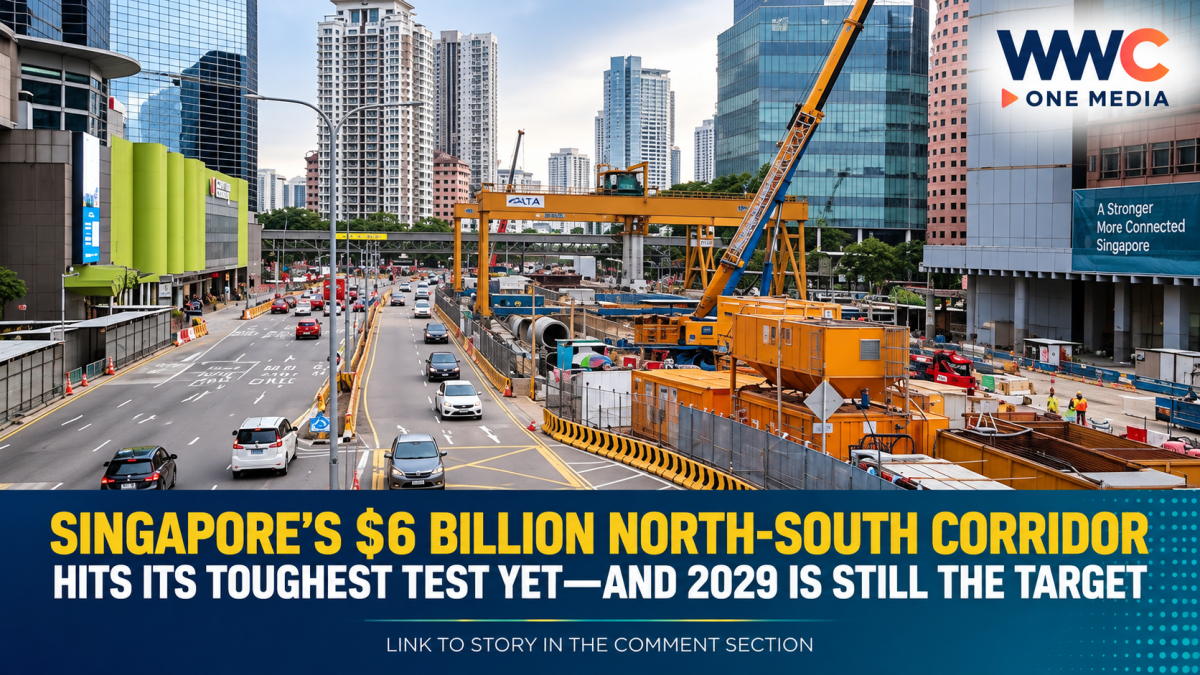
SINGAPORE — Singapore’s massive North-South Corridor (NSC) has entered what the Land Transport Authority (LTA) describes as its most technically demanding phase, with engineers battling hard rock, groundwater and extremely tight working spaces while building tunnels and viaducts around operating MRT lines and major roads.
The 21.5km transport project has been under construction since 2018 and is being built in phases. Its northern viaduct section is targeted to open from 2027, while the remaining underground road tunnel is scheduled for 2029.
But the latest engineering challenges show why one of Singapore’s biggest infrastructure projects has taken years to complete.
Building a road just metres from an operating MRT line
One of the most difficult sections is in Novena, where the NSC tunnel has to pass both above and below the existing North-South MRT Line.
In one section, the clearance between the new tunnel and the operating MRT infrastructure is as little as 1 metre.
During excavation for the northbound tunnel beneath the MRT line, workers encountered fractured rock and groundwater that could not be fully identified before excavation began.
LTA subsequently switched to a slower, more controlled excavation technique, digging the tunnel in smaller sections and stabilising each section before moving forward.
The approach takes more time, but it is designed to protect the existing MRT infrastructure and allow train services to continue operating safely.
It’s not just Novena
The engineering difficulties extend across several parts of the corridor.
At Nicoll Highway, the new tunnel passes above existing Circle Line tunnels, with clearances of only about 1.5m to 2.5m in some areas.
Because the area also has soft reclaimed ground, engineers are using specialised ground-support and improvement measures to reduce the risk of ground movement.
At Kampong Java, stacked tunnels are being constructed beneath the Kampong Java Flyover along the Central Expressway. The flyover itself needs to be supported while construction takes place underneath it.
And in Thomson, workers encountered hard rock formations and large boulders that were closer to the surface than expected, forcing additional rock removal and ground-stabilisation work.
Singapore’s longest viaduct is also taking shape
The NSC isn’t just an underground project.
Its planned 8.8km viaduct will be Singapore’s longest, measuring approximately 40 metres wide and about 19 metres high at some sections.
More than 6,000 precast elements have to be manufactured, transported and installed.
Much of the major segment installation has to happen during short overnight windows of roughly four to five hours, allowing construction to take place while minimising disruption to motorists and bus services.
The challenge becomes even greater when the viaduct has to cross existing roads, major junctions and operating transport infrastructure.
More than 90 per cent of the viaduct foundation works have now been completed, LTA said.
The project is consequently moving into another highly complex stage involving columns, crossheads and the launching of massive viaduct sections over live roads and MRT infrastructure.
Why the project has taken so long
The NSC was originally expected to be completed around 2026, but that timeline changed.
The project was affected by the COVID-19 pandemic and manpower disruptions, pushing completion into later phases.
The current plan is for the corridor to open progressively, rather than all at once.
The northern viaduct from Admiralty Road West to Lentor Avenue is targeted for 2027, while the underground section from Lentor Avenue to East Coast Parkway is scheduled for completion in 2029.
LTA has said it will provide further updates on the completion timeline as construction progresses.
What will Singapore get when it’s finished?
The NSC is designed to do more than provide another road into the city.
The corridor will connect northern areas including Sembawang, Yishun, Ang Mo Kio, Toa Payoh, Novena and Rochor with the central and southern parts of Singapore.
The project consists of an 8.8km elevated viaduct, about 400m of ground-level roads and a 12.3km underground road tunnel.
It is also Singapore’s first integrated transport corridor designed with dedicated bus lanes and cycling infrastructure, alongside more pedestrian-friendly surface streets.
The Ministry of Transport says the 21.5km corridor will help ease congestion along the Central Expressway (CTE) and other major arterial roads.
Once traffic is shifted onto the NSC, surface space currently dominated by major roads can be repurposed for walking, cycling, public transport and community spaces.
Residents and businesses have paid the price
For people living and working along the route, however, the benefits remain years away.
Residents and businesses have endured years of construction noise, dust, barriers, road diversions and constantly changing traffic arrangements.
A CNA TODAY report in June found that residents and businesses along the corridor described the disruption as a “decade of inconveniences”, with some businesses reporting reduced visibility and footfall because of construction barriers.
LTA said it recognises the impact on businesses and has worked with affected stakeholders on measures such as directional signage and advertising banners on hoardings.
The authority also expects construction noise to decline as heavy foundation works are completed and more of the remaining work moves underground.
The latest challenge could determine how fast the project moves
The latest revelations underline the difficult reality of building major infrastructure in an already-developed city.
Engineers aren’t working on an empty construction site. They are excavating around operating MRT lines, existing roads, utility networks, residential areas and major junctions—often with only metres of separation.
Unexpected geological conditions can therefore force construction teams to change methods rather than simply accelerate the work.
For the NSC, safety takes precedence over speed.
And that may be the most important reason the corridor’s opening is being staged rather than rushed.
The bigger payoff
When completed, the North-South Corridor is expected to provide a new north-to-city connection while giving Singapore an opportunity to redesign portions of the existing surface-road network.
But before commuters enjoy those benefits, engineers still have some of the project’s most difficult work ahead of them.
The question is no longer simply when Singapore’s North-South Corridor will open. It’s whether engineers can complete one of the country’s most complicated transport projects without compromising the MRT lines, roads and communities surrounding it.
For now, 2027 marks the start of phased openings, with the full corridor’s remaining underground section targeted for 2029.




Leave a Reply