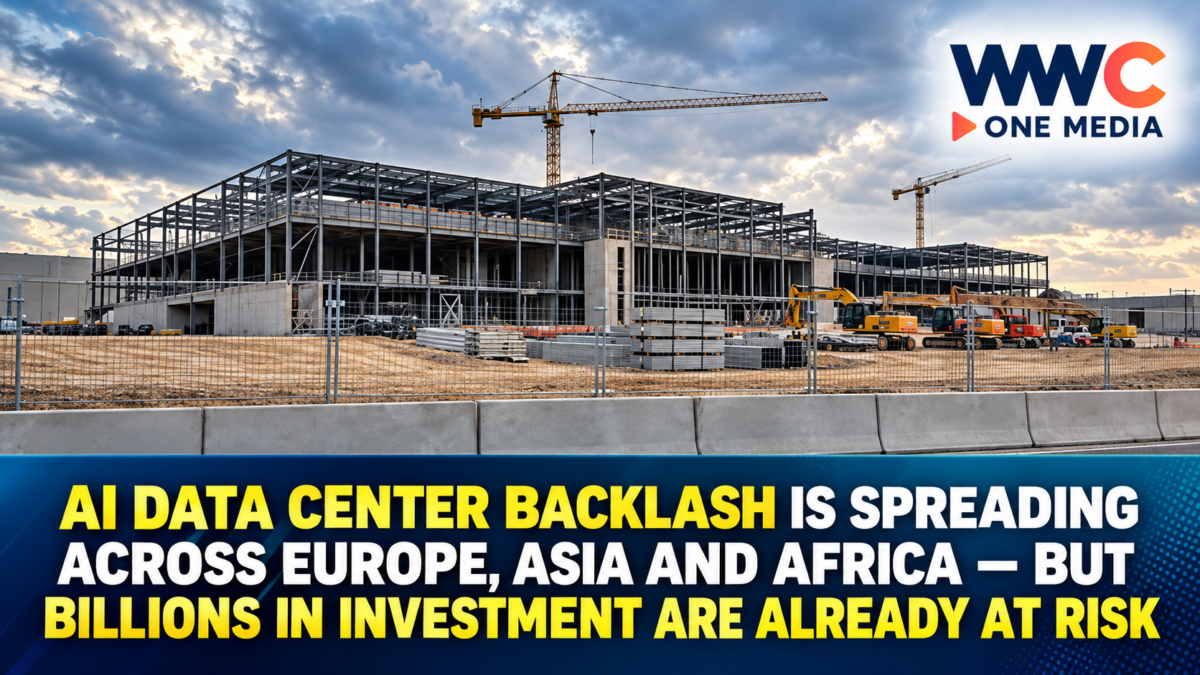
LONDON/SINGAPORE — The artificial intelligence boom is colliding with an increasingly powerful obstacle: the communities expected to host the massive data centers required to keep it running.
What began as a wave of opposition in parts of the United States is now appearing across Europe, Asia and Africa, as residents, regulators and politicians question how much electricity, water and land should be devoted to AI infrastructure — and who should pay for the enormous upgrades needed to support it.
Research cited by CNBC estimates that community resistance, permitting disputes and regulatory restrictions have already affected roughly $42 billion worth of proposed European data-center investment, compared with about $77 billion in the United States. The figures refer to projects affected through delays and cancellations rather than money that has necessarily been lost outright.
The backlash is accelerating quickly.
The European Data Centre Monitor says more than 70 projects were rejected or restricted across Europe between January and April 2026 alone, already exceeding the total recorded throughout 2025.
The message to technology companies is becoming increasingly clear:
Communities may want the economic benefits of artificial intelligence.
But they are becoming far less willing to accept its infrastructure at any cost.
Why Data Centers Are Suddenly Becoming Political
AI systems do not operate in the abstract.
Chatbots, generative video, autonomous agents and enterprise AI applications require enormous quantities of computing power.
That computing happens inside massive data centers packed with advanced processors, networking hardware and cooling systems.
And the facilities can consume extraordinary amounts of electricity.
The International Energy Agency has warned that global data-center electricity consumption is rising rapidly as AI workloads expand. Financial Times reporting citing IEA figures said data-center power use increased about 17% in 2025 and could roughly double by 2030.
That means AI growth increasingly competes with homes, factories and other industries for power-grid capacity.
It also forces governments to confront a difficult question:
Should ordinary consumers help pay for the new electricity infrastructure required by some of the world’s richest technology companies?
That debate has already become politically explosive in the United States.
Reuters reported that more than 100 data-center moratorium proposals were being considered around the country amid concerns about electricity and water use. Amazon responded this week by announcing a $1 billion, five-year investment program for communities hosting its data centers.
Amazon said the funds would support education, job training, energy affordability and resource conservation.
The announcement itself shows how seriously technology companies now view the political risk.
Europe May Face an Even Bigger Problem
Europe could be particularly vulnerable to the backlash.
Many European countries have higher electricity prices, denser populations and less available land than the United States.
That makes conflicts over energy and space more difficult to avoid.
Olivier Darmouni, an associate professor at HEC Paris specializing in the energy transition, told CNBC that public opposition could become the “straw that breaks the camel’s back” for some projects as already difficult economics collide with permitting resistance.
The fundamental problem is geographic.
The economic benefits of AI can spread across entire countries or even around the world.
But the physical costs of hosting its infrastructure are concentrated in one town or neighborhood.
A data center may power AI services used by millions of people.
But local residents experience the transmission lines, construction traffic, water consumption, generators and industrial buildings.
That imbalance is increasingly driving resistance.
Scotland Puts the Brakes on Hyperscale Projects
Scotland has become one of Europe’s clearest examples.
Political pressure grew during 2026 for a pause on hyperscale AI data centers while the government develops national planning rules.
The Scottish Parliament stopped short of an outright moratorium but backed a 12-month pause on certain planning and consent decisions while new guidance is prepared, according to the European Data Centre Monitor.
Some proposed projects have drawn thousands of objections.
A planned 300-megawatt development in Larbert generated more than 7,000 objections, while another proposed 600-megawatt facility in Fife attracted more than 1,200 formal objections and thousands of petition signatures.
Those numbers illustrate how data centers are transforming from obscure infrastructure projects into major political controversies.
One UK Project Would Consume 1.5 Gigawatts
The scale of proposed projects is another reason opposition is growing.
In North Devon, residents are campaigning against a proposed AI data center from Xlinks with a planned capacity of around 1.5 gigawatts.
The proposal would also include a 1.8-gigawatt battery storage system across hundreds of hectares near a UNESCO biosphere reserve.
The Guardian reported that opponents have raised concerns about farmland loss, water use, noise, pollution and insufficient public consultation. A petition opposing large projects outside designated AI development zones has attracted around 30,000 signatures.
To put 1.5 gigawatts in perspective, that is comparable to the output of a major conventional power station.
A single computing facility demanding electricity on that scale changes the discussion from technology infrastructure to national energy policy.
Denmark Is Prioritizing the Grid
Denmark is also tightening its approach.
After rapid growth in electricity connection requests from data-center developers, the country passed measures that could effectively move some large data centers behind other users in the queue for access to grid capacity.
That represents a significant policy shift.
Historically, governments competed to attract hyperscale facilities with tax incentives and streamlined approvals.
Increasingly, regulators are instead asking whether data centers should receive priority access to limited electricity infrastructure.
That reversal could fundamentally change where companies such as Microsoft, Google, Amazon and Meta decide to build their next facilities.
Spain Wants More Renewable Power
Spain has taken another approach.
Proposals introduced there would require large data centers to secure a substantial portion of their electricity from renewable sources, with reports citing an 80% renewable-power requirement among the contemplated rules.
Spain has become attractive to developers because of its renewable-energy potential and relatively large land availability.
But rapid growth in data-center demand has increased political pressure over whether those renewable resources should serve digital infrastructure or broader industrial and residential needs.
France faces similar debates.
Le Monde reported growing opposition to projects over land consumption, electricity demand and cooling-water use, especially as climate pressures intensify competition for natural resources.
Ireland Has Already Shown What Can Happen
Europe already has a warning case.
Ireland became one of the world’s most concentrated data-center markets because of its attractive corporate environment and status as a European base for major U.S. technology companies.
But the boom created enormous pressure on the electricity grid.
Data centers now consume roughly one-fifth of Ireland’s electricity, according to European data-center monitoring data.
That led regulators to impose restrictions on new connections around Dublin.
The lesson is increasingly being cited by policymakers elsewhere:
Once hyperscale facilities arrive, their electricity demand can grow faster than the grid serving them.
South Korea Is Facing Its Own Backlash
The problem is not confined to Europe.
South Korea sits at the heart of the AI supply chain because of companies such as Samsung Electronics and SK Hynix, two of the world’s most important semiconductor manufacturers.
Yet local governments are increasingly resisting data centers close to residential communities.
Seoul Economic Daily reported that some municipalities are introducing rules that could require majority resident consent, while others are proposing minimum distances between new facilities and residential areas.
A proposed data center in Gwacheon’s Juam district has faced efforts by local authorities to remove data centers from the list of permitted uses for the site following resident opposition.
Municipalities argue they need stronger tools to address local concerns.
Developers counter that a patchwork of different regulations makes investment unpredictable.
That creates a dilemma for Seoul.
South Korea wants to remain one of the world’s leading AI and semiconductor economies.
But the physical infrastructure supporting that ambition has to be built somewhere.
Even Africa Is Entering the Debate
The backlash is also beginning to reach Africa.
South Africa has emerged as the continent’s most important data-center hub and reportedly accounts for roughly 70% of African data-center capacity.
But a proposed Equinix hyperscale facility near Cape Town International Airport is facing a legal challenge from campaign groups concerned about water consumption and electricity demand.
The proposed complex covers about 122,500 square meters, according to Financial Times reporting.
Opponents argue that existing planning rules were designed for ordinary warehouse-style development and do not properly evaluate infrastructure with the resource demands of a hyperscale data center.
The dispute is especially sensitive because South Africa has experienced both severe drought conditions and recurring electricity shortages.
Campaigners have called for broader national rules — and in some cases even a moratorium — until the environmental and infrastructure impacts can be more clearly assessed.
Water May Become Just as Controversial as Electricity
Power consumption receives most of the attention.
But water is becoming another major flashpoint.
Many large data centers use substantial volumes of water for cooling.
That can become politically difficult in regions already struggling with drought, agricultural demand or rapidly growing populations.
Some newer facilities use closed-loop systems, air cooling or recycled water to reduce consumption, but design varies considerably.
And campaigners increasingly complain that operators do not provide enough public information about how much water they expect to consume.
This transparency issue is becoming part of the backlash itself.
European reporting has found that many operators disclose limited environmental data despite regulatory requirements intended to improve reporting.
Residents increasingly want answers before projects are approved — not after construction begins.
The Jobs Question Is Becoming Harder to Ignore
Developers usually emphasize economic benefits.
Construction creates thousands of temporary jobs.
Data centers can generate tax revenue.
And their presence can attract additional technology investment.
But critics question how many permanent jobs remain once construction finishes.
A hyperscale facility may occupy enormous amounts of land, consume power equivalent to a large industrial operation and represent billions of dollars in investment — yet employ relatively few people compared with a factory of similar physical size.
That makes the political tradeoff complicated.
Local governments must weigh:
large tax revenues and strategic investment
against
high electricity consumption, land use and potentially limited permanent employment.
There is still no widely accepted global standard for calculating the economic value created by a data center relative to the electricity it consumes.
That uncertainty helps explain why communities increasingly challenge developers’ economic claims.
AI Companies Cannot Simply Stop Building
Despite the backlash, technology companies have a problem:
They desperately need more computing capacity.
Microsoft, Amazon, Alphabet, Meta and other hyperscalers are investing hundreds of billions of dollars into AI infrastructure.
Financial Times analysis estimates U.S. AI hyperscalers could spend around $800 billion in capital expenditure during 2026 and potentially more than $1 trillion in 2027, much of it tied directly or indirectly to computing infrastructure.
The AI industry therefore faces a physical bottleneck.
Companies can design better models.
Chipmakers can produce faster processors.
But without electricity, substations, transmission lines, land, cooling systems and local permits, those chips cannot operate at scale.
That makes community acceptance an increasingly important part of the global AI race.
Data Centers Are Becoming an Investment Risk
For investors, the consequences extend beyond individual protests.
Projects delayed for years can lose customers, incur financing costs and miss the technology cycle they were designed to serve.
In Ireland, European monitoring reports that Vantage Data Centers faces a €152 million compensation exposure linked to delays involving a Dublin project.
The issue is forcing developers to treat local opposition almost like construction costs or electricity pricing.
Site selection increasingly requires analysis of:
community sentiment,
water availability,
grid connection timelines,
political risk,
planning restrictions,
and whether residents believe the project will benefit them.
That is a major change from only a few years ago, when many governments treated data centers as almost automatically desirable technology investments.
Big Tech Is Starting to Respond
Technology companies appear to recognize the danger.
Amazon’s new $1 billion community investment program is one of the clearest examples.
AWS says it will put money into communities where its data centers operate, including Indiana, Louisiana, North Carolina, Virginia and Mississippi.
The company has also repeated its goal of becoming water positive by 2030, meaning it intends to return more water to communities than it consumes.
Amazon said it was already about 75% of the way toward that target.
Other technology companies are increasingly exploring similar arrangements around renewable energy, community benefits and direct investment in electricity infrastructure.
The industry’s future may depend on whether those promises convince local residents that they are receiving enough in return.
The AI Boom Has Reached Its Physical Limits
The first phase of the generative-AI boom was mostly about software.
Chatbots.
Models.
Chips.
Startups.
The next phase is increasingly about infrastructure.
Power plants.
Electric grids.
Water.
Land.
Transmission lines.
And local politics.
That shift could become one of the most important constraints on global AI growth.
A technology company may have billions of dollars available to build a hyperscale data center.
But money alone cannot guarantee electricity connections, planning permission or community approval.
Across Europe, South Korea, South Africa and other emerging markets, governments are discovering that supporting artificial intelligence in theory is much easier than deciding where its enormous physical infrastructure should actually go.
The AI race therefore may not ultimately be determined only by who develops the smartest model or the fastest chip.
It could also be decided by which countries can build enough power and data-center capacity without triggering a political revolt from the communities expected to host them.