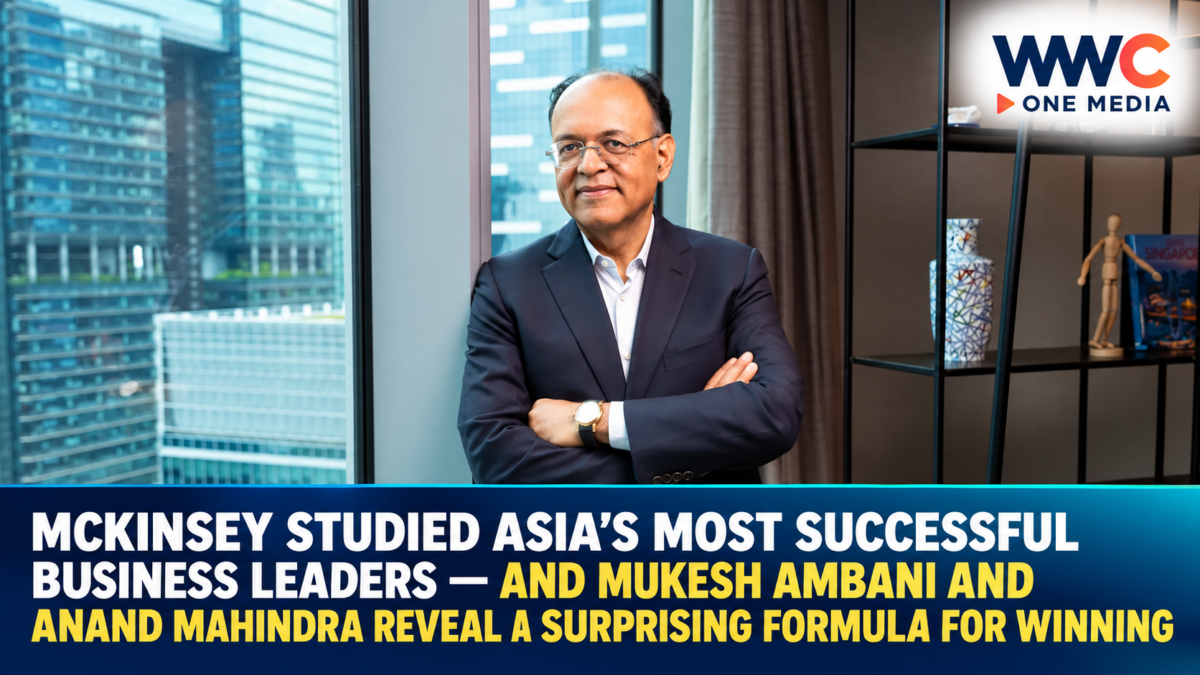
SINGAPORE — What separates the leaders who build billion-dollar companies from those who simply manage them? According to McKinsey, the answer may have less to do with choosing between competing strategies and more to do with mastering both at the same time.
McKinsey Asia Chairman Gautam Kumra says some of Asia’s most successful owner-CEOs share an unusual ability to hold seemingly contradictory ideas in their minds simultaneously — thinking decades ahead while obsessing over today’s execution, making enormous bets while preparing carefully for failure, and professionalizing their companies without destroying the entrepreneurial culture that made them successful in the first place.
That conclusion comes from McKinsey’s new book, “Shapers and Founders: The Untold Stories of Asia’s Extraordinary Owner-CEOs,” written by Kumra, Cheryl Lim and Joydeep Sengupta and published in September 2026.
The research draws on interviews and profiles involving some of Asia’s most influential business builders, including leaders associated with Reliance Industries, Mahindra Group, Infosys, Sun Pharma, Bajaj Finserv and other major Asian companies.
And two Indian corporate giants illustrate the idea especially clearly: Mukesh Ambani and Anand Mahindra.
The Winning CEOs Think With a ‘Telescope’ and a ‘Microscope’
One of McKinsey’s strongest findings is what the authors describe as having a “telescope in one eye and a microscope in the other.”
The telescope represents an extremely long-term perspective — often not five or seven years, but 20 or 30 years into the future.
The microscope represents a leader’s willingness to examine what is happening inside the company right now, including execution, customers, costs, people and operational performance.
Most executives are pressured to choose between the two.
Quarterly earnings, investor expectations and immediate operational problems encourage leaders to focus on the short term.
At the same time, major technological and economic shifts require companies to invest years before a business opportunity becomes fully visible.
McKinsey found that exceptional owner-CEOs often refuse to choose.
They attempt to manage both simultaneously.
That may sound simple, but Kumra and his co-authors argue it is extraordinarily difficult to execute consistently.
Mukesh Ambani’s Jio Bet Shows What That Looks Like
Mukesh Ambani provides one of McKinsey’s clearest examples.
Under Ambani, Reliance Industries made a massive bet on India’s digital future when it built Jio, despite considerable skepticism about whether the investment would generate acceptable returns.
McKinsey says Reliance constructed roughly 90,000 telecom towers and 250,000 kilometers of fiber-optic infrastructure as part of the project.
The underlying question was enormous:
Could Reliance make affordable 4G connectivity available at national scale in India?
Ambani was willing to commit billions of dollars to finding out.
According to McKinsey’s account, Ambani framed the investment partly as a nation-building project — arguing that even if Reliance failed commercially, expanding India’s digital infrastructure would still create value for the country.
The gamble ultimately transformed India’s telecommunications industry.
Today, Jio has more than 500 million subscribers, making it one of the world’s largest telecommunications platforms. Forbes says Reliance itself generates about $125 billion in annual revenue across businesses spanning energy, telecom, retail, media and financial services.
That scale is important because Ambani’s strategy did not stop with telecommunications.
The digital network became a foundation for a much larger ecosystem involving broadband, digital services, retail, financial services, cloud computing and increasingly artificial intelligence.
Reliance Is Now Making Another Huge Bet — This Time on AI
The same long-term pattern is appearing again.
Ambani has announced plans for massive investments in artificial-intelligence infrastructure in India, with Forbes reporting plans involving as much as $110 billion in AI infrastructure investment over seven years.
Jio is also moving toward a landmark public listing.
India’s securities regulator approved plans in August for a Jio Platforms IPO expected to raise around $3.8 billion. Reuters reported that Jio had more than 533 million subscribers and had expanded beyond traditional mobile services into AI, cloud computing and enterprise technology.
If completed on the expected scale, the IPO could become one of the largest public listings in India’s history.
That makes Ambani’s strategy another example of McKinsey’s “telescope and microscope” concept:
Build infrastructure today around a technology trend that may reshape the economy decades into the future.
But McKinsey Says Great Leaders Aren’t Reckless Gamblers
One of the more surprising findings in McKinsey’s research is that leaders who appear from the outside to be aggressive risk-takers often see themselves very differently.
Kumra said many of the CEOs interviewed considered themselves conservative risk managers.
They were comfortable taking extraordinarily large bets, but only after examining what could go wrong and preparing their organizations to survive the downside.
That creates another leadership contradiction:
Think extremely big — but manage the risks extremely carefully.
McKinsey says this ability to simultaneously pursue the best possible outcome while preparing for the worst is one of the defining characteristics of the group it studied.
That distinction matters in today’s business environment.
CEOs are dealing simultaneously with artificial intelligence, geopolitical tensions, volatile currencies, trade restrictions, energy shocks and rapidly changing consumer behavior.
McKinsey argues that the ability to operate comfortably under uncertainty may therefore become even more valuable.
Anand Mahindra Shows Another Side of the Formula
Mahindra Group Chairman Anand Mahindra provides a different example.
Rather than focusing only on capital allocation or giant investment decisions, McKinsey highlights Mahindra’s ability to identify talent that traditional corporate structures might overlook.
One story involves Veejay Ram Nakra, who was once described by Mahindra as essentially the “executive assistant to my executive assistant.”
When Mahindra wanted to grow the company in South Africa, he selected Nakra for the assignment despite questions about whether someone at that organizational level should be entrusted with such a significant responsibility.
Mahindra believed Nakra had entrepreneurial drive, sophistication and values that matched what the company required.
The move worked.
Nakra eventually rose to become president of Mahindra & Mahindra’s automotive division, according to McKinsey.
The lesson goes beyond one executive promotion.
McKinsey found that successful owner-CEOs frequently evaluate people based on potential rather than organizational rank.
Instead of allowing job titles or corporate hierarchies to define employees’ capabilities, these leaders deliberately stretch promising people by giving them responsibilities beyond their existing positions.
Mahindra’s Business Is Facing a Real-World Test Right Now
The leadership philosophy matters because Mahindra operates in one of the world’s most competitive automotive markets.
India is simultaneously experiencing rapid growth in SUVs, electric vehicles and advanced automotive technology while global and domestic manufacturers fight aggressively for market share.
Mahindra & Mahindra remains one of India’s major automakers, but it faces competition from companies including Tata Motors, Maruti Suzuki and international manufacturers.
Reuters reported this week that Mahindra’s tractor business also experienced a 21% decline in September sales amid India’s weakest monsoon in more than a decade, which weakened rural demand.
That is exactly the type of environment where McKinsey’s leadership philosophy becomes relevant.
Long-term strategies still matter.
But leaders must simultaneously respond to immediate economic shocks.
Another Secret: Don’t Let Growth Create Bureaucracy
Successful companies often face a paradox.
The bigger they become, the more systems, managers, controls and processes they need.
But those same structures can slow decision-making.
McKinsey calls this challenge “scaling without losing soul.”
Founder-led companies need professional management to expand, but their leaders often fear that too much structure will produce bureaucracy, complacency and organizational inertia.
One example highlighted by McKinsey is Bajaj Finserv Chairman and Managing Director Sanjiv Bajaj.
Bajaj Finserv uses a model of “accountable empowerment,” with smaller teams and decision-making pushed closer to employees serving customers rather than concentrating every decision at headquarters.
The broader lesson is important for companies everywhere:
Growth should add capability without automatically adding layers of approval.
Big Innovation Isn’t Enough
McKinsey also divides innovation into two categories.
There is “big I” innovation — major disruptive bets such as Reliance building Jio.
Then there is “small i” innovation — making small improvements continuously across the organization.
Infosys founder Narayana Murthy, for example, encouraged employees to constantly ask whether something could be done faster, cheaper or better.
The idea was to make improvement an everyday responsibility rather than waiting for occasional breakthroughs from a dedicated innovation department.
McKinsey’s conclusion is that the best leaders pursue both.
They make transformational bets while simultaneously demanding thousands of smaller improvements.
Relationships Matter More Than Transactions
Another characteristic that repeatedly appeared in McKinsey’s research was unusually strong relationship-building.
The strongest owner-CEOs did not treat networks merely as sources of immediate business deals.
Instead, they built relationships over decades with employees, suppliers, investors, government institutions and business partners.
That long-term mentality is especially relevant in Asia, where many of the region’s largest companies remain influenced by founders or controlling families.
Those leaders frequently think not just about the next quarter or even their own tenure.
They think about whether the institution can survive across generations.
Succession May Be the Hardest Test
That creates another challenge that professional CEOs do not always face to the same degree.
An owner-CEO must eventually answer two questions:
Who will lead the business next?
And:
Can the institution survive without its founder?
McKinsey says successful succession requires more than naming an heir.
Companies need governance systems, leadership pipelines, durable cultures and clear performance expectations that can continue functioning after the founder or dominant leader leaves.
The issue has become increasingly relevant for some of Asia’s biggest family-controlled companies.
At Reliance, Ambani’s three children are already playing significant roles across the conglomerate.
Akash Ambani leads Jio, Isha Ambani is involved in retail and financial services, and Anant Ambani is involved in the energy business.
The long-term challenge is turning leadership succession into institutional continuity rather than simply transferring control.
Asia’s Leadership Model Is Becoming More Important Globally
McKinsey’s interest in these executives reflects a larger shift in the global economy.
The consultancy says Asia could plausibly account for as much as 60% of Fortune 500 companies within the next decade and describes the region as an increasingly important engine of world trade.
Its “Leading Asia” research already includes executives from India, Singapore, Indonesia, Thailand, Taiwan, South Korea and the Philippines, among others.
That list includes Jaime Augusto Zóbel de Ayala, who discussed how Ayala Corporation has remained relevant across seven generations — another example of the same question confronting family-controlled companies throughout Asia: how do you preserve entrepreneurial thinking while creating institutions capable of surviving for decades?
Why This Leadership Formula Matters More in the AI Era
There may be a reason McKinsey is emphasizing these traits now.
Artificial intelligence is compressing the time companies have to respond to technological change.
Businesses may need to make enormous long-term investments in infrastructure, data, talent and software even while the technology itself changes every few months.
That requires exactly the kind of dual thinking McKinsey identified.
Leaders must be willing to place ambitious bets on the future while remaining obsessive about execution today.
They need organizations large enough to deploy billions of dollars but agile enough to change direction quickly.
And they need employees willing to experiment without believing a failed experiment will end their careers.
Kumra argues that Asian owner-CEOs may be unusually well positioned for that environment because many have already spent decades operating through economic crises, geopolitical instability and technological disruption.
The Real Secret May Be Refusing to Choose
Management advice often tells executives to choose.
Growth or profitability.
Innovation or efficiency.
Long-term strategy or short-term execution.
Boldness or caution.
Entrepreneurship or professional management.
McKinsey’s research suggests Asia’s most successful owner-CEOs frequently do something different.
They try to master both sides of the equation.
Mukesh Ambani can commit billions to a telecommunications network built for India’s future while demanding disciplined execution today.
Anand Mahindra can run a sprawling multinational group while betting on an employee whose position on the organizational chart might suggest he was not ready.
Founder-led companies can adopt professional management systems while actively fighting the bureaucracy those systems can create.
That ability to function inside contradiction may increasingly separate companies that merely survive uncertainty from those that use it to grow.
And with AI, geopolitical tension and technological disruption accelerating simultaneously, the leadership advantage McKinsey found in Asia may soon face its biggest test yet.