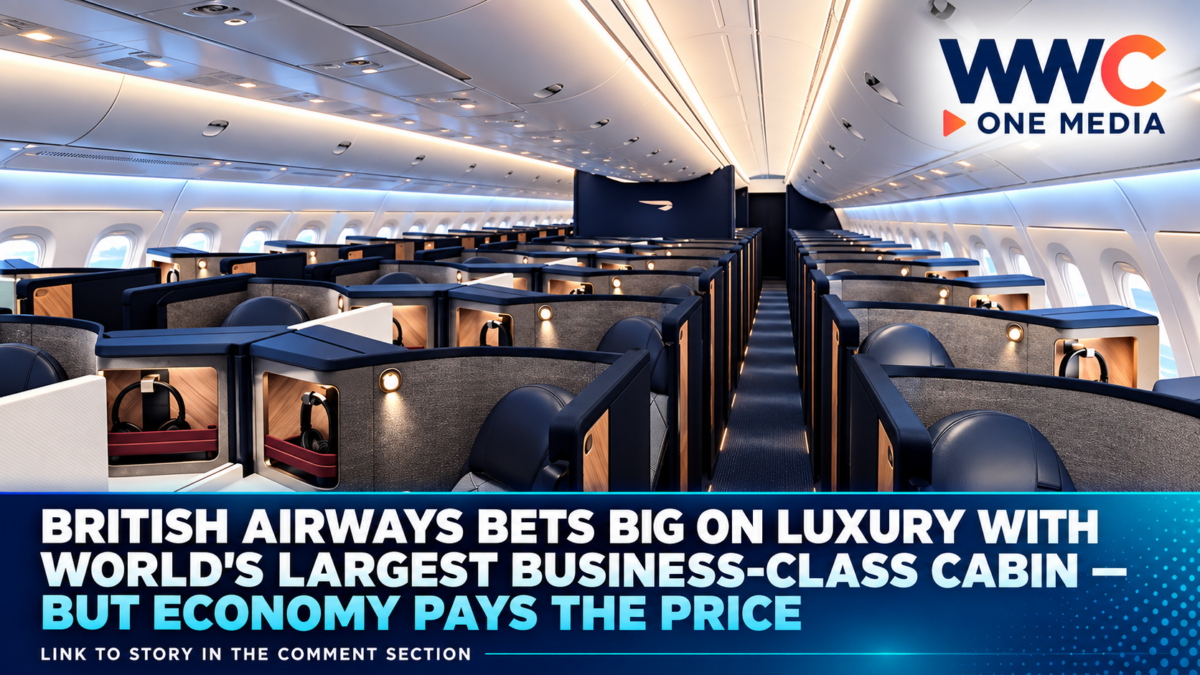
LONDON — British Airways is making one of its boldest bets yet on premium travel, transforming its Airbus A380 superjumbos with what it says will be the world’s largest business-class cabin — 106 Club Suites filling the aircraft’s entire upper deck.
The overhaul is far more than a cosmetic refresh. British Airways is redesigning all four cabins aboard its A380s as part of a wider multibillion-pound effort to restore its premium image, attract high-spending long-haul passengers and keep the giant double-decker aircraft flying for years to come.
Under the new configuration, the refurbished A380 will carry 417 passengers, down from the current 469-seat layout. The aircraft will feature 12 First suites, 106 Club World business-class seats, 84 World Traveller Plus premium-economy seats and 215 World Traveller economy seats.
That means British Airways is sacrificing roughly 11% of the aircraft’s total capacity to create more space for premium passengers — with much of the reduction coming from economy.
British Airways says the redesigned Club World cabin will occupy the entire upper deck, giving every passenger direct aisle access, a fully flat bed and a privacy door. The updated Club Suite will also add storage space, new fabrics and finishes, while the upper deck will be divided into four separate sections to create a more intimate atmosphere despite its unusually large size.
The airline describes the 106-seat cabin as the largest business-class cabin in the world.
A380 Gets a Complete Makeover
The refurbishment goes well beyond business class.
British Airways says each A380 retrofit requires the installation of more than 35,000 individual parts, making it one of the airline’s most extensive aircraft transformation projects.
First class will shrink to just 12 private suites, but passengers will receive substantially more space and privacy. Each suite will feature walls around 60 inches high, a fully flat 6-foot-7-inch bed, a personal wardrobe, dedicated storage and an in-suite minibar.
Passengers travelling together in selected First seats will also be able to lower dividers and dine together.
British Airways says the design takes inspiration from British craftsmanship and elements of Concorde, while First passengers will also receive refreshed dining, bedding and amenity products.
Premium economy is getting a major boost as well.
The refurbished aircraft will have 84 World Traveller Plus seats, which British Airways says will make it the largest premium-economy cabin in its fleet. Seats will include privacy wings, larger entertainment screens and redesigned upholstery.
Economy passengers are also getting new wider seats, upgraded bedding, larger entertainment screens and Bluetooth connectivity — although there will be considerably fewer economy seats than before.
The Bigger Story: Airlines Want Premium Passengers
British Airways’ decision highlights a major shift across long-haul aviation.
Rather than squeezing the maximum possible number of passengers aboard large aircraft, major international carriers are increasingly using valuable cabin space for business class, premium economy and high-end suites, where fares — and potential margins — can be far higher.
On BA’s refurbished A380, premium cabins will account for 202 of the aircraft’s 417 seats when First, Club World and World Traveller Plus are combined.
That means nearly half of all seats will sit above standard economy.
The strategy is particularly striking on the A380. The world’s largest passenger aircraft was once prized primarily for the enormous number of travellers it could carry. But newer twin-engine jets are generally more fuel-efficient, forcing airlines that still operate A380s to find ways to make the superjumbo financially attractive.
For British Airways, the answer increasingly appears to be premiumization.
The carrier operates 12 A380s, and each aircraft reportedly requires roughly 100 days to complete the retrofit. The first refurbished jet is expected to enter passenger service on selected routes in the coming months.
BA Is Trying to Rebuild Its Premium Reputation
The A380 project forms part of a wider British Airways investment programme aimed at upgrading aircraft, lounges, onboard service and the overall passenger experience.
Chief Executive Sean Doyle described the A380 project as one of the most significant aircraft transformations British Airways has undertaken.
The airline is also investing in its Heathrow facilities, including planned lounge improvements, as it competes with premium-heavy rivals such as Emirates, Qatar Airways, Singapore Airlines and other major international carriers for lucrative corporate and affluent leisure travellers.
The challenge is that expensive seats alone will not determine whether British Airways succeeds.
Premium travellers increasingly judge airlines on the entire journey — from airport lounges and punctuality to catering, cabin-crew service, technology and baggage handling.
And competitors have continued raising the luxury bar.
Emirates, for example, has made its A380 synonymous with extravagant features including onboard showers for First passengers and a bar for premium customers. British Airways’ redesigned aircraft will remain more restrained, focusing instead on private suites, improved seating and greater premium capacity.
Why the 106 Business-Class Seats Matter
The most important number in British Airways’ announcement may therefore not be the cost of the refurbishment.
It is 106.
Turning an entire A380 upper deck into business class shows just how much airlines believe wealthy leisure travellers, corporate customers and premium flyers will shape the economics of long-haul aviation.
British Airways is effectively accepting fewer passengers overall in exchange for dramatically more premium seating.
If demand remains strong, the strategy could turn an aircraft once criticized for being too large and expensive into a highly profitable premium flagship.
But it also creates a major test.
With more than 100 business-class passengers aboard a single aircraft, British Airways will need to deliver consistently high-end catering, lounge access, ground handling and personalized service at an unusually large scale.
The airline may soon have the world’s biggest business-class cabin.
The harder challenge will be making every one of those 106 passengers feel as though they are not sitting in it.