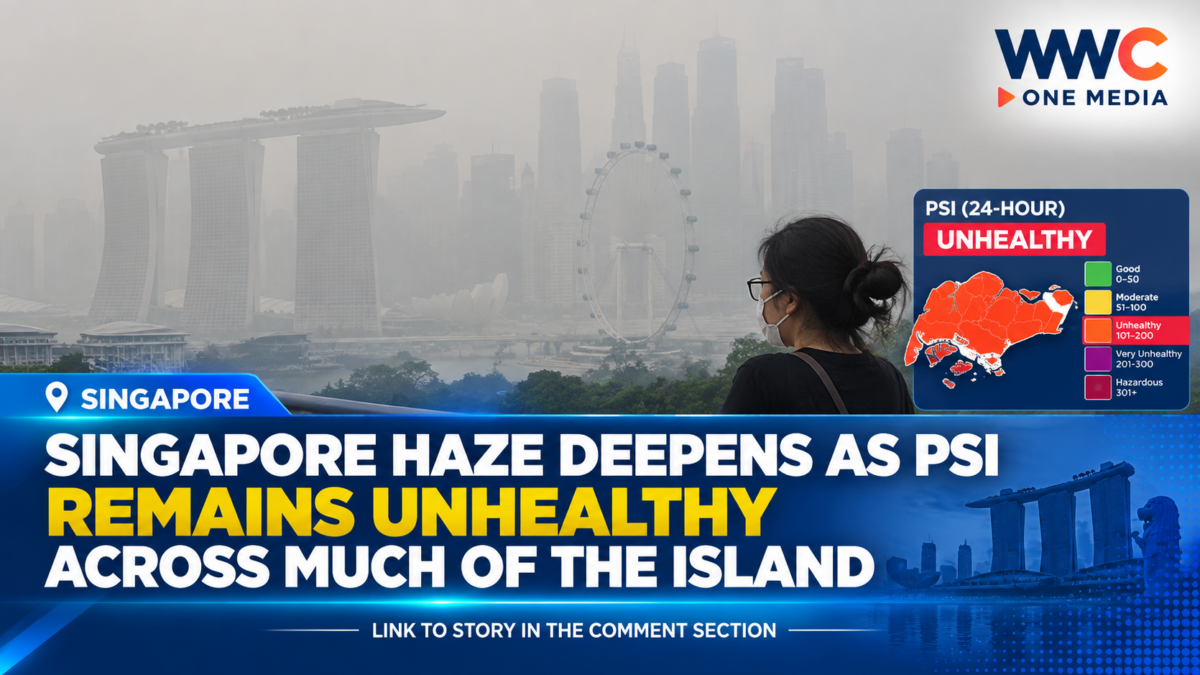
SINGAPORE — Singapore’s haze situation is showing few signs of easing, with air quality remaining in the unhealthy range across most of the island as smoke from neighbouring Indonesia continues to drift into the city-state.
As of Oct. 6, the 24-hour Pollutant Standards Index (PSI) ranged from 102 to 135, with readings in the unhealthy band across Singapore’s regions. The southern region briefly improved to moderate levels, but other areas remained affected by elevated pollution.
The National Environment Agency (NEA) said moderate to dense smoke plumes from southern Sumatra and West Kalimantan were observed moving towards Singapore. Dry weather in parts of Kalimantan and southern and central Sumatra is expected to persist, keeping the risk of transboundary haze elevated.
The situation had already worsened earlier in the week. On Oct. 5, the PSI climbed into the unhealthy range in all five regions, with the central area reaching 134 late that night. PM2.5 concentrations were also elevated islandwide, indicating increased levels of fine particles in the air.
The unhealthy readings come after Singapore experienced a prolonged spell of haze in September. The PSI first crossed into the unhealthy range on Sept. 4, while the year’s highest reading — 167 in central Singapore — was recorded on Sept. 29. The episode marked Singapore’s first haze-related unhealthy PSI readings since October 2023.
Why the haze is persisting
Weather conditions are playing a major role. Authorities say prevailing winds from the southeast and east-southeast are helping carry smoke towards Singapore, while persistent dryness over parts of Indonesia is supporting the continued development and movement of smoke plumes.
Singapore’s authorities are also warning that the haze could remain a concern as the region waits for wetter conditions to return. Meteorological Service Singapore has said the transition away from the dry season may occur only in late October or early November this year.
What residents should know
NEA advises residents to use the 1-hour PM2.5 reading when deciding whether outdoor activity is appropriate in the immediate term, while the 24-hour PSI forecast is intended to help with planning activities for the following day.
When the PSI is unhealthy, healthy people are advised to reduce prolonged or strenuous outdoor physical activity. Children, older people and other vulnerable groups should take greater precautions, while people with chronic heart or lung conditions are advised to avoid prolonged or strenuous outdoor exertion.
For now, the combination of dry weather, Indonesian smoke plumes and shifting winds means Singapore’s haze problem is far from over — and the next change in weather could determine whether the air finally clears or another spike in pollution follows.
WWC ONE MEDIA G,A