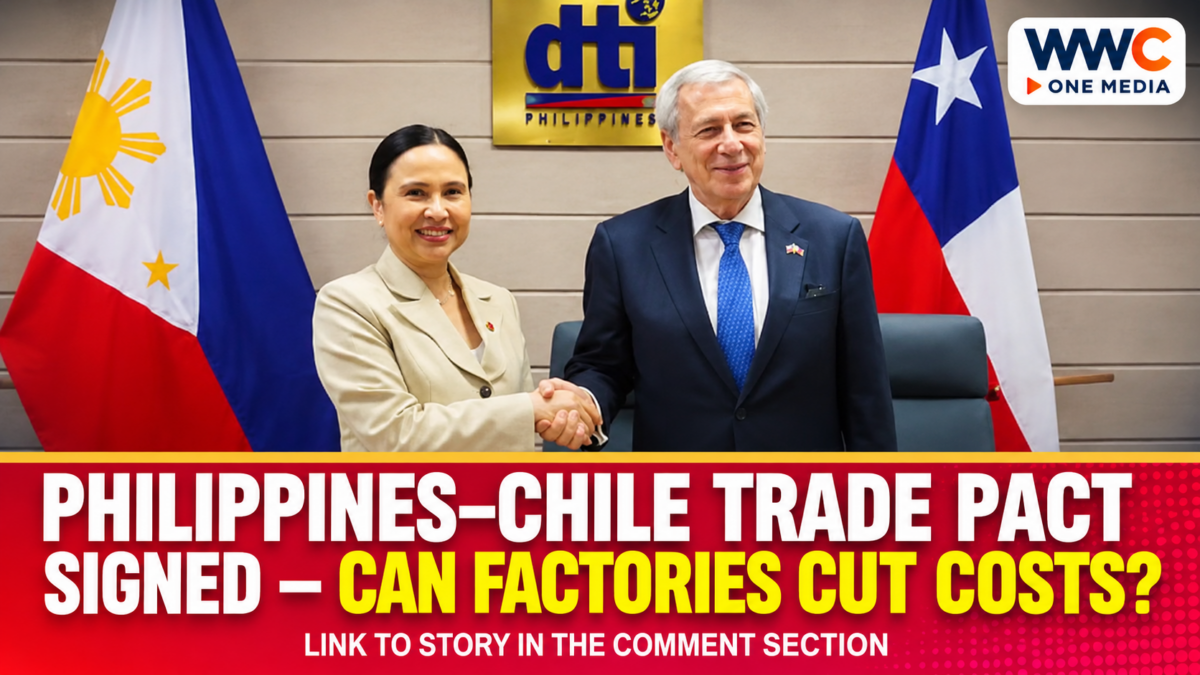
The Philippines and Chile signed their Comprehensive Economic Partnership Agreement (CEPA) on Nov. 19, 2026, during the Asia-Pacific Economic Cooperation meetings in Shenzhen, China. The agreement establishes a new framework for trade between the two countries, with industrial supplies, manufacturing and export access among its major commercial priorities.
For Philippine factories, the crucial question is whether the Philippines Chile trade pact will translate into more affordable production materials and stronger overseas sales.
The agreement creates potential benefits, but signing alone does not establish that lower tariffs are already available to individual importers and exporters. Businesses still need the applicable implementation dates, product schedules and customs requirements before calculating savings.
What the Philippines Chile trade pact actually covers
The agreement is the Philippines’ first bilateral free trade agreement with a Latin American country. Trade Secretary Ma. Cristina Roque and Chilean Foreign Minister Francisco Pérez Mackenna signed it following a bilateral meeting between President Ferdinand R. Marcos Jr. and Chilean President José Antonio Kast.
The negotiations concluded in July 2026 after discussions covering goods, services, investment and other areas of economic cooperation.
Chile’s official negotiating record identifies approximately 8,632 product categories receiving preferential access to its market. These represent about 99% of the value of Chile’s imports from the Philippines.
On the other side, more than 10,467 product categories are covered by preferential treatment for Chilean exports to the Philippines, representing approximately 90% of the value of existing Chilean shipments.
These figures describe the agreement’s negotiated market-access coverage. They do not mean every shipment immediately qualifies for duty-free entry.
The distinction is important for companies planning purchases, sales contracts and future production capacity.
Why cheaper industrial inputs could matter
One significant feature of the agreement is the opportunity to improve access to industrial materials.
The Philippine government’s announcement highlights copper as an important input for semiconductors, electronics, renewable energy and advanced manufacturing.
Chile’s published negotiating materials also identify industrial products such as copper cathodes, copper wire, minerals and other inputs among the goods potentially benefiting from preferential access.
For Philippine manufacturers, lower import duties could improve the economics of sourcing eligible materials from Chile.
However, an importer’s final expense includes more than customs duties. Shipping, insurance, exchange rates, handling charges and local distribution all affect the delivered cost.
A lower tariff would therefore not automatically guarantee cheaper finished products or higher company profits.
What this could mean: Manufacturers that regularly purchase eligible Chilean materials may have an opportunity to revisit sourcing arrangements once the agreement becomes operational.
Companies would still need to compare the total delivered price with offers from existing suppliers.
This practical distinction resembles the challenge examined in WWC ONE MEDIA’s review of US–Philippines trade rules and tariff uncertainty.
Philippine exporters could gain another market
The agreement also offers potential benefits to Philippine exporters seeking customers beyond their existing markets.
Chile’s negotiating announcement identifies Philippine products including printing machinery, projectors, textiles, inks, electrical transformers, coconut products, computers and sulphuric acid within the broader trading relationship.
Preferential market access may help eligible businesses compete on price, particularly where existing import duties affect purchasing decisions.
Yet access to a market is not the same as obtaining confirmed sales.
Exporters must still find buyers, comply with product standards, prepare customs documents and deliver goods at commercially competitive prices.
For smaller manufacturers, these requirements can influence whether the agreement becomes a genuine expansion opportunity or remains an unused option.
The Philippines is pursuing other trade arrangements alongside the Chile agreement. WWC has also examined what Filipino exporters could gain from the proposed Philippines–Canada free trade agreement.
The two developments represent different stages of trade negotiations: the Chile agreement has been signed, while the Canada negotiations concluded with a separate signing process still ahead.
Trade figures show the relationship’s potential
The Philippines and Chile already exchange goods, although their bilateral market remains relatively modest.
Chile’s economic-relations agency recorded approximately US$143 million in two-way trade during 2025.
Its records identify food products, especially salmon, along with paperboard and wine, among Chile’s exports to the Philippines. Philippine shipments to Chile include printing equipment, projectors, sulphuric acid and fishing nets.
The Philippine government’s November announcement also highlighted the value of copper-related imports for domestic industrial activity.
These figures provide a starting point for evaluating the agreement’s future performance.
A meaningful assessment will require tracking whether trade volumes increase after implementation and whether new companies begin using the preferences.
Why it matters: A trade agreement may diversify sourcing and export opportunities, but its economic value depends on whether businesses actually use the available provisions.
This is also relevant to agricultural and food-processing businesses. WWC’s analysis of Philippine farm exports and opportunities in Canada and Brazil explores how access to overseas buyers must be supported by reliable production and delivery.
The agreement extends beyond physical goods
The CEPA also addresses services, investment and other areas of cooperation.
The Philippine government has identified professional services, information and communications technology, research and development, consulting, education, tourism and logistics among the areas covered by its market-access commitments.
These provisions potentially matter to Philippine businesses whose revenue comes from services rather than merchandise exports.
For example, an engineering, technology or consulting company may be interested in the commercial opportunities created by clearer international service-trade rules.
However, companies should not assume the agreement automatically removes professional licensing, registration or other regulatory requirements.
The practical benefits will depend on the detailed commitments and the domestic rules governing each activity.
What happens next
The immediate priority is establishing how and when businesses can use the agreement.
The signing on Nov. 19 was an important milestone, but the official materials reviewed for this article do not establish an operational date for every preferential tariff.
Manufacturers and exporters should therefore examine the final agreement text, tariff schedules, product classifications and rules of origin when these are made available.
Those details will determine which goods qualify, when preferences apply and what documentation importers must provide.
Businesses can also compare their existing sourcing and export arrangements with the new opportunities rather than assuming savings in advance.
Ultimately, the pact’s success will be measured through actual trade activity, diversified suppliers, competitive exports and sustainable commercial relationships.
For Philippine factories, the signing opens a possibility. The next test is whether that possibility becomes a measurable reduction in production costs.
Frequently asked questions
1. Have the Philippines and Chile signed a free trade agreement?
Yes. The two countries signed their Comprehensive Economic Partnership Agreement on Nov. 19, 2026, in Shenzhen, China.
2. Will Philippine factories immediately pay less for Chilean imports?
Not necessarily. Savings depend on the applicable tariffs, implementation dates, rules of origin and the total cost of importing the goods.
3. Which Philippine products could benefit from the agreement?
Chile’s official negotiating documents identify categories including printing equipment, projectors, textiles, electrical transformers, coconut products and computers among the products relevant to Philippine market access.
4. Why is copper important to the Philippines–Chile agreement?
Copper is an industrial input used in sectors including electronics, semiconductor manufacturing and renewable energy. Improved access could support sourcing opportunities, although actual savings have not yet been established.
5. When will the new trade preferences take effect?
The official materials reviewed confirm the agreement’s signing but do not establish a verified effective date for every tariff preference. Businesses should rely on subsequent implementation notices and customs instructions.