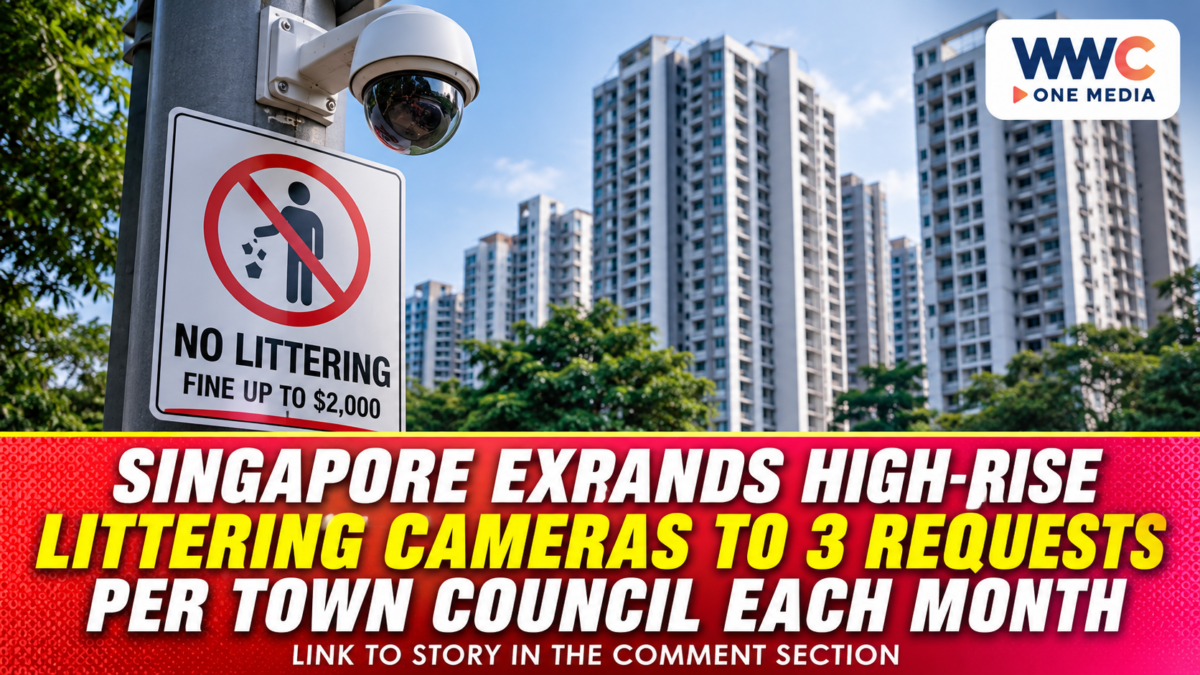
Singapore has expanded its partnership with town councils to tackle high-rise littering, allowing each council to request up to three surveillance camera deployments per month from November 2026. The change follows a six-month pilot in which cameras placed at locations identified by town councils achieved a 34 per cent catch rate, compared with 26 per cent for the National Environment Agency’s islandwide deployments over the same period.
The expansion gives local councils a bigger role in identifying where cameras should be installed, using their knowledge of recurring complaints and estate conditions. It also marks a shift towards more targeted enforcement as authorities continue to deal with thousands of reports involving rubbish thrown from residential buildings.
Why Singapore is giving town councils a bigger role
The partnership began as a six-month pilot in October 2025. Under the original arrangement, each town council could request up to two surveillance camera deployments per month at locations identified through ground observations and resident feedback.
NEA deployed the cameras and investigated offences detected through the system. Town councils helped identify locations where local knowledge could guide enforcement.
The pilot’s reported 34 per cent catch rate compared with 26 per cent for NEA’s islandwide deployments suggests that location selection can make a difference. It does not mean every camera deployment results in an offence being detected, but it indicates that the targeted approach performed better during the pilot period.
From November 2026, each town council can request up to three deployments per month. That is one additional monthly request under the expanded arrangement.
The practical significance is that residents’ reports and town councils’ observations can help authorities direct surveillance towards persistent problem areas instead of relying exclusively on broader deployment decisions.
A recent prosecution shows how the cameras can work
The latest enforcement update included a case at Telok Blangah Drive.
A camera deployed at a location identified by Tanjong Pagar Town Council captured a high-rise littering offence and helped NEA identify the source unit. Following investigations, the offender was prosecuted and convicted in court on Oct. 20, 2026, and fined S$700.
The case illustrates the intended sequence: a town council identifies a location, NEA deploys surveillance equipment, investigators examine the evidence and enforcement action may follow where an offence is established.
It also shows why identifying the correct source unit matters. Objects thrown from residential buildings can land in shared spaces used by residents, visitors and passers-by. Without evidence linking an incident to a particular unit, enforcement can be difficult.
High-rise littering remains a persistent problem
The expanded partnership does not mean the problem has disappeared.
NEA has said feedback involving high-rise littering has averaged about 28,600 cases annually over the past three years. In 2025, the agency conducted approximately 2,200 camera deployments for high-rise littering.
The figures show why authorities are continuing to invest in targeted monitoring even as they improve detection methods.
The challenge is not simply the number of complaints. Investigators must establish where discarded objects originated and gather sufficient evidence to support enforcement.
Singapore has also strengthened the legal framework. A statutory presumption provision that took effect on July 1, 2023, places greater responsibility on registered flat owners and, in relevant cases, tenants when littering from a residential flat is established.
The presumption is not automatic proof that a particular person personally threw an object. The law provides ways for an owner or tenant to rebut it, including showing that they were not present, could not have committed the offence or identifying the person reasonably believed to be responsible.
A person convicted of high-rise littering can face a court fine of up to S$2,000 for a first conviction, S$4,000 for a second conviction and S$10,000 for a third or subsequent conviction. A court may also impose a Corrective Work Order requiring the offender to clean public areas for up to 12 hours.
Surveillance is only one part of the cleanliness effort
Singapore’s approach combines enforcement with community participation and public education.
Residents can report environmental public-health concerns through official channels, while town councils and public agencies can use local feedback to identify recurring problems. Community clean-up activities also encourage residents to take responsibility for shared spaces.
A recent Tampines neighbourhood clean-up that collected 21kg of litter offered an example of how residents and community groups can contribute alongside enforcement agencies.
Other public-cleanliness rules address behaviour beyond litter thrown from flats. Singapore’s clarification on removing recyclable containers from public refuse bins highlights how waste management requirements apply to shared spaces in different circumstances.
The wider effort also includes the upkeep of public facilities. NEA’s published schedules for hawker-centre cleaning and maintenance show another part of the system involved in maintaining communal environments.
What happens next?
The expanded camera arrangement is now operational, with each town council able to request up to three high-rise littering surveillance deployments per month from November 2026.
The next measure of its effectiveness will be whether the additional capacity helps authorities detect more offences, identify responsible units and reduce recurring littering at the locations being monitored.
The pilot’s 34 per cent catch rate provides an encouraging starting point, but it does not establish that the expanded programme will automatically produce the same result across every town council or reduce complaints across Singapore.
For residents, the key issue is whether targeted enforcement leads to cleaner surroundings over time. More cameras may improve the chances of identifying offenders, but lasting results will also depend on deterrence, responsible behaviour and consistent follow-through.Singapore Expands High-Rise Littering Cameras to 3 Requests Per Town Council Each Month — But Will More Surveillance Finally Catch the Offenders?
Singapore has expanded its partnership with town councils to tackle high-rise littering, allowing each council to request up to three surveillance camera deployments per month from November 2026. The change follows a six-month pilot in which cameras placed at locations identified by town councils achieved a 34 per cent catch rate, compared with 26 per cent for the National Environment Agency’s islandwide deployments over the same period.
The expansion gives local councils a bigger role in identifying where cameras should be installed, using their knowledge of recurring complaints and estate conditions. It also marks a shift towards more targeted enforcement as authorities continue to deal with thousands of reports involving rubbish thrown from residential buildings.
Why Singapore is giving town councils a bigger role
The partnership began as a six-month pilot in October 2025. Under the original arrangement, each town council could request up to two surveillance camera deployments per month at locations identified through ground observations and resident feedback.
NEA deployed the cameras and investigated offences detected through the system. Town councils helped identify locations where local knowledge could guide enforcement.
The pilot’s reported 34 per cent catch rate compared with 26 per cent for NEA’s islandwide deployments suggests that location selection can make a difference. It does not mean every camera deployment results in an offence being detected, but it indicates that the targeted approach performed better during the pilot period.
From November 2026, each town council can request up to three deployments per month. That is one additional monthly request under the expanded arrangement.
The practical significance is that residents’ reports and town councils’ observations can help authorities direct surveillance towards persistent problem areas instead of relying exclusively on broader deployment decisions.
A recent prosecution shows how the cameras can work
The latest enforcement update included a case at Telok Blangah Drive.
A camera deployed at a location identified by Tanjong Pagar Town Council captured a high-rise littering offence and helped NEA identify the source unit. Following investigations, the offender was prosecuted and convicted in court on Oct. 20, 2026, and fined S$700.
The case illustrates the intended sequence: a town council identifies a location, NEA deploys surveillance equipment, investigators examine the evidence and enforcement action may follow where an offence is established.
It also shows why identifying the correct source unit matters. Objects thrown from residential buildings can land in shared spaces used by residents, visitors and passers-by. Without evidence linking an incident to a particular unit, enforcement can be difficult.
High-rise littering remains a persistent problem
The expanded partnership does not mean the problem has disappeared.
NEA has said feedback involving high-rise littering has averaged about 28,600 cases annually over the past three years. In 2025, the agency conducted approximately 2,200 camera deployments for high-rise littering.
The figures show why authorities are continuing to invest in targeted monitoring even as they improve detection methods.
The challenge is not simply the number of complaints. Investigators must establish where discarded objects originated and gather sufficient evidence to support enforcement.
Singapore has also strengthened the legal framework. A statutory presumption provision that took effect on July 1, 2023, places greater responsibility on registered flat owners and, in relevant cases, tenants when littering from a residential flat is established.
The presumption is not automatic proof that a particular person personally threw an object. The law provides ways for an owner or tenant to rebut it, including showing that they were not present, could not have committed the offence or identifying the person reasonably believed to be responsible.
A person convicted of high-rise littering can face a court fine of up to S$2,000 for a first conviction, S$4,000 for a second conviction and S$10,000 for a third or subsequent conviction. A court may also impose a Corrective Work Order requiring the offender to clean public areas for up to 12 hours.
Surveillance is only one part of the cleanliness effort
Singapore’s approach combines enforcement with community participation and public education.
Residents can report environmental public-health concerns through official channels, while town councils and public agencies can use local feedback to identify recurring problems. Community clean-up activities also encourage residents to take responsibility for shared spaces.
A recent Tampines neighbourhood clean-up that collected 21kg of litter offered an example of how residents and community groups can contribute alongside enforcement agencies.
Other public-cleanliness rules address behaviour beyond litter thrown from flats. Singapore’s clarification on removing recyclable containers from public refuse bins highlights how waste management requirements apply to shared spaces in different circumstances.
The wider effort also includes the upkeep of public facilities. NEA’s published schedules for hawker-centre cleaning and maintenance show another part of the system involved in maintaining communal environments.
What happens next?
The expanded camera arrangement is now operational, with each town council able to request up to three high-rise littering surveillance deployments per month from November 2026.
The next measure of its effectiveness will be whether the additional capacity helps authorities detect more offences, identify responsible units and reduce recurring littering at the locations being monitored.
The pilot’s 34 per cent catch rate provides an encouraging starting point, but it does not establish that the expanded programme will automatically produce the same result across every town council or reduce complaints across Singapore.
For residents, the key issue is whether targeted enforcement leads to cleaner surroundings over time. More cameras may improve the chances of identifying offenders, but lasting results will also depend on deterrence, responsible behaviour and consistent follow-through.