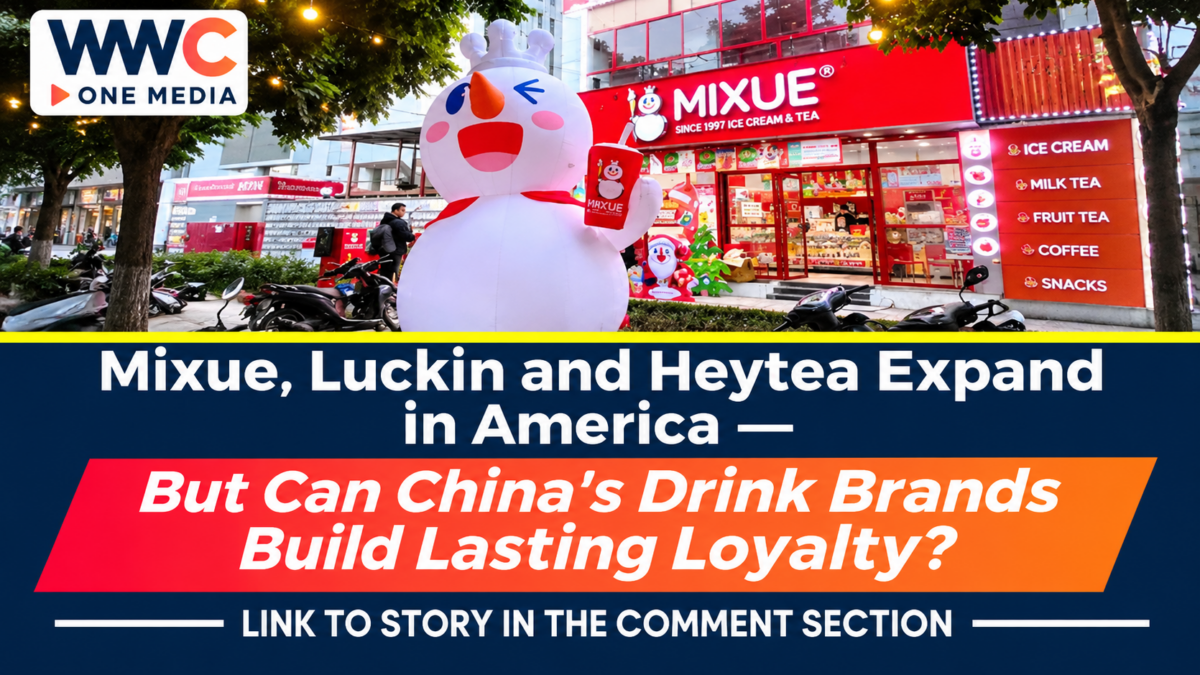
NEW YORK, Nov. 15, 2026 — Chinese drink brands Mixue, Luckin Coffee and Heytea have established a presence in the United States, bringing their different approaches to affordable refreshments, technology-driven coffee sales and specialty tea into an intensely competitive market. Company filings and official store records confirm the expansion, but they do not establish that a reported social-media trend among American teenagers is driving sales.
The business question is more measurable than online excitement: can stores attract repeat customers, maintain margins and justify further investment after their openings? Public disclosures offer an early framework for answering it, although comparable US revenue figures for all three brands are not available.
Chinese Drink Brands Are Taking Different Routes Into America
Mixue Group disclosed in its 2025 annual results that it entered the United States and Kazakhstan during that year. At Dec. 31, 2025, the group reported 59,823 stores worldwide, including 4,467 outside mainland China. Those overseas figures cover numerous countries, not the United States alone.
Luckin, which operates a technology-centred coffee business, reported two net new US locations in the third quarter of 2026. Its network worldwide reached 38,909 stores at Sept. 30, with the majority located in China. The company did not describe the two American openings as proof of nationwide demand.
Heytea’s own store portfolio identifies a tea laboratory concept in New York’s Times Square that opened Feb. 22, 2025. Unlike a financial filing, this official branded page establishes the location and design concept, not its revenue or profitability.
WWC has previously examined cross-border restaurant competition between American and Chinese chains. The more specific issue here is how three different beverage models might convert initial curiosity into recurring business.
Mixue’s Large Network Comes With a Complicated Overseas Picture
Mixue’s 2025 year-end total of 59,823 stores represented growth from 46,479 a year earlier. Yet stores outside mainland China decreased from 4,895 to 4,467 over the same period. The company described efforts to optimise its existing operations in Indonesia and Vietnam while entering additional markets.
That contrast is instructive. Overall expansion can coexist with closures or network adjustments in individual countries. A company’s global footprint, therefore, should never be treated as a count of successful US outlets.
Mixue’s 2025 annual results recorded revenue of approximately RMB33.56 billion, up 35.2% year on year, and profit for the year of approximately RMB5.93 billion, up 33.1%. Those are group-wide figures and do not disclose how the American launch performed.
Analysis: The low-cost drinks model may be attractive to budget-conscious customers, but favourable product pricing alone cannot prove sustainable unit economics. Rent, staffing, supply logistics and repeat purchases all matter in a new market.
Luckin’s Store Growth Is Not the Same as Same-Store Growth
Luckin’s Nov. 3 financial release reported third-quarter net revenue of RMB17.89 billion, an increase of 17.0% from a year earlier. It added 2,599 net stores across its markets during the quarter and reported 123.0 million average monthly transacting customers worldwide.
At the same time, comparable sales at self-operated stores declined 11.1% year on year. Luckin linked that weakness chiefly to a demanding comparison with the previous year’s period, when food-delivery subsidies had boosted activity. The comparable-sales figure is not a measure of US-only performance.
The company also reported a 23.3% store-level operating margin at self-operated locations, a measure distinct from its overall corporate profit margin. Investors and retail competitors should not mix those metrics.
Its US entry can also be assessed alongside WWC’s earlier coverage of Luckin Coffee’s Taiwan market-entry scrutiny. The regulatory circumstances are different, but both illustrate that expanding abroad involves more than opening a shop and marketing a familiar brand.
Heytea Competes on Experience Rather Than Scale Alone
Heytea presents its Times Square tea laboratory as an experiment-oriented retail concept, emphasising store design and beverage development. Its official page documents the opening date but offers no verified American same-store sales series or national customer-demographic breakdown.
Analysis: That positioning creates a different potential advantage from Mixue’s value proposition or Luckin’s app-oriented operations. A distinctive store can generate customer interest, but its long-term performance depends on how regularly consumers return after the novelty fades.
It would be misleading to rank the three companies by US popularity using their global store counts, social-media posts or individual store photographs. A reliable comparison would need consistent US store totals, sales, customer retention and profitability data.
The competitive context also includes established coffee chains. WWC’s reporting on Starbucks’ China business restructuring shows how a large international operator can adjust its strategy as local competition intensifies. That example concerns China, not a forecast for American outlets.
Can Online Attention Become Sustainable Demand?
The expression “Chinamaxxing” has appeared in descriptions of online interest in Chinese products and aesthetics. But the records reviewed do not include a representative US teen survey proving that this enthusiasm is widespread, or a company disclosure linking it causally to beverage sales.
There is an important distinction between visibility and consumption. A widely shared store-opening video can reach people who never visit, while a smaller group of repeat customers may contribute more to a shop’s financial health.
Analysis: The clearest tests are repeat purchases, revenue per outlet, marketing costs, retention and store-level profitability. Without comparable public US data, an evidence-based article can document expansion and competitive strategies, but not declare a generational consumer takeover.
What Happens Next
Future company earnings, audited filings and updated store directories could establish whether US networks are expanding, consolidating or becoming profitable. Any credible claim about teenagers’ preferences would additionally require transparent, properly sampled consumer research.
For now, Mixue, Luckin and Heytea have real American operations, but their ability to maintain US demand over time remains an open business question—not a result already demonstrated by the global numbers.
Frequently Asked Questions
Are Mixue, Luckin and Heytea operating in the United States?
Yes. Mixue disclosed entry into the US in 2025; Luckin reported US store additions in 2026; and Heytea officially lists a Times Square concept opened in February 2025.
How many stores does Mixue have worldwide?
Mixue reported 59,823 group stores at Dec. 31, 2025. That number covers all markets, not just the US.
Is Luckin Coffee growing profitably?
Luckin reported positive group operating income in the third quarter of 2026, alongside declining comparable sales at self-operated stores. Neither figure isolates its American outlets.
Does “Chinamaxxing” prove US teenagers prefer these brands?
No. Verified store openings cannot establish a demographic trend. Such a claim requires representative consumer evidence.