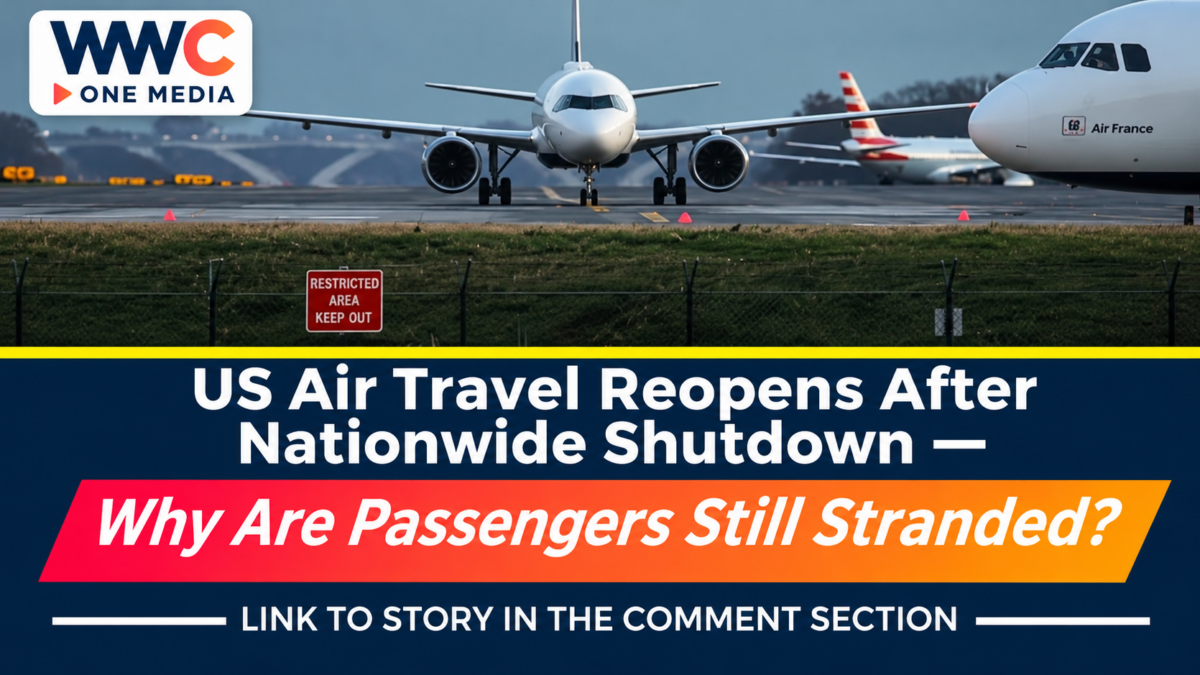
UNITED STATES — Nov. 15, 2026. US airlines were still rebuilding their flight schedules this weekend after the Federal Aviation Administration lifted a nationwide ground stop late Friday, Nov. 13. The Transportation Department warned that passengers could continue to encounter cancellations and delays even though the airspace had reopened.
The recovery challenge is putting aircraft, crews and passengers back into position after the restriction ends.
US Flight Delays: What Officials Have Actually Confirmed
The FAA ordered the nationwide ground stop after communications problems affected multiple air traffic control centres. In its preliminary Nov. 13 notice, the agency said technicians were examining the disruption and cautioned that its early findings could change.
Transportation Secretary Sean P. Duffy said radar and communications instability began at 3:36 p.m. Eastern Time. He later announced that airspace reopened at 8:15 p.m. that evening. A published FAA advisory also records cancellation of the nationwide ground stop early on Nov. 14 in coordinated universal time.
The government reported that more than 3,500 aircraft were airborne during the response and that more than 8,000 flight operations resumed after restrictions were removed. Those figures describe the safety response and subsequent operations; neither is a verified count of cancelled flights.
Why Sunday Flights Could Still Be Disrupted
The Transportation Department’s Nov. 14 update said US airspace was open but warned passengers to prepare for continuing delays and cancellations. A reopened route is not a promise that every aircraft or flight crew is available at its next scheduled departure point.
Delta Air Lines made that problem concrete in its own Saturday update. The airline said it was repositioning aircraft and crews, continued to offer flexible rebooking and advised customers whose plans allowed it to move travel to Monday, Nov. 16, or later.
Travellers should check their operating airline’s flight status rather than rely on a nationwide announcement.
For a broader explanation of how the incident disrupted the underlying air traffic network, WWC’s examination of the L3Harris maintenance investigation separates the official technical questions from unproven responsibility.
Why a Ground Stop Creates Delays After It Ends
An airline timetable works as a connected sequence. One aircraft may fly several sectors in a day, while the crews assigned to those journeys have their own availability and duty limitations. When departures pause nationwide, those sequences can break at multiple airports at once.
Resuming departure clearance solves only one part of that problem. Airlines still need to decide which journeys can operate, where replacement crews are necessary, whether missed connections can be repaired and when a customer should be moved to another flight.
The FAA’s Nov. 14 operations plan separately listed local staffing triggers, weather constraints and possible airport-specific traffic programmes. Such entries show why some flight restrictions can remain local and unrelated to a continuing nationwide shutdown.
WWC’s coverage of US sports travel disrupted by the ground stop illustrates how shifting arrival times can complicate events scheduled after the original aviation restriction.
What Passengers Can Do About Rebooking and Refunds
Affected travellers should first check the airline’s official application or website for the latest status of every leg. A passenger with a connection should verify the entire itinerary, not just the first flight, before making alternative arrangements.
Delta’s posted waiver permits qualifying travellers to change flights without extra cost within specified conditions. Its public advisory lists a Nov. 21 rebooking deadline and says the affected tickets must have been issued on or before Nov. 13; the exact terms matter.
A free change is different from a statutory refund. Under US Transportation Department guidance, a traveller whose flight is cancelled or significantly changed may be entitled to a refund when they do not accept the alternative transportation or compensation offered. Accepting a replacement flight generally changes the situation.
The refund rules apply to covered flights to, from or within the United States, so their relevance is not limited to US citizens. However, they do not mean every delay automatically produces a cash payment or a right to a hotel stay.
WWC’s earlier guide to what stranded passengers can claim provides additional context on distinguishing refund rights from other assistance. Passengers should retain their booking confirmation, airline notices and receipts while their case is being resolved.
What the Technical Inquiry Can—and Cannot—Establish Yet
Duffy’s Nov. 14 briefing connected the disruption to telecommunications work involving L3Harris and described unusually frequent connection attempts affecting communications and radar feeds. Officials were still examining whether an installation problem, human error or equipment defect had caused the abnormal activity.
Those possibilities remain under investigation. Identifying a contractor involved in maintenance is not the same as establishing legal or technical liability. Duffy also said officials did not believe the event was a cyberattack, but that statement was a preliminary assessment rather than a published final forensic finding.
The public record supports a narrower conclusion: precautionary restrictions were imposed after air traffic systems became unstable, and the authorities restored operations while continuing the inquiry into the cause.
For the aviation industry, an important longer-term question is how upgrades to legacy communications infrastructure can be performed without exposing interconnected systems to a wider outage. That is a policy and engineering question, not proof that a specific proposed reform would have prevented this incident.
What Happens Next
Travellers should continue monitoring flight-specific updates on Sunday, Nov. 15, particularly if they depend on tight connections or are scheduled to fly through several US airports. The FAA’s published status tools and airlines’ own alerts are more useful for individual decisions than outdated systemwide cancellation estimates.
Further official findings may clarify the maintenance sequence, the exact source of abnormal network activity and any future safeguards. Until those findings appear, the responsible interpretation is that US airspace reopened on Friday evening while airlines continued the slower work of restoring their schedules.
Frequently Asked Questions
Is the nationwide FAA ground stop still in effect?
No. The Transportation Department said US airspace reopened at 8:15 p.m. Eastern Time on Nov. 13. Individual flights may still be delayed or cancelled.
Why are flights disrupted after the ground stop ended?
Airlines have to reposition aircraft and crews and restore missed connections. That takes time even when air traffic control allows departures again.
Can I change my Delta flight for free?
Delta published a temporary waiver for eligible tickets and travel dates. Travellers must check the specific conditions and rebooking deadline on the airline’s official site.
Can I get a refund if my US flight is cancelled?
Generally, a refund is owed if the covered flight is cancelled and the passenger does not accept rebooking or another offered alternative. Significant itinerary changes can also qualify under US rules.
Has the cause of the FAA disruption been confirmed?
Not conclusively. Officials identified telecommunications maintenance and abnormal network activity as part of the inquiry, but had not issued a final finding identifying the precise technical fault.