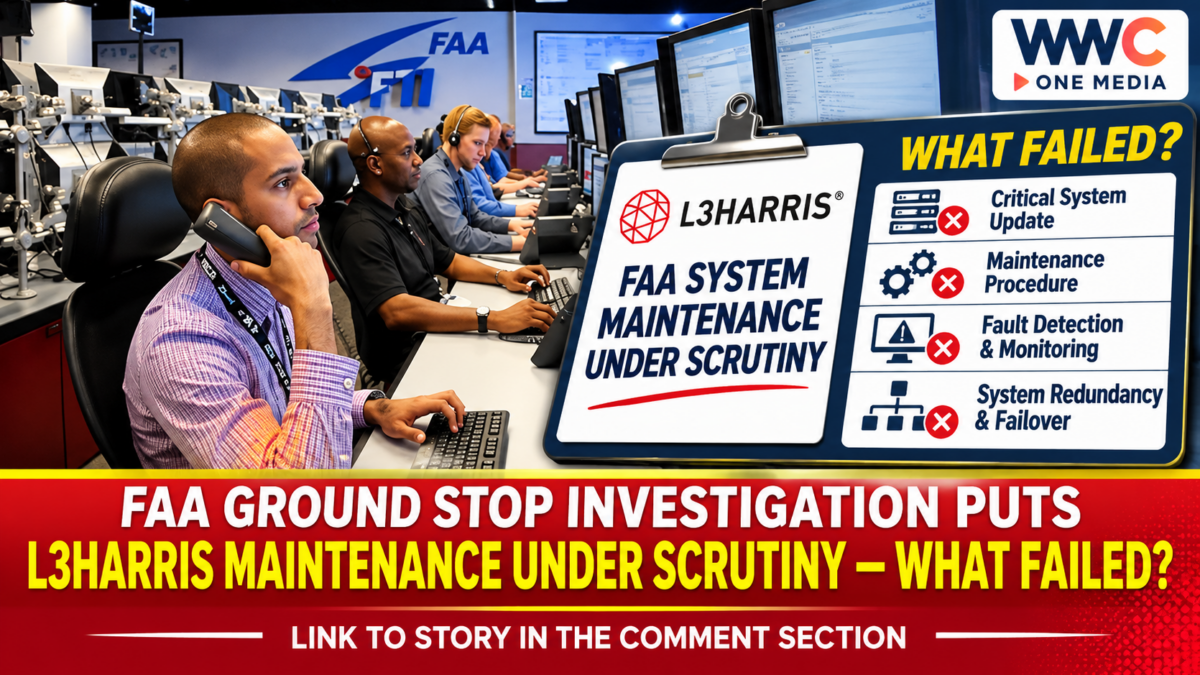
WASHINGTON, United States — Nov. 15, 2026. US Transportation Secretary Sean P. Duffy has identified maintenance work involving contractor L3Harris as a focus of the investigation into the nationwide air-traffic ground stop on Nov. 13. In a Nov. 14 public briefing, he said investigators were still determining whether the disruption resulted from an equipment fault or an error during installation.
The FAA ground stop investigation matters beyond one contractor: it raises questions about how ageing communications equipment can be replaced safely while a nationwide aviation network remains in operation. L3Harris has acknowledged the incident and said it is assisting the authorities, but no final finding of negligence has been made public.
What the FAA Ground Stop Investigation Has Established
The Federal Aviation Administration said communications problems affecting several Air Route Traffic Control Centers prompted a nationwide ground stop on Nov. 13. The agency labelled its initial information preliminary and said technicians were investigating.
Duffy’s subsequent account added operational detail. He said instability in communications and radar services emerged at 3:36 p.m. Eastern Time. Controllers and pilots then managed the restriction while the affected network was isolated and services restored.
The Transportation Department reported that more than 3,500 aircraft were airborne during the response and more than 8,000 flight operations resumed after restrictions were lifted. These figures describe different operational periods; they should not be added together as a count of affected passengers.
For context, WWC’s earlier review of longstanding FAA technology risks examined the wider modernisation challenge. The contractor-specific investigation is a narrower matter: finding what happened during a particular maintenance operation.
Why L3Harris Is Part of the Inquiry
Duffy identified L3Harris as the legacy network provider involved in work at a remote FAA location. The maintenance involved converting ageing copper telecommunications lines to fibre-optic connections, a shift from older analogue infrastructure towards internet-protocol-based services.
During the briefing, Duffy described a router generating more than 1,000 connection attempts every four to five seconds. He said the excessive activity affected air traffic communications and some radar feeds. His explanation was an initial technical account, not a completed engineering report.
Officials are weighing more than one possibility, including an installation or user error and a faulty router. The public record establishes neither possibility nor contractor fault.
This distinction matters because a network disturbance can have several layers: the device that begins sending unexpected traffic, the configuration permitting its spread, and the protection systems meant to contain the disruption. Each requires evidence before assigning responsibility.
What L3Harris Said in Its Official Response
In its Nov. 14 statement, L3Harris said it had been upgrading communications infrastructure in coordination with the FAA and telecommunications partners. It reported completing more than 70% of planned conversions from copper to fibre.
The company said it was supporting the investigation and recognised the disruption’s effect on travellers, airlines and air traffic operations. Its statement did not identify a root cause, announce corrective findings or admit fault.
There is a numerical difference worth preserving. Duffy said 69% of copper communications had been replaced, while L3Harris referred to more than 70% of planned conversions. The published statements do not demonstrate that the two percentages use precisely the same measurement basis, so they should not be treated as contradictory without further documentation.
The reviewed announcements do not allocate responsibility among network providers and equipment makers.
Why Officials Separate Maintenance From Modernisation
The November breakdown occurred against the backdrop of a much larger government effort to upgrade American air traffic technology. But FAA Administrator Bryan Bedford made an important distinction in the Nov. 14 briefing: the particular telecommunications changeover was routine maintenance, not part of the separate Peraton–FAA modernisation effort.
Duffy said Congress had provided $12.5 billion towards the broader programme. He described work involving upgraded radio sites, digital flight strips and new systems at control towers. The government’s account of progress does not establish that the newer equipment caused the outage.
The challenge is maintaining old and new systems at the same time. Technical transitions may improve reliability over the long term, but they can create temporary operational exposure if changes affect connected infrastructure unexpectedly.
In analysis, the critical measure of modernisation is therefore not just how much equipment has been replaced. It is also whether operators can detect an abnormal event, prevent it from spreading and restore services without compromising safety.
What Officials Said About Cybersecurity and Flight Recovery
Duffy said his department did not believe a cyberattack was responsible. He based that preliminary assessment on the restoration of systems after the maintenance activity was isolated. The public material reviewed here does not contain a final forensic finding.
The Transportation Department said the airspace reopened at 8:15 p.m. Eastern Time on Nov. 13. Even then, airlines still needed to return aircraft and crews to scheduled positions, which can take longer than restoring permission to depart.
WWC’s explainer on delays after the FAA ground stop addressed that difference. Another report on the impact on US college sports travel showed how flight disruption can affect events beyond the airport. Those are consequences of operational interruptions, not evidence of why the network malfunctioned.
Passengers whose journeys remain affected should check the operating airline’s latest flight information rather than assume that nationwide airspace reopening means every itinerary has returned to schedule.
What Happens Next
Investigators still need to establish the technical root cause, whether maintenance procedures were followed and which safeguards could prevent an isolated fault from affecting other network components. The public announcements do not identify a final report date or a formal finding against L3Harris.
Duffy said officials would reassess when some telecommunications changeovers should take place. That is a stated direction for review, not proof that a revised nationwide maintenance policy has already been adopted.
The central lesson is straightforward: the nationwide ground stop shows the stakes of protecting interconnected aviation systems during upgrades. Whether the fault lay with a device, an installation process or some other failure must be determined by evidence, not by the prominence of the contractor’s name.
Frequently Asked Questions
What caused the FAA ground stop on Nov. 13, 2026?
The FAA confirmed communications problems affecting multiple control centres. Duffy described abnormal network activity during telecommunications maintenance, but officials have not issued a final determination of the fault.
Did L3Harris cause the nationwide outage?
L3Harris was identified as the contractor involved in the maintenance under review. The official record does not establish negligence or final responsibility.
Was the outage a cyberattack?
Duffy said officials did not believe it was cyber-related. That was a preliminary assessment, not a published final forensic report.
When did US airspace reopen?
The Transportation Department said airspace reopened at 8:15 p.m. Eastern Time on Nov. 13, 2026, although delays and cancellations could continue.
Is the FAA’s wider modernisation programme responsible?
FAA Administrator Bryan Bedford distinguished the maintenance operation from the separate modernisation programme. No official finding links the wider programme to the ground stop.