
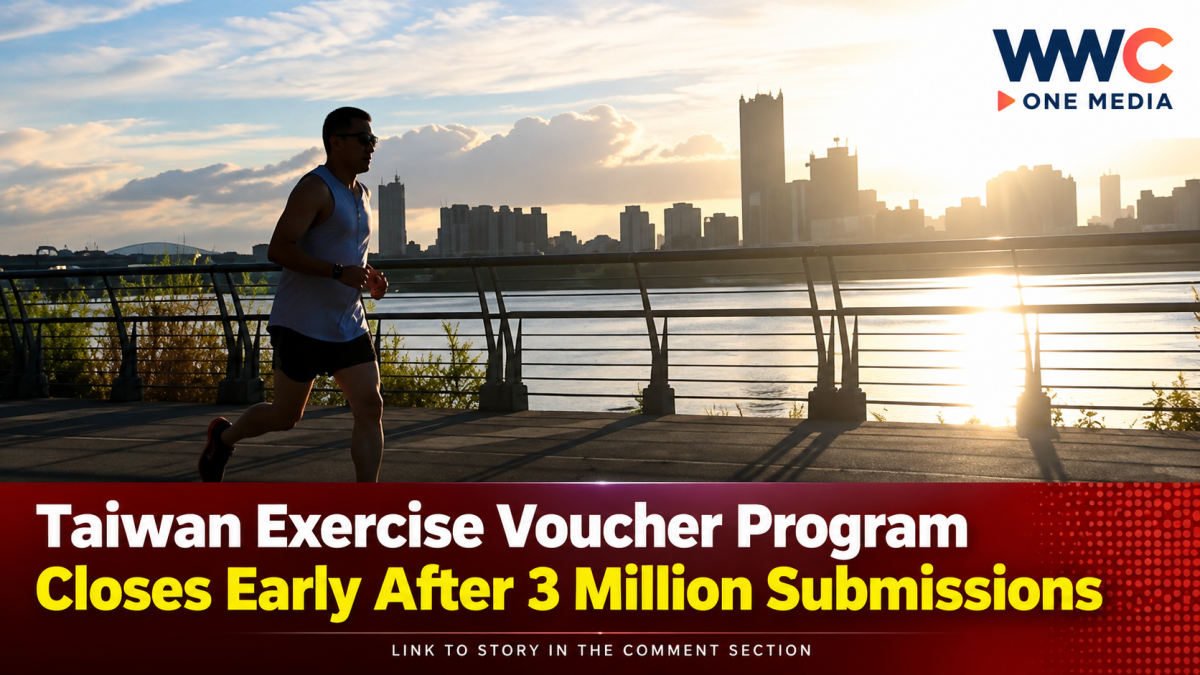
TAIPEI, Taiwan — Taiwan’s new exercise incentive program has ended far earlier than expected after receiving 3 million exercise submissions in just two weeks, highlighting the enormous public response to a government campaign designed to encourage healthier lifestyles.
The program, launched by Taiwan’s Ministry of Sports on September 1, was originally scheduled to continue through the end of November. But the available vouchers were exhausted after the campaign reached its expanded ceiling of 3 million submissions.
Demand Quickly Outpaced Expectations
The initiative initially offered 2 million NT$50 (about US$1.58) vouchers to eligible participants who completed designated physical activities and submitted proof.
The response was so strong that the ministry added another 1 million vouchers after submissions surpassed 1.8 million by September 8.
That additional allocation has now also been used, prompting officials to close registration and online submissions ahead of schedule.
The rapid exhaustion of the vouchers means the campaign effectively reached its participation ceiling only around two weeks after launch.
How the Exercise Voucher Worked
The program was designed to make everyday physical activity eligible for a small financial reward.
Taiwanese nationals aged 16 and above could qualify by completing one of several designated activities and submitting digital evidence for verification.
Qualifying activities included:
- Walking at least 8,000 steps in a day
- Completing at least 30 minutes of exercise in one session
- Walking or running at least 5 kilometers
- Cycling at least 15 kilometers
Each approved submission earned a NT$50 voucher, with participants limited to one voucher per week.
The vouchers could then be redeemed at participating retailers for health-oriented food and beverages.
The Program Tapped Into an Existing Fitness Trend
The overwhelming response comes against the backdrop of rising participation in exercise among Taiwan’s population.
A Ministry of Sports survey conducted last year found that 83.3% of Taiwan’s nationals exercised, while the proportion reporting regular exercise reached 35.6% — the highest level recorded in the past decade and the fifth consecutive annual increase.
The survey also found an association between regular physical activity and people’s perceptions of their health and life satisfaction.
Among people who exercised regularly, 81.8% rated their health as good, while 73.6% reported being satisfied with their lives.
A Small Voucher With a Big Response
At NT$50 per approved submission, the financial incentive was relatively modest.
Yet the speed at which the program reached its limit suggests that even a small reward can attract significant participation when combined with activities many people already perform as part of their daily routines.
Taiwan Plus reported during the program’s first week that more than 500,000 vouchers had already been distributed, with officials anticipating that the original 2 million-voucher allocation could soon be exhausted.
That prediction came true — and the government ultimately had to expand the allocation before closing the program altogether.
Why the Early Closure Matters
The early shutdown gives Taiwan’s Ministry of Sports a significant amount of data on how financial incentives can influence participation in physical activity.
It also raises an obvious question: will the government expand or repeat the program after seeing demand far exceed the original allocation?
For participants who missed the opportunity, however, the immediate answer is less encouraging: the current submission system has closed after the additional 1 million vouchers were also allocated.
The Bigger Picture
The exercise voucher campaign may have been designed as a relatively small public-health incentive, but its rapid uptake has turned it into a notable policy experiment.
Three million submissions in roughly two weeks demonstrate that Taiwan’s residents responded strongly to a program that connected everyday physical activity with a tangible reward.
The next challenge for policymakers will be determining whether the surge represents temporary enthusiasm — or evidence that small incentives could play a larger role in encouraging long-term exercise habits.
For now, one thing is clear: Taiwan’s exercise voucher program ran out of room long before it ran out of public interest.




Leave a Reply