
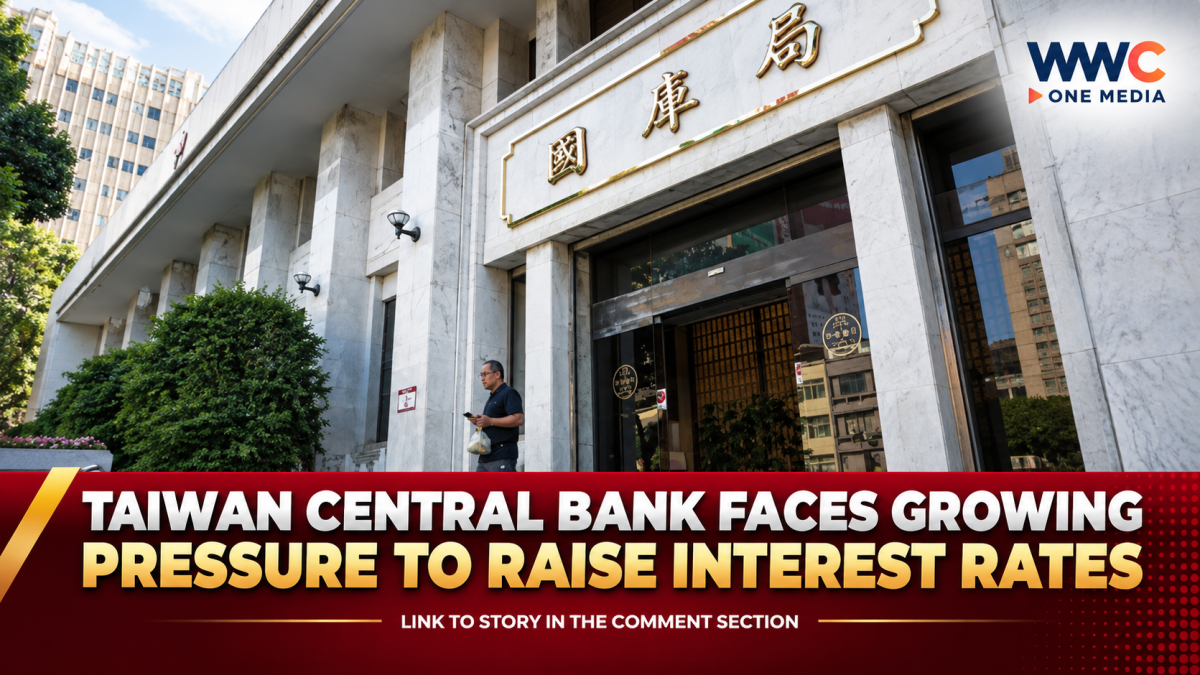
TAIPEI, Taiwan — Taiwan’s central bank is facing growing pressure to raise interest rates as inflation remains above its warning level and the economy continues to expand at an unusually strong pace.
Yet despite the mounting pressure, economists broadly expect the Central Bank of the Republic of China (Taiwan) to leave its benchmark discount rate unchanged at 2% at its quarterly board meeting this week.
A Reuters poll of 31 economists found that 28 expect no change, while three predict a 0.125-percentage-point increase to 2.125%. Several economists nevertheless see a hike becoming more likely later in the year, with December increasingly viewed as a possible turning point.
Inflation Is Keeping the Rate Debate Alive
One of the biggest reasons for the pressure is inflation.
Taiwan’s consumer price index rose 2.04% year-on-year in August, easing from 2.54% in July but remaining just above the central bank’s 2% warning threshold.
The latest figure followed several months in which inflation stayed above that level, keeping monetary policymakers under pressure to demonstrate that price stability remains a priority. Focus Taiwan reported that domestic inflation had exceeded the 2% alert level for a fourth consecutive month in August.
At the same time, underlying price pressures remain important because services and other domestic costs can be slower to cool than headline inflation.
Taiwan’s Economy Is Running Hot
The central bank is also confronting an unusual problem: the economy is performing extremely well.
Taiwan’s technology sector, particularly demand related to artificial intelligence and advanced semiconductors, has driven a powerful export and investment cycle.
Reuters’ latest reporting puts Taiwan’s projected 2026 economic growth at 11.05%, reflecting the strength of the AI-led technology boom.
The central bank itself had already raised its 2026 GDP growth forecast to 9.45% in June, citing robust exports, private investment and strong demand for emerging technology applications.
That strength gives policymakers more room to consider higher borrowing costs without necessarily risking an immediate economic downturn.
Why the Central Bank May Still Wait
Despite the pressure, raising rates immediately is far from certain.
The central bank said in June that domestic inflation was expected to remain moderate and that holding rates would help maintain sound economic and financial conditions.
At that time, it kept the discount rate at 2%, the secured-loan refinancing rate at 2.375% and the temporary-accommodation rate at 4.25%.
August’s softer inflation reading also gives officials an argument for patience.
A sudden rate increase could additionally complicate financial conditions at a time when Taiwan is dealing with uncertain global trade policies, geopolitical risks and changing monetary policy among major economies.
The Fed Could Change the Equation
Another major factor is what happens in the United States.
Markets are watching the Federal Reserve closely after stronger-than-expected U.S. inflation data increased expectations for a Fed rate hike this week. Goldman Sachs and JPMorgan have both shifted toward expecting a September increase.
A higher U.S. interest rate could put additional pressure on Taiwan’s policymakers, particularly through global bond yields and exchange-rate movements.
Taiwanese stocks already came under pressure on Sept. 11 amid growing fears of a Fed hike and higher oil prices. Focus Taiwan reported that the benchmark Taiex fell more than 750 points that day, with technology shares leading the decline.
Markets Are Looking Beyond September
The bigger question may therefore not be whether Taiwan raises rates this week, but when the first hike will come.
DBS Group Research expects the central bank to remain on hold at its September meeting before potentially raising the policy rate to 2.125% in December.
That would represent a relatively modest tightening step, but it would nevertheless signal that policymakers believe inflation and economic momentum have changed enough to warrant higher borrowing costs.
What a Rate Hike Could Mean
A higher policy rate would eventually feed through to borrowing costs across the economy.
Households could face higher interest expenses on loans, while businesses could see financing become more expensive. On the other hand, tighter monetary policy can help contain inflationary pressure and potentially support the currency by making local assets relatively more attractive.
The central bank has also been monitoring credit and property-market conditions. In June, it noted strong growth in bank loans and investments and continued to adjust selective credit controls in the housing sector.
The Bigger Test for Taiwan
Taiwan’s policymakers are now balancing two very different forces.
On one side is an exceptionally strong AI and semiconductor-driven economy, rising price pressures and a global shift toward tighter monetary policy.
On the other is the risk that higher rates could unnecessarily weaken domestic demand or financial conditions if inflation begins cooling on its own.
For now, the consensus points toward patience rather than an immediate rate hike.
But with inflation hovering around the central bank’s warning level, Taiwan’s economy expanding rapidly and the Federal Reserve potentially moving in the opposite direction, the pressure on policymakers is unlikely to disappear.
The September meeting may therefore be less about whether Taiwan hikes rates now — and more about whether officials signal that a December increase is coming.




Leave a Reply