
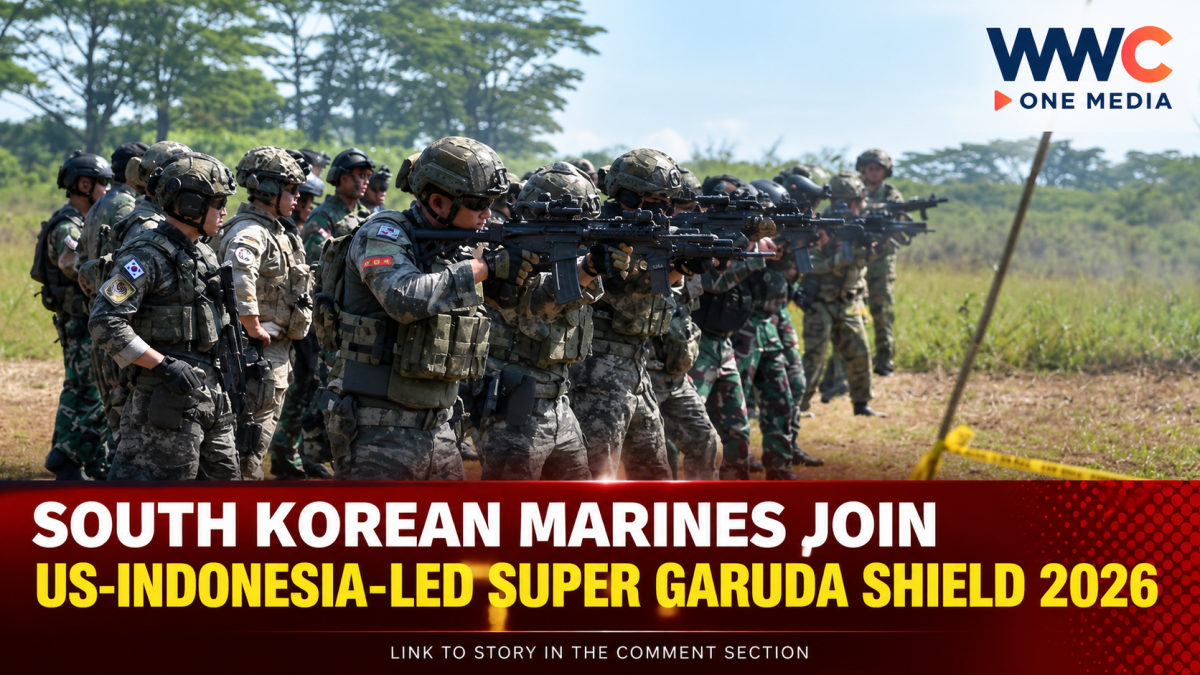
SEOUL, South Korea — South Korean Marines have joined the 2026 Super Garuda Shield, a major multinational military exercise led by the United States and Indonesia, as Seoul expands its participation in multinational training across the Indo-Pacific.
The two-week exercise ran from August 31 through September 11 at locations including Lampung and Bandung in Indonesia. Troops from 15 nations, including South Korea, Japan and Canada, took part in this year’s drills.
For South Korea, the exercise marks the second consecutive year its Marines have participated after joining Super Garuda Shield for the first time in 2025.
South Korean Marines Train Alongside Regional Partners
The South Korean contingent participated in several forms of multinational training designed to improve coordination between participating forces.
Activities included field training exercises focused on jungle warfare, as well as cyber-related drills intended to familiarize troops with defensive and offensive cyber capabilities.
South Korean Marines also participated alongside U.S., Indonesian and Japanese personnel in an infantry marksmanship training program during the exercise, according to Indonesia’s ANTARA news agency.
The multinational format gives participating forces opportunities to practice working together under common procedures and conditions.
From a Bilateral Exercise to a Regional Platform
Super Garuda Shield began in 2007 as a bilateral U.S.-Indonesia exercise focused largely on improving operational capabilities, including jungle warfare.
Over time, it developed into a much broader multinational exercise involving a growing number of partner countries.
That evolution reflects the increasing emphasis on interoperability and cooperation among Indo-Pacific militaries.
The 2026 exercise involved thousands of personnel from countries across the region and beyond, with training extending beyond traditional field operations to include areas such as cyber capabilities and multinational coordination.
South Korea’s Broader Multinational Training
The Korean Marines’ participation comes as Seoul continues to expand military exchanges with countries in the Indo-Pacific.
In 2025, roughly 20 South Korean Marines participated in Super Garuda Shield, including special reconnaissance and infantry personnel. Their training included urban and jungle warfare as well as amphibious operations.
South Korean Marines have also participated in other multinational exercises in the region, including KAMANDAG in the Philippines, demonstrating Seoul’s interest in building practical cooperation with regional partners.
Why the Exercise Matters
The 2026 drills come amid a broader push by countries in the Indo-Pacific to strengthen interoperability and maintain closer defense relationships.
For South Korea, overseas multinational exercises provide opportunities to work with forces outside its traditional U.S.-South Korea alliance framework.
For Indonesia and the United States, meanwhile, Super Garuda Shield has become an important platform for bringing together a wider group of regional partners.
The exercise does not mean that all participating countries have formed a new military alliance. Rather, it provides a venue for training, professional exchanges and improving the ability of different forces to operate alongside one another.
A Growing Indo-Pacific Network
The participation of South Korean Marines also comes against a complicated backdrop for U.S.-South Korean military cooperation.
The United States recently reduced its participation in the planned 2026 Ssangyong amphibious exercise with South Korea because of constraints linked to the conflict in Iran. South Korean officials nevertheless pointed to continuing cooperation through other multinational exercises, including Super Garuda Shield.
That makes Seoul’s participation in overseas exercises particularly notable.
Rather than relying exclusively on bilateral drills on the Korean Peninsula, South Korean forces are increasingly gaining experience alongside a wider network of regional partners.
The Bigger Picture
Super Garuda Shield 2026 shows how multinational military exercises in the Indo-Pacific are becoming broader and more complex.
South Korean Marines’ second consecutive participation strengthens their practical ties with U.S., Indonesian and Japanese forces while giving Seoul another avenue for regional military cooperation.
For Indonesia and the United States, the exercise similarly demonstrates the growing importance of multinational interoperability.
As Super Garuda Shield continues to expand, the bigger question is how far South Korea and other Indo-Pacific partners will take this growing network of military cooperation.




Leave a Reply