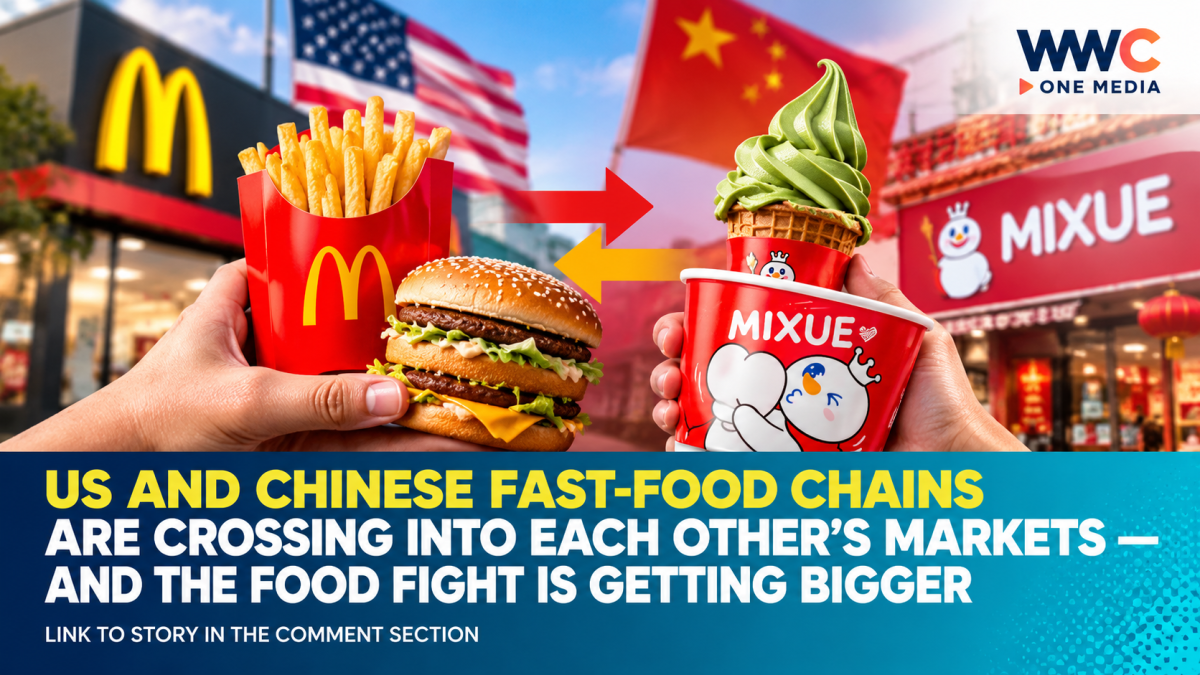
American burgers, fried chicken and coffee are continuing to expand across China, while Chinese bubble tea, coffee and fast-food brands are increasingly opening stores in the United States.
The unusual two-way expansion is happening despite major tensions between Washington and Beijing over tariffs, technology and Taiwan, turning fast food into an unexpected point of connection between consumers in the world’s two largest economies.
In China, American brands still see enormous room for growth. Church’s Texas Chicken recently opened its first Shanghai outlet, with plans for at least 600 more restaurants in China. Wendy’s expects to open as many as 1,000 locations there over the next decade, while McDonald’s has announced plans for another 1,000 Chinese restaurants this year and a target of 10,000 locations in China by 2028.
KFC remains one of the biggest examples of how deeply an American food brand has become established in China. The chain has about 13,000 restaurants in the country, compared with roughly 3,750 in the United States, making China its largest market by a wide margin.
But these companies are no longer simply exporting American menus. Localization has become central to their strategy. KFC outlets in China, for example, sell familiar fried chicken and fries alongside products such as egg tarts and congee, adapting the menu to local eating habits.
That approach has helped foreign chains compete in a market where consumers have increasingly diverse tastes, but China’s difficult economic environment and intense restaurant competition mean expansion is far from guaranteed. Many international brands are also working with Chinese partners to share investment and operational risks.
At the same time, the flow is moving in the opposite direction.
Mixue, one of China’s largest food-and-beverage chains with more than 53,000 locations worldwide, opened its first three US stores in December. Its affordable soft-serve ice cream, fruit teas and milk tea have already attracted attention from American customers, including crowds at its New York debut.
The company has announced plans for at least two dozen additional US locations across four states. Other Chinese brands have also entered the American market, including Heytea and Luckin Coffee. Luckin now has 20 stores in New York, while Heytea has about 40 US locations.
Chinese restaurant company Wallace is taking another route. The chain, which built a network of more than 20,000 outlets in China selling American-style chicken and hamburgers, has begun expanding into the United States and opened its second American location in California in August.
For some Chinese brands, the attraction of the US market is obvious. The country accounts for a large share of global restaurant revenue despite representing only a small fraction of the world’s population, creating an enormous potential customer base for companies able to establish a foothold.
Price could become another factor.
Chinese chains often compete aggressively on affordability. A recent comparison in California found a Mixue matcha latte selling for less than a comparable Starbucks drink nearby, while Wallace markets multiple chicken sandwiches at a relatively low price.
But low prices can also create challenges. Analysts cited by the Associated Press said Chinese brands could face pressure over tariffs, potential consumer backlash and scrutiny surrounding customer data as their US presence grows.
The changing competitive landscape is already visible beyond fast food. Starbucks completed a deal this year that transferred control of its China retail operations to a joint venture led by Boyu Capital, while Starbucks retained a 40 per cent stake and ownership of its brand and intellectual property.
The broader pattern is becoming harder to ignore: American brands are adapting to Chinese consumers while Chinese companies are testing whether their own food and beverage concepts can win over American customers.
For consumers, that could mean more choices, more localized menus and increasingly intense competition on price and convenience.
And with Chinese brands now pushing deeper into the US while American chains continue expanding across China, the bigger question is no longer whether the two food cultures will meet — but which brands can turn curiosity into long-term loyalty.