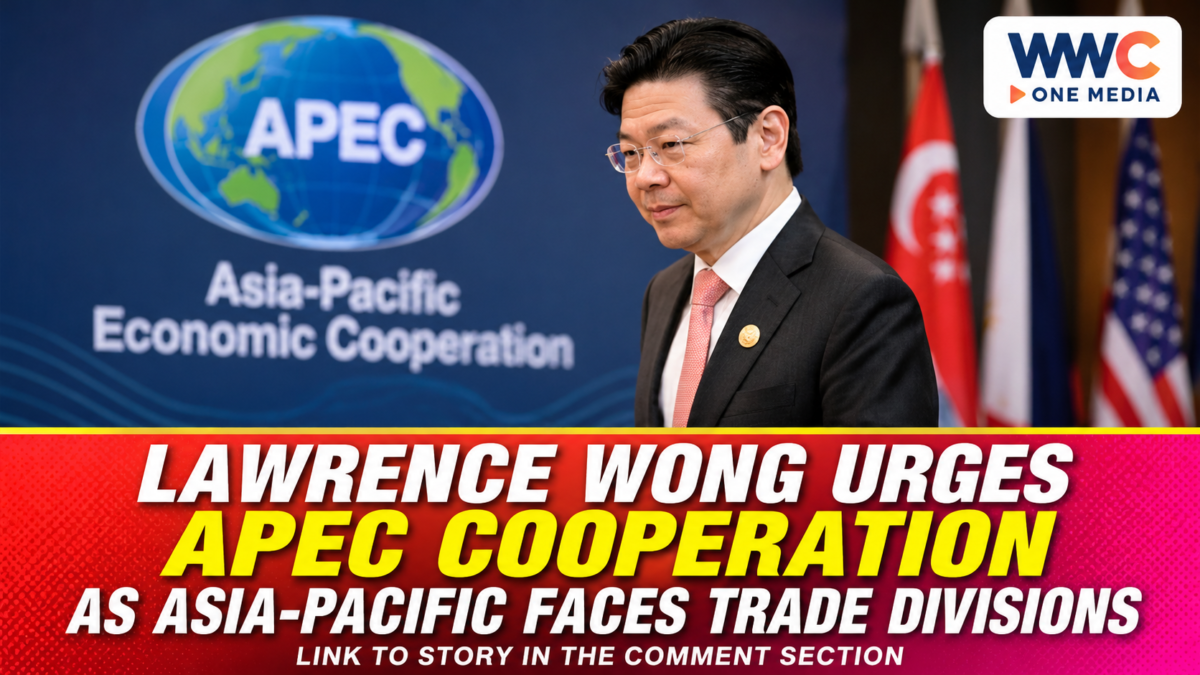
Singapore Prime Minister Lawrence Wong used the 33rd Asia-Pacific Economic Cooperation (APEC) Economic Leaders’ Meeting in Shenzhen on Nov. 19, 2026, to call for stronger regional cooperation as geopolitical tensions and economic fragmentation challenge established trade relationships.
His message went beyond defending open markets. Wong argued that economies should continue working together even when they cannot agree on every issue, while ensuring that regional cooperation produces practical benefits for businesses, workers and ordinary people.
The position matters to the Philippines, whose exporters, manufacturers and service providers depend on cross-border trade, international supply chains and access to major Asia-Pacific markets. The challenge is whether APEC economies can turn their shared objectives into improvements that companies can actually use.
APEC cooperation faces a more complicated trading environment
Wong’s remarks came as governments reassess economic relationships amid growing geopolitical tensions and concerns about national security.
He warned that the region was entering a more fragmented phase of globalisation. In his assessment, economies should not allow these pressures to divide the Asia-Pacific into competing economic blocs.
The Singapore prime minister identified openness and connectivity as priorities. He pointed to existing regional trade arrangements, including the Comprehensive and Progressive Agreement for Trans-Pacific Partnership (CPTPP) and the Regional Comprehensive Economic Partnership (RCEP), as foundations on which economies could continue building.
He also called for practical progress towards APEC’s long-term vision of a Free Trade Area of the Asia-Pacific (FTAAP).
That does not mean a region-wide free trade agreement has been completed. The FTAAP remains a long-term objective, and further work would be needed before businesses could benefit from any new common trade arrangements.
For companies operating across several economies, the distinction is important. Political support for integration does not automatically remove tariffs, simplify customs procedures or change market-access requirements.
Cooperation does not have to wait for complete agreement
Wong also addressed a practical problem facing multilateral organisations: reaching agreement among economies with different interests is becoming increasingly difficult.
His proposed approach was to allow willing participants to advance cooperation in areas where progress is possible, while keeping opportunities open for others to join later.
He pointed to initiatives at the World Trade Organization, including the Multi-Party Interim Appeal Arbitration Arrangement and the E-Commerce Agreement, as examples of cooperation involving participating members.
He also identified the Green Economy Partnership and the Future of Investment and Trade Partnership as initiatives that could help countries explore new areas of economic cooperation.
This approach recognises that regional progress does not always require every participating economy to move at the same speed.
However, flexible cooperation also creates a challenge. Different groups may adopt different rules or standards, potentially making the business environment more complicated if their arrangements are not compatible.
For smaller exporters, the value of cooperation will depend on whether the resulting procedures are understandable, affordable and accessible.
Paperless trade offers a practical example for businesses
One of the initiatives Wong highlighted was the APEC Centre of Excellence for Paperless Trade, conceived by Australia and Singapore together with the APEC Business Advisory Council.
The initiative aims to make it easier for businesses to exchange trade documents electronically across borders.
Paper-based documentation can add administrative work to international transactions. Companies may need to prepare, submit and verify multiple documents as goods move between suppliers, customs authorities, logistics providers and buyers.
Electronic document exchange could reduce some of that burden, provided participating economies recognise compatible systems and establish workable procedures.
For smaller businesses, the potential benefit is particularly relevant. A company with limited administrative staff may find complex documentation requirements more difficult to manage than a large multinational with dedicated trade-compliance teams.
Still, the initiative’s stated objective should not be mistaken for proof that every APEC economy has already adopted a common paperless-trade system.
The practical test will be whether businesses can use the systems across borders without having to repeat the same processes in different formats.
Artificial intelligence is becoming part of the regional trade agenda
Wong also called for APEC economies to cooperate on artificial intelligence, particularly in areas where shared approaches could help businesses and workers.
He identified AI safety, responsible use and productivity as possible areas for collaboration. He also said APEC could support adoption among small and medium-sized enterprises, encourage investment in AI infrastructure and help workers develop the skills needed to benefit from the technology.
The focus on smaller firms is significant because access to advanced technology is not evenly distributed.
Large companies may have the capital, technical teams and computing infrastructure needed to deploy AI systems. Smaller businesses may face higher barriers involving cost, expertise, cybersecurity and data management.
Regional cooperation could help spread knowledge and encourage more consistent approaches to responsible adoption. However, it cannot replace domestic investment in digital infrastructure, education and workforce development.
For the Philippines, the issue is not simply whether businesses adopt AI. It is whether local companies can use the technology to improve productivity, develop new services and compete in regional markets.
Why the Philippines should pay attention
The Philippines is closely connected to Asia-Pacific trade through exports, imports, manufacturing and services.
That makes regional rules and economic cooperation relevant to businesses that source components from neighbouring economies or sell finished products to customers abroad.
The changing investment environment also creates opportunities and risks. WWC’s report on shifting ASEAN supply chains and the Philippines’ ability to attract investment examines why companies are diversifying production and what the country needs to compete for a larger share of regional investment.
Trade relationships are also shaped by bilateral arrangements. The Philippines’ negotiations with Canada, for example, show how governments are pursuing additional market access while businesses wait for the final rules. The Philippines-Canada trade agreement negotiations illustrate why announcements must be distinguished from agreements that have entered into force.
Meanwhile, the country’s commercial relationship with the United States remains important. The wider US-Philippines trade framework and tariff issues demonstrate how policy decisions in major markets can affect exporters and manufacturers.
These issues reinforce the importance of predictable rules. Regional cooperation can help create better conditions for trade, but Philippine companies still need competitive products, reliable logistics, skilled workers and the ability to meet overseas standards.
What happens next
Wong’s remarks set out Singapore’s position at the leaders’ meeting, but they do not by themselves establish new obligations for APEC economies.
The next stage will depend on the decisions governments make through their own trade policies, regional initiatives and cooperation programmes.
For businesses, the most meaningful developments will be practical ones: recognised electronic trade documents, clearer cross-border procedures, wider access to digital tools and more opportunities to participate in regional supply chains.
The central question is therefore not whether APEC leaders support cooperation. It is whether that support produces measurable improvements for companies and workers across the region.
Frequently asked questions
What did Lawrence Wong say at the 2026 APEC meeting?
He called for an open and connected Asia-Pacific, more flexible cooperation among economies, and practical initiatives that help businesses, workers and communities.
Where was the 2026 APEC Economic Leaders’ Meeting held?
The 33rd APEC Economic Leaders’ Meeting was held in Shenzhen, China, on Nov. 18 and 19, 2026.
Is the Free Trade Area of the Asia-Pacific already in effect?
No. The FTAAP is a long-term APEC vision for regional economic integration. Wong called for further steps towards that objective, not the announcement of a completed free trade agreement.
How could APEC cooperation benefit Philippine businesses?
Potential benefits include more efficient cross-border documentation, improved digital connectivity, stronger regional supply chains and opportunities to use emerging technologies. These benefits depend on implementation by participating economies.
What role could AI play in APEC cooperation?
Wong identified AI safety, responsible use, productivity, support for small and medium-sized enterprises and worker skills as areas where APEC economies could work together.