Sudan’s prolonged armed conflict is deepening an education emergency that threatens millions of children, with children with disabilities facing additional barriers to schooling, protection and essential support. A UNICEF country programme document for 2026–2028 identifies conflict-related injuries, trauma and disrupted health services as factors increasing disability among children and leaving them vulnerable to exclusion and abuse.
The crisis presents a difficult challenge for Sudan’s education recovery: reopening schools will not automatically restore access for children who require additional assistance, accessible facilities, specialised support or alternative learning arrangements.
The distinction matters as humanitarian organisations attempt to rebuild education services while responding to displacement, damaged infrastructure and limited resources. Sudan’s recovery will depend not only on how many schools resume operations, but also on whether vulnerable learners can participate in them.
Sudan disability education crisis exposes a deeper problem
The scale of Sudan’s education emergency is already substantial.
In its country programme document submitted to the UNICEF Executive Board in February 2026, UNICEF reported that more than 13 million children were out of school at the beginning of 2025, compared with approximately seven million before the conflict.
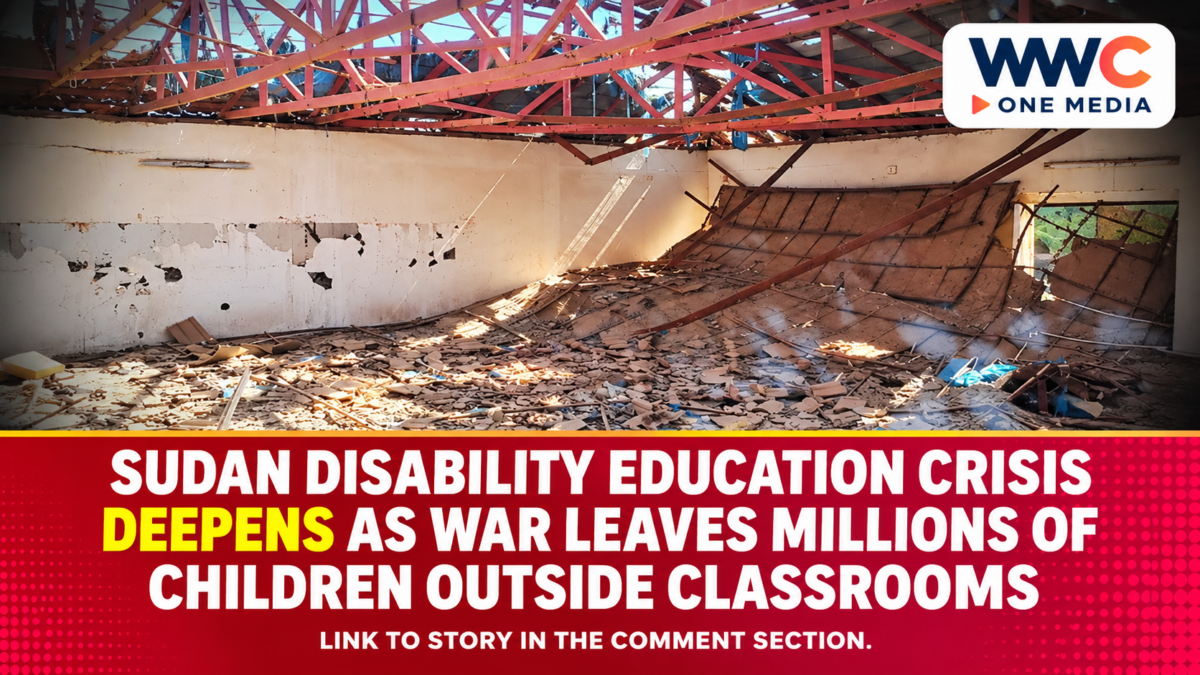
More than 10,000 primary schools remained closed, while over 2,500 were being used to accommodate internally displaced people.
The same document identifies another consequence of the conflict: an increase in children with disabilities resulting from injuries, trauma and interrupted health services.
These circumstances create overlapping disadvantages. A child displaced by fighting may already have lost access to school, family support and familiar surroundings. If that child also has a disability, returning to education can involve additional requirements that an ordinary school reopening programme might not address.
UNICEF specifically identifies children with disabilities as a priority group for its education and protection interventions. UNICEF Global+1
Millions of children remain disconnected from learning
The education emergency extends beyond individual school closures.
Sudan’s conflict has disrupted teachers’ work, the distribution of learning materials and the availability of safe learning environments. Displacement has also changed where families live, making it harder for children to return to their previous schools.
UNICEF’s mid-year humanitarian situation report for January to June 2026 documented more than eight million school-aged children out of school, from an estimated population of 17 million.
The report also found that 63 per cent of schools nationwide were operational. However, the situation was considerably worse in Darfur, where 81 per cent of schools remained closed and 70 per cent of children were not attending school.
These figures show why national reopening statistics cannot fully describe the education situation. Access varies significantly between regions, and children in areas affected by insecurity face particularly difficult conditions.
The same report identified disrupted schooling in Kadugli and Dilling, where insecurity continued to restrict humanitarian access and service delivery, particularly affecting girls, displaced children and children with disabilities. UNICEF Global
Children with disabilities need more than reopened classrooms
For children with disabilities, access to education involves more than having a functioning school building.
Depending on individual needs, meaningful participation can require accessible classrooms, appropriate learning materials, assistive technology, trained teachers, communication support and reliable access to health and rehabilitation services.
These are important considerations in a country where conflict has weakened several systems that ordinarily support children’s education and development.
UNICEF’s 2026–2028 Sudan programme explicitly proposes expanding safe and accessible learning spaces and prioritising displaced children, girls and children with disabilities.
Its planned interventions also include teacher training, school grants, psychosocial support, inclusive school environments and assistive technology.
These commitments are significant because they recognise that education recovery must address the circumstances preventing children from participating, rather than simply increasing enrolment figures.
However, a programme commitment is not proof that all these services are already operating nationwide. Their implementation will depend on resources, security conditions, humanitarian access and coordination with local education authorities. UNICEF Global
The importance of specialised support is also relevant beyond Sudan. WWC previously examined the need for additional specialists in Philippine schools in its report on DepEd’s inclusive education staffing requirements.
Humanitarian programmes are providing support, but gaps remain
There are measurable efforts to help children affected by the conflict.
UNICEF’s January–June 2026 situation report recorded that 940,757 people received community-based mental health and psychosocial support services.
Of those beneficiaries, 766,400 were children, including 54,000 children with disabilities.
The services were delivered through child-friendly spaces, schools, nutrition centres, community platforms and integrated protection programmes.
The report also recorded 5,500 unaccompanied and separated children receiving support through family tracing, reunification, alternative care arrangements and referrals. This group included 138 children with disabilities.
These figures demonstrate that disability inclusion is already part of some humanitarian protection activities. However, they should not be interpreted as the number of disabled children receiving education. The reported figures concern psychosocial and protection services, which are different from school enrolment and classroom participation. UNICEF Global
The broader education response also faces financial pressure.
By June 30, UNICEF had mobilised US$351.1 million against its 2026 humanitarian appeal of approximately US$963 million, leaving a reported funding gap of US$611.8 million.
That shortfall creates additional uncertainty over how consistently programmes can reach children in areas where assistance is most difficult to deliver. UNICEF Global
New education initiatives face difficult operating conditions
On May 4, 2026, UNICEF, Save the Children and partners launched the Building Resilience to Improve Development and Growth in Education in Sudan programme, known as BRIDGES.
The initiative aims to help more than 328,000 conflict-affected children return to learning between 2026 and 2028.
Its plans include reopening approximately 850 schools across seven conflict-affected states, supporting more than 9,000 teachers and establishing nearly 1,800 safe learning spaces.
The programme also includes support for teaching materials, school grants and improvements to education planning.
These measures could help restore learning opportunities for children whose education has been interrupted.
Nevertheless, the programme’s announced targets should not be confused with completed results. Its ability to reach children with disabilities will also depend on whether accessibility and specialised support are incorporated into implementation at individual schools and learning centres. UNICEF Global
The obstacles are not limited to school buildings.
On September 22, UNICEF reported that drone strikes on two warehouses in Shikan locality, North Kordofan, destroyed more than 292,000 textbooks, 40,000 Arabic Language and Mathematics Review Books, and other educational materials.
The supplies had been intended for distribution ahead of the October 2026 school year.
The incident illustrates how insecurity can undermine education programmes even when funding, teachers and reopening plans are available. UNICEF Global
The wider issue of student support is also explored in WWC’s reporting on the shortage of guidance counsellors in Philippine schools, highlighting why educational participation involves more than classroom availability.
What this means for Sudan’s education recovery
Sudan’s education emergency is also a question of inclusion.
Restoring classrooms without considering accessibility could leave some children unable to benefit from the recovery. Children with disabilities may require additional assistance precisely when conflict has weakened the services and institutions that would ordinarily provide it.
There is also a long-term economic dimension.
Education interruptions can reduce future opportunities for employment, skills development and participation in community life. When children already facing barriers are excluded for extended periods, the consequences can extend well beyond the duration of the conflict.
This makes disability-inclusive education an important part of national recovery, rather than a separate humanitarian concern.
The same principle applies to education reforms elsewhere. As WWC discussed in its examination of Philippine education performance and learning recovery, improvements in national education indicators must ultimately translate into meaningful learning opportunities.
What happens next
The next major test is whether Sudan’s education recovery programmes can translate their commitments into sustained access for children in conflict-affected communities.
Key developments to watch include the reopening of schools, the delivery of accessible learning materials, teacher recruitment and training, assistive technology provision and the expansion of child protection services.
The implementation of the BRIDGES programme through 2028 will also be important.
For children with disabilities, progress should be measured not simply by the number of schools reopened, but by whether they can enrol, attend regularly, participate in lessons and receive the support necessary to continue learning.
Until those conditions are established, a return to schooling will remain out of reach for some of Sudan’s most vulnerable children.