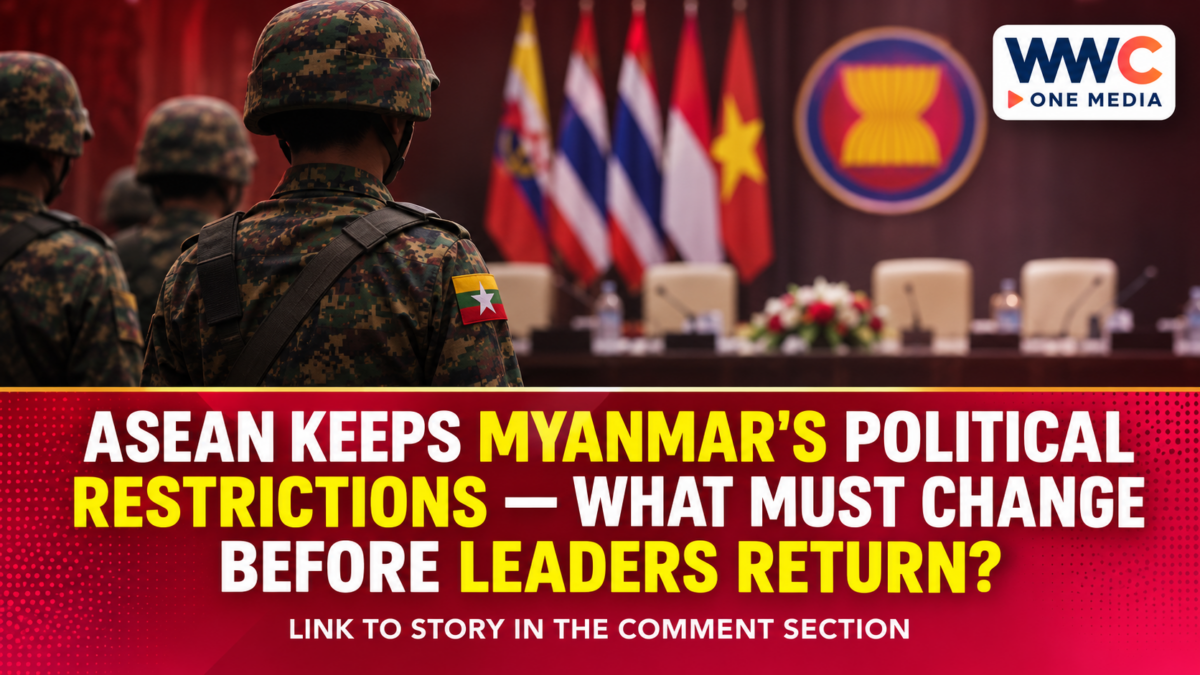
MANILA, Philippines — ASEAN leaders decided on Nov. 15, 2026, to maintain Myanmar’s restricted political representation at the regional bloc’s highest-level meetings. The decision, adopted in Manila, tied any eventual restoration of full representation to meaningful progress under ASEAN’s Five-Point Consensus.
The latest ASEAN Myanmar restrictions do not remove the country from the regional organisation. Instead, they preserve a distinction between participation in ASEAN’s political leadership meetings and continued cooperation through its other ministerial bodies.
The decision reveals a difficult diplomatic balance: ASEAN wants to keep communication open while avoiding the appearance that normal political representation has returned without sufficient progress towards peace.
ASEAN Myanmar restrictions remain tied to peace progress
The Nov. 15 decision maintains the policy of allowing only non-political representation from Myanmar at ASEAN summits and foreign ministers’ meetings.
It also explicitly states that Myanmar’s participation in other ASEAN sectoral ministerial bodies and mechanisms should remain unrestricted at all levels.
That distinction is central to understanding the policy.
Myanmar has not been expelled or suspended from ASEAN membership. The restrictions instead apply to political representation at specific high-level gatherings.
The decision also provides a possible route towards restoring full representation, but it does not offer automatic reinstatement.
ASEAN may consider a gradual restoration if Myanmar demonstrates sustained and concrete progress in implementing the Five-Point Consensus.
This means diplomatic engagement, by itself, is not enough to guarantee a change in representation.
WWC previously examined the formal basis for these measures in its report on Myanmar’s political restrictions at ASEAN meetings.
Why the Five-Point Consensus remains central
ASEAN adopted the Five-Point Consensus in April 2021 as its framework for addressing Myanmar’s political crisis.
The November decision reaffirmed that framework as the regional organisation’s main reference for pursuing a peaceful and durable settlement.
ASEAN leaders expressed concern about continuing conflict and the humanitarian situation. They called for an end to violence against civilians, protection of civilian infrastructure and conditions that would permit humanitarian assistance and inclusive political dialogue.
The leaders also urged the parties involved, including armed forces, security forces and armed groups, to reduce violence and support confidence-building measures.
These commitments do not establish that a ceasefire is in force or that comprehensive negotiations have begun.
They identify the conditions ASEAN considers necessary for progress.
The distinction is important because a diplomatic declaration and an improvement in conditions inside Myanmar are not the same thing.
For a regional bloc seeking to maintain a common position, the next challenge is determining which developments amount to meaningful implementation rather than expressions of willingness to cooperate.
Humanitarian assistance offers limited measurable progress
ASEAN’s November review acknowledged that humanitarian work had advanced in some areas despite insufficient overall implementation of the peace framework.
The document welcomed an ASEAN Coordinating Centre for Humanitarian Assistance on disaster management monitoring mission to Myanmar on Oct. 28, 2026.
That mission marked the beginning of a month-long distribution programme intended to support more than 11,000 households, including communities in four priority townships not previously reached by the AHA Centre.
This is one of the measurable developments recorded in the decision.
However, the announcement of a distribution programme does not independently establish that every intended household received assistance.
ASEAN’s overall assessment remained cautious, describing progress under the Five-Point Consensus as insufficient and progress in humanitarian assistance as limited.
The leaders called for aid to reach internally displaced people and communities that humanitarian operations had not yet served.
They also encouraged regional and international partners to provide financial support for continued assistance.
Why it matters: Humanitarian delivery provides a practical way to evaluate cooperation, but access to additional communities alone does not establish that the wider political crisis has been resolved.
WWC has separately explored the interaction between diplomacy and humanitarian conditions in its analysis of Myanmar’s peace framework and prospects for political engagement.
Diplomacy continues despite restrictions
ASEAN’s policy is not a complete withdrawal from dialogue with Myanmar.
The November decision recognised the diplomatic work of Philippine Foreign Affairs Secretary Ma. Theresa P. Lazaro, who served as the ASEAN Chair’s Special Envoy on Myanmar.
Her recorded engagements included visits to Nay Pyi Taw on Jan. 6 and Oct. 29, 2026.
The decision also welcomed discussions involving different Myanmar stakeholders, including meetings in Tagaytay in January and Pattaya, Thailand, in July.
These engagements illustrate the regional organisation’s effort to maintain channels with parties involved in Myanmar’s conflict.
But contact between officials and stakeholders is not itself a settlement.
ASEAN continues to seek an inclusive national political dialogue and sustained action to reduce violence.
The leaders also encouraged coordination with neighbouring countries and international organisations.
Thailand’s diplomatic involvement is one example of the wider regional effort, explored in WWC’s coverage of Thailand’s attempts to support Myanmar peace discussions.
The central question is whether these separate contacts can support a credible process that produces measurable results.
Singapore inherits an unresolved ASEAN challenge
The Nov. 15 decision did not establish a deadline for restoring Myanmar’s full political representation.
Instead, it directed ASEAN foreign ministers to continue monitoring implementation and report to the next ASEAN Summit.
The leaders also called for stronger coordination between previous, current and incoming ASEAN chairs.
They acknowledged continuing discussions over a possible longer-term special envoy arrangement and methods for assessing progress.
Neither measure was presented as a completed institutional reform.
Singapore’s 2027 ASEAN chairmanship will therefore inherit an established policy, but also unresolved questions about implementation and continuity.
ASEAN additionally identified displacement, human trafficking, drug trafficking, cyber threats and online scams as regional security concerns requiring cooperation.
These issues demonstrate why Myanmar’s crisis cannot be treated solely as a question of who occupies a seat at a summit.
The broader challenge involves regional security, civilian protection and the effectiveness of collective diplomacy.
WWC’s assessment of ASEAN’s transition to Singapore’s 2027 chairmanship examines how unfinished commitments will carry over into the next leadership term.
What happens next
Three questions will determine the significance of ASEAN’s November decision.
First, will conditions inside Myanmar improve sufficiently for ASEAN to identify meaningful progress under the Five-Point Consensus?
Second, can humanitarian operations expand their reach while protecting civilians and ensuring assistance is delivered without discrimination?
Third, will ASEAN develop a consistent method for assessing progress before considering the restoration of political representation?
The November decision leaves these questions open.
For now, the regional organisation has chosen continued engagement with conditions rather than either full political normalisation or complete disengagement.
The outcome will depend less on the number of diplomatic meetings held than on whether their results can be demonstrated through developments on the ground.