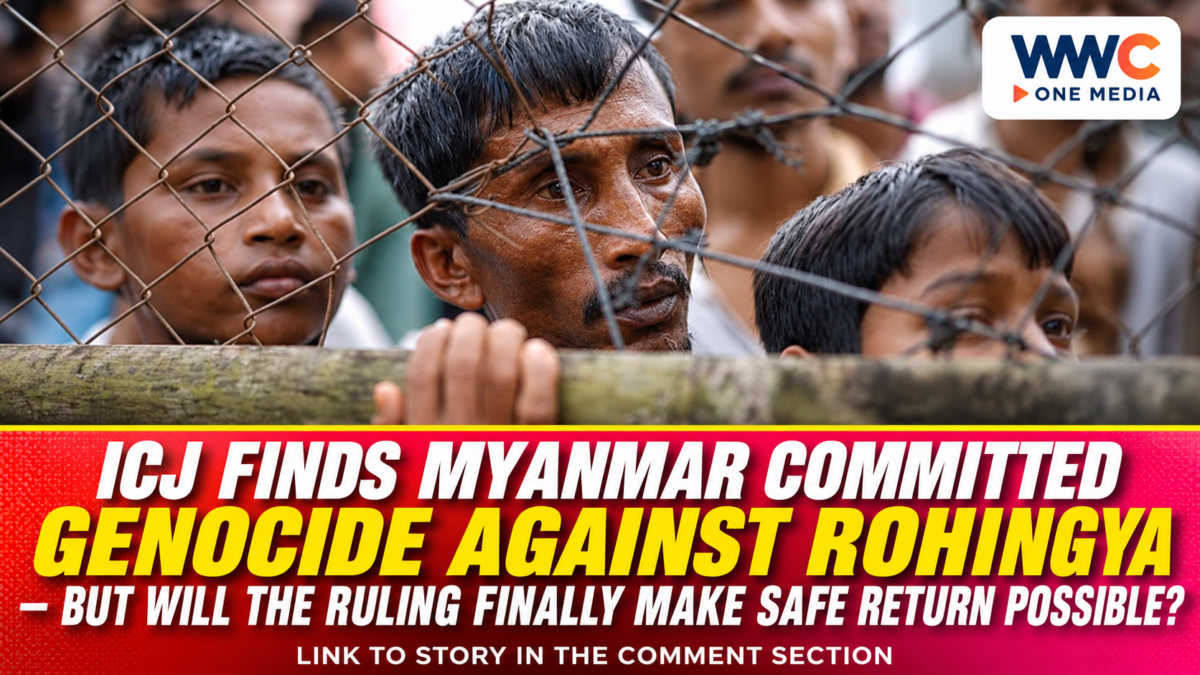
The International Court of Justice (ICJ) ruled on Nov. 19, 2026, that Myanmar committed genocide against the Rohingya in northern Rakhine State during the 2017 military clearance operations, marking a major legal finding in a case brought by The Gambia.
The 15-member court reached the central finding by nine votes to six. It also ordered Myanmar to investigate suspected perpetrators, take steps to prevent similar crimes, facilitate the return of displaced Rohingya under specified conditions and provide compensation for damage that cannot be repaired through restitution.
The decision establishes Myanmar’s responsibility as a state under the Genocide Convention. It does not convict individual military officers or government officials, and it does not automatically make it safe for refugees to return home.
For the Rohingya, many of whom remain displaced outside Myanmar, the next challenge is turning a binding international judgment into protection, accountability and meaningful remedies.
What the court actually decided
The case, formally titled Application of the Convention on the Prevention and Punishment of the Crime of Genocide (The Gambia v. Myanmar), began on Nov. 11, 2019.
The Gambia brought the proceedings over alleged violations of the 1948 Genocide Convention involving the Rohingya population. The court’s judgment, delivered on Nov. 19, found that Myanmar had committed genocide against the group in northern Rakhine State.
The judges also found that Myanmar violated its obligation to prevent genocide by individuals acting alongside its security forces. Separately, the court found that Myanmar had breached its duty to punish genocide and enact the legislation necessary to implement the convention.
The decision was not unanimous. The central genocide finding was adopted by nine votes to six, while other parts of the ruling had different voting results.
One important distinction concerns incitement. By 14 votes to one, the court found that Myanmar had not directly and publicly incited the commission of genocide against the Rohingya by private persons in northern Rakhine State. That finding does not overturn the court’s separate conclusion that Myanmar committed genocide.
Why the 2017 operations were central to the case
The judgment examined events surrounding the military operations in northern Rakhine State in 2016 and 2017.
The court assessed evidence concerning killings, serious bodily and mental harm, conditions of life imposed on the Rohingya, and measures intended to prevent births within the group. It also examined the broader historical context, including discriminatory laws and policies, hate speech, the targeting of Rohingya communities and the destruction of villages.
Myanmar had maintained that its operations were necessary to counter an insurgency by the Arakan Rohingya Salvation Army. The court considered the parties’ arguments and evidence before reaching its conclusions under the Genocide Convention.
The legal question was not simply whether serious violence occurred. The court also had to determine whether the prohibited acts were committed with the specific intent required for genocide.
Its judgment therefore represents a state-responsibility finding based on the evidence and legal standard applied in the proceedings. It is not merely a political declaration or a repetition of allegations made during the case.
Myanmar must investigate and provide remedies
The court ordered Myanmar to take immediate and effective steps to investigate all persons reasonably suspected of committing acts contrary to Article III of the Genocide Convention in relation to the 2017 operations.
Where warranted, those investigations must lead to prosecution and punishment. The order does not mean that particular individuals have already been found criminally guilty; individual responsibility requires separate investigations and judicial proceedings.
The court also directed Myanmar to cease ongoing violations of its obligations by enacting legislation that gives full effect to the convention. It required assurances and guarantees that similar violations will not be repeated.
Reparations form another major part of the ruling.
The court decided that Myanmar must adopt measures of restitution for the Rohingya. These include measures relating to the safe, voluntary and dignified return of displaced people and the reunification of families.
It also ruled that Myanmar must compensate the Rohingya group and its members for damage that is not made good through restitution.
The amount and method of compensation have not yet been fixed. Myanmar must submit a report to the court within two years of the judgment, setting out the restitution measures adopted and, where full restitution is materially impossible, the amount and arrangements for compensation.
A binding judgment does not automatically bring refugees home
The legal decision comes against the background of a prolonged displacement crisis.
Bangladesh continues to host a large Rohingya refugee population, while communities also live in other countries across the region. Many have spent years outside Myanmar, facing uncertainty over legal status, education, employment and access to basic services.
The court’s return-related remedies are significant, but they do not establish that conditions on the ground are already safe. A legal obligation to facilitate return is not the same as proof that refugees can presently go home without facing renewed danger or discrimination.
This distinction is particularly important as neighbouring countries consider their own policies towards Myanmar nationals.
Malaysia’s discussions about possible returns have already raised questions about whether repatriation can be genuinely voluntary and safe. WWC has examined Malaysia’s proposed talks with Myanmar over Rohingya repatriation and the concerns surrounding the country’s return programme.
The ICJ judgment adds an important legal dimension to that debate. Any return policy must be assessed against the requirement that displaced Rohingya can return safely, voluntarily and with dignity.
The ruling does not end individual accountability
The ICJ resolves legal disputes between states. It does not operate as a criminal court for trying individual military commanders or other alleged perpetrators.
That means the ruling and any future criminal prosecutions serve different legal purposes.
The court has determined Myanmar’s responsibility under the Genocide Convention. Separate criminal proceedings would be needed to establish whether particular individuals bear personal criminal responsibility and, if so, what penalties they should face.
The United Nations Independent Investigative Mechanism for Myanmar has collected and analysed evidence to support criminal accountability processes. It has said that the ICJ judgment is an important milestone, but that the wider pursuit of accountability must continue.
This distinction matters because a state-level judgment cannot by itself identify, try and sentence every person who may have participated in crimes.
The wider situation in Myanmar also remains relevant. The country’s continuing conflict and humanitarian challenges affect the prospects for civilian protection and the implementation of any return arrangements. WWC’s coverage of ASEAN’s continuing restrictions on Myanmar’s political engagement provides further context for the regional diplomatic environment.
What happens next
Myanmar is now bound by the court’s final judgment in the case. The next formal steps include implementing the ordered measures, investigating suspected perpetrators and preparing the report on restitution and compensation within the two-year period.
The court has reserved the question of the amount and modalities of compensation for a subsequent phase of the proceedings. It will consider the matter after receiving Myanmar’s report and the views of the parties.
The international community will also face the task of supporting compliance and ensuring that humanitarian needs do not disappear from view after the legal milestone.
For Rohingya refugees, the most immediate test is whether the ruling contributes to real protection, recognition of rights and conditions that make a safe and voluntary return possible.
The judgment has answered a major question about Myanmar’s responsibility under international law. It has not yet resolved the practical question of how the Rohingya can rebuild their lives.
Frequently asked questions
Did the ICJ rule that Myanmar committed genocide against the Rohingya?
Yes. On Nov. 19, 2026, the court found by nine votes to six that Myanmar committed genocide against the Rohingya group in northern Rakhine State, in violation of the Genocide Convention.
Can the ICJ imprison Myanmar’s military leaders?
No. The ICJ decides legal disputes between states. It cannot conduct criminal trials or impose prison sentences on individual people. Individual criminal responsibility requires separate proceedings.
Did the court order Myanmar to compensate Rohingya victims?
Yes. The court ruled that Myanmar must compensate the Rohingya group and its members for damage not made good through restitution. The amount and payment arrangements will be determined in a later phase.
Does the ruling mean Rohingya refugees can immediately return to Myanmar?
No. The court ordered measures concerning safe, voluntary and dignified return, but the judgment does not establish that conditions are already safe. Actual returns must meet the required protections.
When must Myanmar report on its reparations measures?
Myanmar must submit a report to the ICJ within two years of the Nov. 19, 2026 judgment. The report must set out restitution measures and, where necessary, the amount and modalities of compensation.