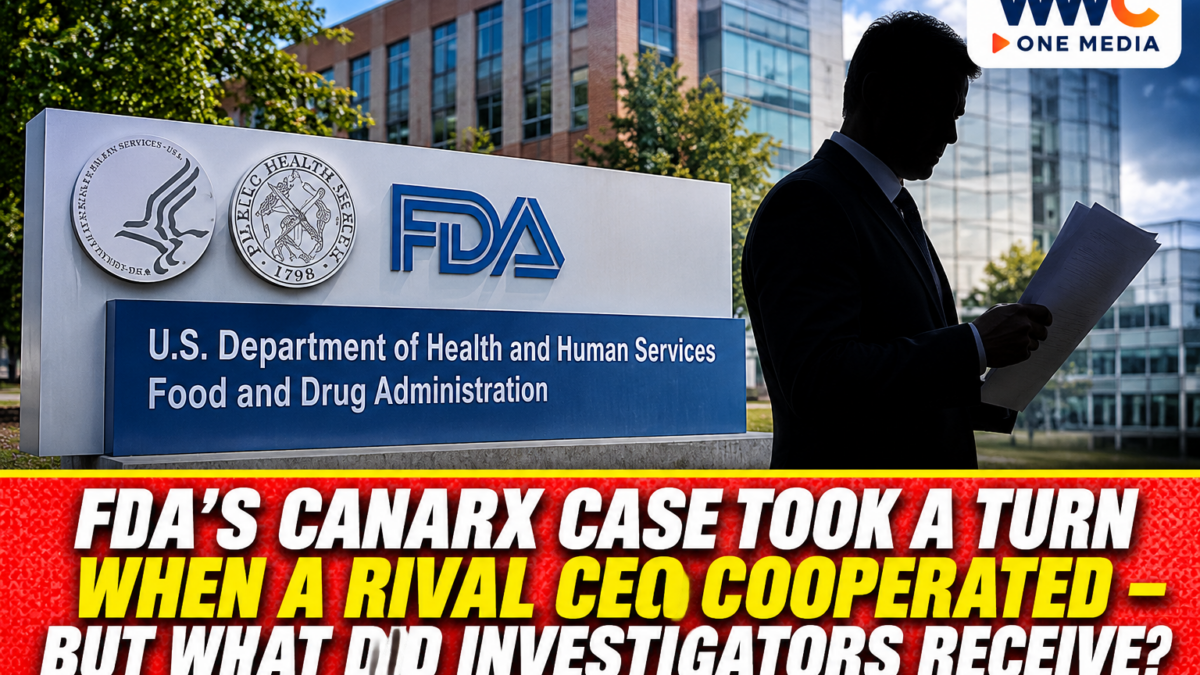
A federal criminal investigation into Canadian prescription drug provider CANARX gained a significant new dimension when the chief executive of a competing prescription-sourcing business agreed to cooperate with US investigators, according to an affidavit filed in federal court.
Gary Becker, the chief executive of ScriptSourcing, became a cooperating witness on or about May 26, 2026, the sworn affidavit of Food and Drug Administration special agent Dustin Dobbs states. Becker agreed to provide information and make telephone calls at the direction of the FDA’s Office of Criminal Investigations.
The affidavit, filed on Oct. 29 in the US District Court for the Western District of Virginia, describes how investigators used Becker’s cooperation to examine the relationship between ScriptSourcing and CanaRx Services Inc., also referred to in the document as CRX.
The disclosure matters because Becker was not an outside observer with no connection to the business under investigation. The affidavit says ScriptSourcing had worked with CRX to facilitate the importation of prescription medicines from foreign pharmacies into the United States. It also identifies Becker as a responsible corporate officer of ScriptSourcing in the alleged criminal activity.
The cooperating witness had a business relationship with CANARX
The affidavit says Becker told investigators that CRX was one of the companies he worked with to facilitate international prescription drug imports. He also said CRX provided a roadmap for operating an international prescription programme.
Investigators described ScriptSourcing as a company that marketed international prescription programmes to employer-sponsored health plans. The business model involved coordinating between employers, employees and foreign pharmacies to obtain medicines from outside the United States.
The affidavit says Becker provided investigators with information about CRX and participated in recorded telephone conversations with John Thomas Howard and, in one call, his brother Bob Howard.
Those conversations became part of the evidence presented in support of the arrest warrant. The allegations remain unproven, and the affidavit represents the investigator’s account of the evidence, not a court finding of guilt.
Records detail thousands of medicines and millions of dollars
One of the most significant disclosures concerns financial and shipment records supplied during the investigation.
The affidavit says Becker’s legal counsel provided an updated spreadsheet on or about Oct. 1, 2026, covering financial transactions between CRX and ScriptSourcing from Jan. 1, 2021, to Sept. 21, 2026.
The spreadsheet indicated that approximately 16,549 prescription drugs had been dispensed in connection with the alleged arrangement. Approximately 238 were shipped to locations within Virginia’s Western District.
The records also showed payments from ScriptSourcing to CRX totalling US$6,263,406.96 across the years listed from 2021 through 2026. Payments in the opposite direction totalled US$2,695.83.
The investigator stated that there was probable cause to believe the payments were not made for a legitimate business purpose. That is the government’s allegation at the warrant stage, not a final judicial determination about the transactions.
A separate shipment list covered 515 shipments of FDA-regulated medications into the Western District of Virginia between Feb. 22, 2017, and April 15, 2026. Of those, 187 were recorded between Jan. 1, 2021, and April 15, 2026.
These figures describe records cited by investigators. They should not be interpreted as the number of patients harmed, the number of counterfeit medicines, or a final count of unlawful prescriptions.
Recorded calls and intercepted shipments added to the investigation
The affidavit also describes several recorded calls between Becker and the Howard brothers in June and July 2026.
In one conversation dated June 17, Becker discussed increased scrutiny of international prescription imports. The affidavit says John Howard discussed the company’s order reporting and the handling of packages delayed at the border.
A July 6 call involved both Howard brothers and Becker. The investigator said the conversation concerned a customer whose shipment of Jardiance had attracted the attention of federal agents.
The affidavit further says Becker’s legal counsel provided information about shipments being prepared or already in transit. One package identified in the investigation contained Neupro, a prescription medicine, and was examined at John F. Kennedy International Airport.
The investigator said the packaging indicated that the medicine was intended for the United Kingdom market. The affidavit treated this as evidence that the product was not approved for the US market.
These details form part of the government’s probable-cause presentation. They do not establish that every shipment handled by the companies involved contained an unlawful or unsafe product.
Why the witness’s role deserves scrutiny
Becker’s cooperation is important to the case, but his position also calls for careful examination.
The affidavit describes ScriptSourcing as a participant in the alleged arrangement and identifies Becker as a responsible corporate officer. The investigator’s conclusion states that there was probable cause to believe ScriptSourcing, CRX and the individuals identified in the document had engaged in the alleged importation and conspiracy offences.
That means Becker’s information is being presented in the context of his own company’s business relationship with CRX. His cooperation may have helped investigators obtain records and conversations, but the affidavit alone does not establish the terms of any agreement with prosecutors or whether Becker received immunity or other consideration.
The records cited in the affidavit go beyond Becker’s statements. They include spreadsheets, emails, recorded conversations and details of packages examined by investigators. Those materials are part of the government’s case, but their evidentiary weight will ultimately be tested through legal proceedings.
The regulatory dispute predates the criminal investigation
The FDA’s concerns about CanaRx were not first raised in the October 2026 affidavit.
On Feb. 26, 2019, the agency issued a warning letter to CanaRx Services Inc. addressed to Gregory Anthony Howard. The letter alleged that the company was facilitating the distribution of unapproved and misbranded prescription medicines to US consumers and asked it to stop the distribution of products the agency considered violative.
The FDA described a model in which the company acted as an intermediary between employer-sponsored health plans and pharmacies outside the United States. It raised concerns about differences in product labelling, regulatory approval and safeguards available through the US drug supply chain.
The 2019 warning letter was a regulatory action, not a criminal conviction. The 2026 criminal case involves separate allegations and evidence presented by an FDA investigator.
The legal distinction matters because a regulatory warning, an arrest warrant and a criminal conviction are different stages of enforcement.
What happens next
The criminal case against John Thomas Howard and Bob Howard remains subject to the federal court process. The affidavit was submitted to establish probable cause for the requested arrest warrant, not to determine guilt beyond a reasonable doubt.
The government’s evidence, including the cooperating witness’s account and the records he supplied, will have to withstand scrutiny in court. Any defence response, challenges to the evidence and subsequent judicial decisions will be important to understanding the case.
For employers and patients, the investigation also raises broader questions about prescription programmes that source medicines internationally to reduce costs. Lower prices do not by themselves establish that a medicine has been approved for distribution in the United States or that it has passed through the country’s required supply-chain controls.
The central issue is therefore not simply how much money the companies exchanged or how many shipments appeared in the records. It is whether the government can prove that the businesses and individuals involved knowingly operated outside the legal framework governing prescription drug imports.