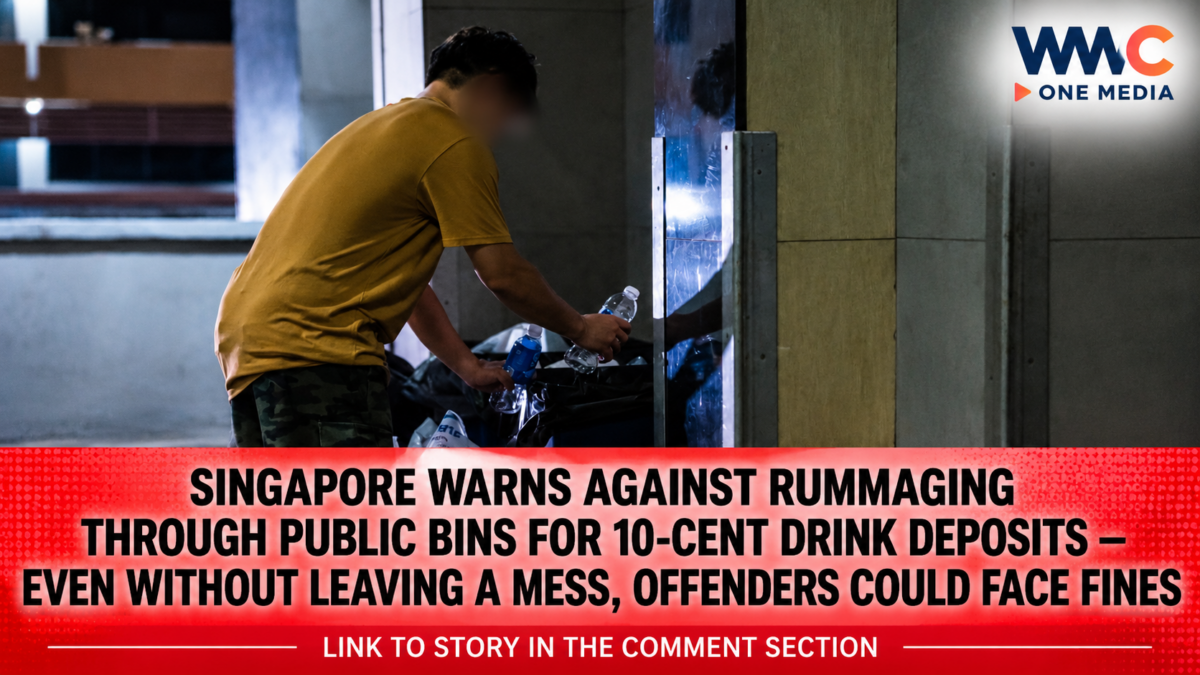
SINGAPORE — Singapore residents who search public rubbish bins for empty drink bottles and cans to collect refundable deposits could face enforcement action, even if they leave the surrounding area clean, Sustainability and the Environment Minister Grace Fu has clarified.
Speaking in a written parliamentary reply on November 3, Fu said members of the public are discouraged from rummaging through refuse bins to retrieve beverage containers under the country’s Beverage Container Return Scheme (BCRS).
Her clarification addresses growing concerns about people searching rubbish bins for eligible bottles and cans that can be exchanged for a 10-cent refund at designated Return Right machines.
The issue has become more visible since Singapore’s nationwide recycling programme entered full operation on October 1, following a six-month transition period.
While the scheme has encouraged more people to return their empty containers, authorities are also dealing with concerns about hygiene, public cleanliness and the safety of individuals who search through discarded waste.
Fu stressed that rummaging through public refuse bins or removing items from them is already covered by Singapore’s public-cleansing regulations.
The key point is that the act itself can constitute an offence, regardless of whether rubbish is scattered on the ground.
GRACE FU: BIN RUMMAGING IS DISCOURAGED EVEN WITHOUT LITTERING
Fu made the clarification in response to a parliamentary question from Punggol GRC MP Yeo Wang Ling.
The MP asked how authorities would approach enforcement against people removing beverage containers from public refuse bins, particularly when their actions did not result in scattered rubbish or other visible public hygiene problems.
Fu explained that there are concerns beyond the appearance of the surrounding area.
Searching through rubbish bins can expose individuals to contaminated waste, sharp objects and other potentially hazardous materials. It can also create discomfort for other members of the public who share the same spaces.
The minister said the National Environment Agency (NEA) considers the circumstances when deciding whether enforcement action is appropriate.
Where individuals are found searching public refuse bins without leaving litter on the ground, NEA officers may issue an advisory.
This does not mean that the activity is permitted.
Rather, it reflects the agency’s calibrated approach, which considers the behaviour observed and the circumstances surrounding the incident.
The distinction is important: leaving the area clean may influence how authorities respond, but it does not automatically make removing items from a public refuse bin lawful.
WHAT PENALTY COULD BIN RUMMAGERS FACE?
Singapore’s Environmental Public Health (Public Cleansing) Regulations prohibit people from combing through refuse bins or removing items from them.
According to Fu, a first offence can carry a fine of up to S$1,000.
A further S$100 may be imposed for each day the offence continues.
The regulations are intended to protect public cleanliness and prevent activities that could undermine the proper management of refuse.
The rules also mean that people cannot assume discarded beverage containers are free for collection simply because they have been thrown away.
Under the BCRS, consumers are encouraged to return eligible containers through designated collection points rather than search through public rubbish bins.
The scheme’s environmental objectives do not override existing public-cleansing requirements.
NEA MAY REFER VULNERABLE INDIVIDUALS TO SOCIAL SUPPORT SERVICES
Fu also explained that the authorities’ response is not limited to issuing warnings or imposing fines.
Before the BCRS was introduced, NEA occasionally received feedback about people searching through public refuse bins.
The agency’s approach has generally prioritised public education and encouraging good hygiene practices.
When officers encounter people rummaging through bins, they may first provide an advisory, depending on the circumstances.
Authorities may also refer individuals who appear to be vulnerable to social service agencies for additional assistance.
Fu said the Ministry of Social and Family Development and its community partners use the Vulnerable-in-Community Network to connect with people who may require support.
The network helps agencies understand an individual’s circumstances and identify suitable assistance.
This approach recognises that not everyone collecting discarded bottles and cans is motivated by the same reasons.
Some may be trying to earn additional money, while others may be experiencing financial or social difficulties.
By combining enforcement with possible social support, authorities can address public hygiene concerns without overlooking the circumstances of vulnerable individuals.
MORE THAN 48 MILLION CONTAINERS COLLECTED UNDER THE SCHEME
The clarification comes as Singapore’s beverage-container return programme records substantial participation.
As of September 27, more than 48 million beverage containers had been collected under the BCRS.
The average number of containers returned in each transaction also increased significantly.
In April, the average stood at 2.8 containers per transaction. By September, it had climbed to 8.2.
The figures suggest that more consumers are becoming familiar with the return process and are bringing larger quantities of eligible bottles and cans to collection machines.
The collected materials are also contributing to Singapore’s recycling objectives.
According to the NEA’s October 1 update, approximately 55 per cent of the collected materials were plastic, while the remaining 45 per cent were metal.
The scheme is designed to encourage consumers to return eligible packaging instead of throwing it into general waste.
It also aims to improve the quality of recyclable materials collected and reduce the amount of waste sent for disposal.
HOW SINGAPORE’S 10-CENT BEVERAGE DEPOSIT SCHEME WORKS
The BCRS began on April 1, 2026, introducing a refundable deposit on eligible pre-packaged drinks sold in Singapore.
Consumers pay an additional S$0.10 when purchasing a regulated beverage container. They can recover the deposit by returning the empty container at a designated Return Right reverse vending machine.
The programme covers eligible plastic and metal beverage containers between 150 millilitres and three litres that carry the official BCRS Deposit Mark.
The deposit follows the container, meaning the person who returns an eligible container can claim the refund, subject to the scheme’s requirements.
The machines scan the container’s barcode and verify whether it qualifies for the refund.
Containers generally need to be empty and should not be crushed because the barcode must remain readable.
The system is intended to make recycling more convenient while encouraging consumers to take responsibility for beverage packaging.
Singapore introduced a six-month transition period from April 1 to September 30 to allow producers and retailers to clear older stock without the required deposit mark.
From October 1, regulated beverage products supplied in Singapore must carry the deposit mark and include the refundable deposit, subject to applicable approved arrangements.
WHY SOME PEOPLE ARE SEARCHING THROUGH RUBBISH BINS
The 10-cent refund may appear small, but collecting many eligible containers can produce a larger amount.
For people who gather bottles and cans from multiple locations, the potential return may provide an additional source of income.
The practice has drawn attention in several Singapore neighbourhoods.
In September, residents raised concerns about individuals searching rubbish bins for recyclable materials and leaving waste scattered around public areas.
One incident at Aljunied Crescent reportedly involved an elderly man who residents said had been turning rubbish bins upside down while searching for bottles, cans and other recyclable items.
Residents complained that discarded food scraps and rubbish left on the ground could attract birds and create unpleasant conditions.
Some members of the public also shared videos showing individuals collecting containers from rubbish bags before returning them through the machines.
Not all collectors, however, leave a mess. Some people collect containers without disturbing surrounding areas.
That difference has become central to the public discussion: how can Singapore encourage recycling and support people who collect recyclable materials while preventing unsafe or disruptive behaviour?
Fu’s parliamentary response makes clear that the law applies to rummaging through public refuse bins and removing items, not only to the littering that may follow.
AUTHORITIES WANT PEOPLE TO RETURN CONTAINERS RESPONSIBLY
The NEA has previously reminded members of the public that participating in the BCRS does not remove their responsibility to keep shared spaces clean.
Consumers are encouraged to use designated return points and avoid leaving unwanted materials around the machines.
The authorities have also advised people to ensure their containers are empty before returning them.
This is important because leftover drinks can create hygiene problems and affect the operation and cleanliness of reverse vending machines.
In an earlier parliamentary response, the Ministry of Sustainability and the Environment said there were no plans to provide dedicated liquid-disposal facilities at return machines because most consumers were already behaving responsibly.
The programme relies on cooperation from residents, retailers, beverage producers and the companies operating the return machines.
The goal is to make recycling convenient without creating additional problems in public spaces.
THE ENVIRONMENTAL BENEFITS MUST BE BALANCED WITH PUBLIC HYGIENE
Singapore introduced the BCRS as part of its broader effort to improve recycling and move towards a circular economy.
The scheme was first proposed by a Recycle Right Citizens’ Workgroup in 2019.
The NEA estimates that the programme could cover more than one billion beverage containers used annually and help recover over 16,000 tonnes of material each year.
The initiative also addresses a wider waste-management challenge.
Packaging waste accounts for a substantial share of Singapore’s domestic waste, while recycling rates remain an ongoing concern.
By attaching a refundable deposit to eligible containers, the government hopes to encourage consumers to return packaging instead of disposing of it with ordinary rubbish.
However, the latest concerns demonstrate that a recycling programme also needs clear rules governing how people collect and handle discarded materials.
A system that increases recycling but encourages unsafe behaviour around public rubbish bins would create a different set of problems.
The authorities are therefore trying to maintain the programme’s environmental benefits while ensuring that public spaces remain clean and safe.
For more background on the programme’s full implementation, read WWC ONE MEDIA’s report: Singapore’s Beverage Container Return Scheme Goes Fully Live With Faster Refunds.
WHAT RESIDENTS SHOULD REMEMBER
The minister’s clarification provides several important points for Singapore residents.
First, people should not assume that an empty bottle or can inside a public rubbish bin can be removed freely.
Second, leaving the area clean does not automatically mean that rummaging through a refuse bin is allowed.
Third, NEA officers may issue advisories depending on the circumstances, particularly when no litter has been left behind.
Fourth, people assessed to be vulnerable may be referred to social service agencies for assistance.
Finally, eligible containers should be returned through designated Return Right machines rather than collected by searching public refuse bins.
The rules are intended to ensure that the recycling programme operates without compromising public hygiene, safety or the proper management of waste.
THE BOTTOM LINE
Singapore’s Beverage Container Return Scheme has already collected more than 48 million bottles and cans, showing how quickly the 10-cent refund system has gained participation.
But its success has also created an unexpected challenge: some people are searching public rubbish bins for containers that can be exchanged for money.
Grace Fu’s parliamentary clarification sends a clear message. Rummaging through public refuse bins and removing items can be an offence even when no rubbish is scattered on the ground.
NEA may issue advisories rather than immediately pursue enforcement in certain circumstances, and vulnerable individuals may be connected with social support services. Nevertheless, the law remains in place, with a first-offence fine of up to S$1,000 and additional penalties for continuing offences.
The bigger issue is finding the right balance between encouraging recycling, protecting vulnerable people and maintaining clean, safe public spaces.
Should Singapore introduce designated collection points for people who want to gather recyclable bottles and cans, or would that risk encouraging more people to search through public rubbish bins?