WWC DESK | November 4, 2026 | 9-minute read
SINGAPORE — Singapore is preparing for another major step in its public transport electrification programme, with 660 new electric buses scheduled to enter passenger service progressively from the end of 2026 as the Land Transport Authority (LTA) replaces ageing diesel vehicles.
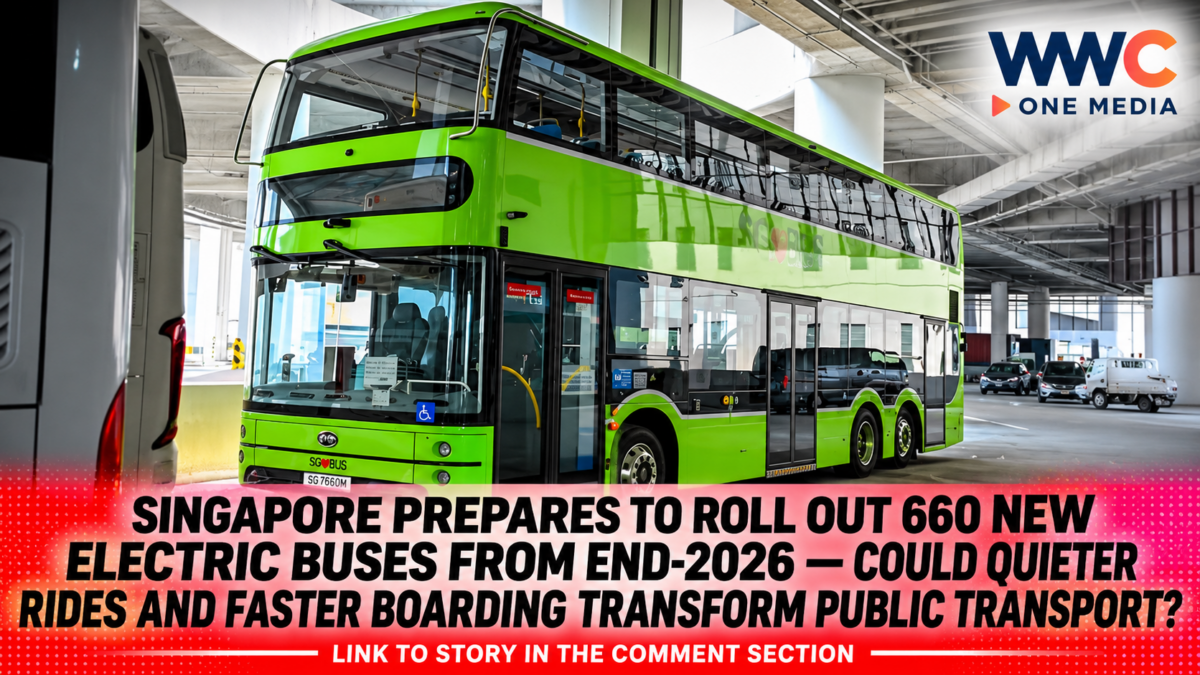
The order includes 360 single-deck buses and 300 double-deck buses, marking the authority’s first large-scale purchase of electric double-deck vehicles.
Awarded through six contracts to four suppliers, the procurement is valued at approximately S$322.2 million. The new fleet will introduce longer operating ranges, upgraded passenger information systems and additional safety technologies designed to assist bus captains and surrounding road users.
The expansion is part of Singapore’s longer-term ambition to make its public bus fleet run entirely on cleaner energy by 2040. Electric buses are expected to account for half of the fleet by 2030.
Beyond reducing emissions, the new vehicles are expected to change the everyday commuting experience through quieter journeys, improved accessibility features and redesigned passenger movement inside double-deck buses.
LTA ORDERS 660 ELECTRIC BUSES IN MAJOR FLEET EXPANSION
The Land Transport Authority awarded six contracts for 660 electric buses in December 2025.
The procurement consists of:
- 360 single-deck electric buses
- 300 double-deck electric buses
The order represents an important expansion of Singapore’s electric public transport fleet and its first large-scale procurement of electric double-deck buses.
The vehicles will progressively enter passenger service from the end of 2026, replacing diesel buses that are approaching the end of their statutory operating lifespan.
The contracts were awarded to four suppliers: ST Engineering Mobility Services, BYD, Yutong and Cycle & Carriage Automotive.
The procurement also includes an option for LTA to purchase up to 50 additional electric buses if required.
The authority said the new vehicles would have improved battery technology and greater capacity, allowing them to travel longer distances and operate more efficiently.
This is important because public buses must operate reliably across multiple routes throughout the day, often with limited opportunities for extended charging between services.
FOUR SUPPLIERS SHARE THE S$322.2 MILLION CONTRACTS
The six contracts were distributed among four tenderers, with different companies responsible for supplying single-deck and double-deck vehicles.
The awarded contracts are:
| Supplier | Buses | Contract value |
|---|---|---|
| ST Engineering Mobility Services | 100 single-deck, 150 double-deck | S$114.7 million |
| BYD Singapore | 160 single-deck, 50 double-deck | S$105.8 million |
| Cycle & Carriage Automotive | 100 double-deck | S$57.8 million |
| Yutong consortium | 100 single-deck | S$43.9 million |
The contracts have a combined value of approximately S$322.2 million.
ST Engineering Mobility Services is partnering with Chinese manufacturer CRRC, while Cycle & Carriage Automotive is working with Zhongtong Bus.
BYD Singapore and the Yutong International Trade–Yutong Bus consortium were also selected.
LTA evaluated the bids using a two-envelope tender process that considered quality and price separately.
The price submissions were opened only after the quality evaluation had been completed.
Factors considered included each supplier’s experience, track record, proposed technical specifications and compliance with Singapore’s regulations. The authority also considered the total life-cycle cost of operating the buses.
This approach is intended to ensure that procurement decisions consider more than the initial purchase price.
LONGER BATTERY RANGE COULD IMPROVE BUS OPERATIONS
One of the most important upgrades involves battery performance.
Electric buses depend on battery capacity to determine how far they can travel before requiring recharging.
The new models are expected to offer improved battery technology and longer operating ranges, giving transport operators greater flexibility when assigning vehicles to routes.
LTA’s specifications for the new fleet include improved battery capacity designed to support more efficient operations.
Additional information reported about the procurement indicates that the new single-deck models are expected to travel at least 310 kilometres per charge, while the double-deck models are expected to cover at least 240 kilometres.
These operating ranges matter because buses must complete scheduled journeys while accounting for passenger loads, traffic conditions, weather and energy consumption from onboard systems.
A longer range can reduce the need for frequent charging interruptions and help operators plan vehicle rotations more efficiently.
However, actual performance can vary depending on operating conditions, route characteristics and passenger demand.
DOUBLE-DECK ELECTRIC BUSES WILL HAVE THREE DOORS AND TWO STAIRCASES
The 300 double-deck electric buses will introduce a design intended to improve passenger movement.
Unlike conventional double-deck layouts with a single staircase, the new buses will feature three doors and two staircases.
This arrangement is intended to allow passengers on the upper deck to leave through the rear staircase, helping separate boarding and alighting movements.
The additional staircase could reduce congestion inside the bus, particularly during busy periods when many passengers are getting on and off at the same stop.
The third door also provides another access point for passengers, potentially improving the flow of people through the vehicle.
However, the usefulness of the additional door depends on the infrastructure at individual bus stops.
LTA has previously explained that not every stop can immediately accommodate a three-door arrangement because of platform dimensions and surrounding physical constraints.
The authority has been working on upgrading suitable bus stops and managing locations where changes may not be practical.
The design therefore represents both an opportunity to improve boarding efficiency and an infrastructure challenge that must be addressed across the network.
NEW PASSENGER INFORMATION SYSTEMS WILL PROVIDE REAL-TIME UPDATES
The new buses will also feature passenger information display systems providing audio and visual updates throughout journeys.
These systems are intended to help commuters follow their routes and identify upcoming stops.
Real-time information is particularly useful for passengers unfamiliar with a particular service, older commuters and people who may have difficulty following announcements.
Combining visual displays with audio announcements can also make travel information more accessible to passengers with different needs.
As public transport becomes increasingly digital, onboard information systems are becoming an important part of the overall commuting experience.
The new buses will incorporate these features as standard equipment.
ADDITIONAL SAFETY TECHNOLOGY FOR BUS CAPTAINS
The vehicles will include several systems designed to support bus captains and improve awareness of surrounding traffic.
According to LTA, the safety features include:
- Onboard CCTV surveillance.
- Collision warning systems.
- Surround-view functions.
- Driver anti-fatigue monitoring.
- Camera mirror systems.
The systems are intended to provide additional information and assistance while buses are operating on busy roads.
Collision warning technology can help alert drivers to potential hazards, while surround-view systems can provide a wider picture of the vehicle’s immediate surroundings.
Driver anti-fatigue monitoring is intended to identify signs of reduced alertness.
Camera mirror systems replace conventional physical mirrors with camera-based displays, allowing drivers to monitor areas around the bus.
The authority also plans to install colour electronic displays at the rear of the new buses.
These displays will communicate the bus captain’s intentions to surrounding road users, including when the vehicle is turning, stopping or moving off.
The features were recommended by the Bus Safety Tripartite Taskforce, which was established following concerns about public bus safety.
Although technology can assist drivers, it does not eliminate the need for careful driving, training and responsible road behaviour.
CHARGING INFRASTRUCTURE IS EXPANDING TO SUPPORT THE NEW FLEET
The arrival of hundreds of additional electric buses requires more than purchasing vehicles.
The buses need reliable charging infrastructure at depots and transport hubs to ensure that they can operate according to their schedules.
LTA called for a separate tender in November 2025 to install electric-vehicle charging systems at Mandai Bus Depot and future integrated transport hubs in Kallang, Beauty World and Tampines North.
The expansion complements earlier charging infrastructure projects at locations including Sengkang West, East Coast and Gali Batu.
Charging facilities must be carefully integrated into depot operations.
Operators need to determine when buses should be charged, how charging equipment is allocated and how vehicles can be prepared for service without disrupting scheduled departures.
Smart charging systems can also help manage electricity demand and monitor the condition of charging equipment.
As the number of electric buses increases, depot infrastructure will become an increasingly important part of Singapore’s public transport system.
SINGAPORE ALREADY HAS HUNDREDS OF ELECTRIC BUSES ON THE ROAD
The 660-bus procurement builds on earlier purchases.
In November 2023, LTA awarded contracts for 360 electric single-deck buses, with deployment beginning progressively from December 2024.
The authority later awarded the additional 660-bus order in December 2025.
By the end of May 2026, approximately 480 electric public buses were already in service, according to reporting citing LTA.
Once the latest 660 buses are progressively deployed, the total number of electric buses in Singapore’s public fleet is expected to reach approximately 1,140.
This expansion represents a significant increase in the number of electric vehicles operating on the country’s bus network.
It also means more depots, charging facilities and maintenance arrangements must be prepared to support the larger fleet.
The transition will take place gradually rather than through an immediate replacement of all diesel buses.
HOW ELECTRIC BUSES FIT INTO SINGAPORE’S 2040 TARGET
Singapore has set a long-term goal of having its entire public bus fleet operate on cleaner energy by 2040.
By 2030, electric buses are expected to account for half of the public bus fleet.
It is important to distinguish between these two targets: the 2040 objective refers to a cleaner-energy fleet, which includes electric and other cleaner-energy technologies, rather than necessarily requiring every bus to be fully electric.
The transition is part of the country’s broader effort to reduce emissions from transportation.
Public buses operate throughout the day and travel substantial distances, making their energy consumption an important consideration in transport decarbonisation.
Electric vehicles produce no tailpipe emissions while operating, although their overall environmental impact also depends on how the electricity used to charge them is generated and how batteries are manufactured and managed.
For Singapore, the shift also offers an opportunity to modernise its bus infrastructure and introduce more advanced vehicle technologies.
WHAT WILL COMMUTERS NOTICE?
For passengers, the transition may be most noticeable through quieter journeys and changes inside the buses.
Electric buses generally operate more quietly than diesel-powered vehicles, particularly when accelerating from bus stops.
Passengers may also notice updated information displays, redesigned double-deck layouts and additional doors.
The new safety systems are primarily intended to assist bus captains and improve awareness around the vehicle, rather than replace human responsibility.
The overall experience will depend on the specific bus model, route and operating conditions.
The introduction of additional electric double-deck buses could also make the technology a more familiar part of daily commuting.
However, passengers should not expect every bus route to change at once. LTA plans to deploy the vehicles progressively as deliveries are completed and supporting infrastructure becomes available.
THE BOTTOM LINE
Singapore’s planned introduction of 660 new electric buses marks another major stage in its effort to modernise public transport and reduce reliance on conventional diesel vehicles.
The S$322.2 million procurement includes 360 single-deck and 300 double-deck buses, with the first deployments scheduled to begin progressively from the end of 2026.
The new vehicles will feature improved battery capacity, real-time passenger information systems, additional driver-assistance technology and a three-door, two-staircase design for double-deck models.
The expansion will also require more charging infrastructure and coordination among bus operators, manufacturers and transport authorities.
For commuters, the changes could mean quieter journeys, improved passenger movement and more modern onboard facilities.
But the bigger test will be whether Singapore can expand its electric fleet while maintaining reliable services, managing infrastructure costs and ensuring that the new technology delivers practical benefits on everyday routes.
Would you welcome more electric buses on Singapore’s roads, and which improvement matters most to you: quieter journeys, better safety technology or faster boarding and alighting?