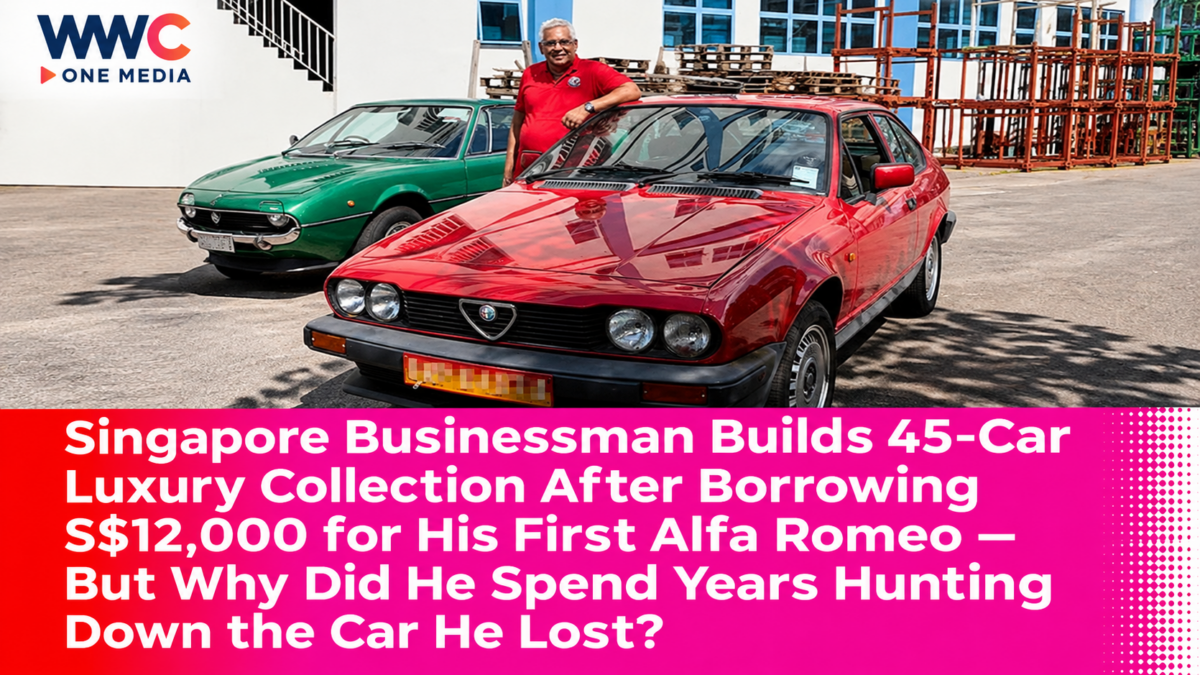
SINGAPORE — What began with a teenager borrowing S$12,000 from his mother to buy a second-hand Italian sports car has become one of Singapore’s most fascinating stories of automotive passion, entrepreneurship and the determination to preserve motoring history.
Today, Singapore businessman Kumar Balasingam owns approximately 45 classic cars, including rare Alfa Romeos, Ferraris, Aston Martins, Mercedes-Benz models and other collector vehicles.
But despite building a remarkable collection that includes a rare Alfa Romeo Montreal for which he once rejected a US$400,000 offer, his most treasured possession is not necessarily the most expensive.
It is an apple-green 1972 Alfa Romeo 2000 GTV—the very first car he purchased when he was just 19.
The vehicle became such an important part of his life that when it was sold while he was overseas, he spent years trying to track it down.
His search eventually led him across the border to a workshop in Melaka, Malaysia, where a familiar shade of green and an old registration plate revealed that he had finally found the car.
But discovering it was only the beginning.
Bringing the vehicle back to Singapore required years of negotiations, legal registration procedures and restoration work.
Now, after losing and recovering the car that started his lifelong obsession, Balasingam says he has no intention of selling it again.
His story, featured by CNA Luxury on November 8, reveals how one man’s enthusiasm for classic vehicles grew into a substantial international collection—and why the emotional value of a car can sometimes outweigh its market price.
A S$12,000 Loan From His Mother Changed Everything
Balasingam’s automotive journey began with a 1972 Alfa Romeo 2000 GTV.
He was only 19, studying and working while developing a growing fascination with Italian sports cars.
The GTV stood out because of its unusual apple-green paint and light tan interior.
He purchased it from an ice-cream vendor in Geylang after borrowing S$12,000 from his mother.
It was an ambitious purchase for someone so young.
But buying the car was only the beginning of his financial commitment.
Classic Alfa Romeos require careful maintenance, and the young Balasingam did not have unlimited money to spend on professional mechanics.
Instead, he began learning how to repair and maintain the vehicle himself.
He studied wiring diagrams, spark plugs, carburettors and other mechanical components.
The car’s owner’s manual became his most important source of information.
Over time, he developed an understanding of how Alfa Romeo engines behaved under different driving conditions.
He also discovered that some problems owners blamed on poor reliability could actually result from incorrect servicing.
For example, he believed some engines were fitted with unsuitable spark plugs, creating misfires and uneven performance.
His experience taught him a lesson that would influence his collecting philosophy for decades.
Understanding a machine could be just as rewarding as driving it.
Love, Marriage and Two Alfa Romeo Alfettas
Balasingam’s passion for Italian cars soon became part of his family life.
When he married in 1984, he and his wife each owned an Alfa Romeo Alfetta.
His car was green.
Hers was gold.
The couple drove the vehicles for several years, turning their enthusiasm for Alfa Romeo into a shared experience.
The Alfetta, an Italian sports saloon associated with Alfa Romeo’s distinctive engineering heritage, became another important chapter in Balasingam’s automotive education.
He eventually began buying, repairing and selling other Alfettas.
Each vehicle offered new mechanical challenges and helped him understand the practical realities of collecting cars.
But Singapore’s tightly regulated vehicle-ownership system would eventually create a painful dilemma.
The S$40,000 COE Problem That Cost Him His First Alfa Romeo
Years after purchasing his beloved GTV, Balasingam was travelling overseas on business.
He was visiting an aircraft factory in the Czech Republic when his wife contacted him with difficult news.
The Certificate of Entitlement, or COE, for his cherished Alfa Romeo was approaching expiry.
Renewing it would cost more than S$40,000.
With two young sons to raise, the family faced competing financial priorities.
Keeping the car would require a substantial expense.
Selling it appeared to be the more practical decision.
A buyer was found, and the GTV changed hands.
Balasingam accepted the decision, but losing the vehicle left a lasting emotional impact.
For many motorists, selling an ageing car is simply part of ownership.
For him, it meant losing the vehicle that had introduced him to decades of memories, mechanical discoveries and personal milestones.
And the problems did not end with the sale.
Sold to Malaysia — Then a Registration Nightmare Begins
After the transaction, the buyer transported the Alfa Romeo into Malaysia.
But Balasingam later discovered that the vehicle had not been properly deregistered.
He subsequently received letters from Singapore’s Land Transport Authority concerning the vehicle’s registration status.
According to his account to CNA Luxury, he faced allegations involving failure to deregister the car and keeping a deregistered vehicle.
He eventually resolved the matter and paid the applicable fines.
But the registration problem was only one part of the story.
He still wanted his Alfa Romeo back.
Balasingam contacted acquaintances in Malaysia and asked them to watch for the distinctive green GTV.
For years, he had little information about its whereabouts.
He did not know whether the car had been dismantled, repainted or sold to another owner.
Nevertheless, he continued hoping that someone would recognize it.
Three years after the sale, he finally received a promising lead.
A green Alfa Romeo had reportedly been spotted at a workshop in Melaka.
The Incredible Melaka Discovery: A Familiar Green Car and an Old Number Plate
Balasingam travelled to the workshop early in the morning.
Inside, several used vehicles were parked.
Then he noticed an unmistakable shade of green.
It was the colour he remembered from his first Alfa Romeo.
Balasingam approached the vehicle and examined it carefully.
Looking through the rear window, he spotted something that confirmed his suspicions.
His old Singapore licence plate, EA5448U, was still inside the car.
After years of searching, he had found the GTV.
The discovery was extraordinary because classic vehicles can change owners, locations, paint colours and registration numbers over time.
Yet this one still carried a recognizable link to his past.
Balasingam confronted the people at the workshop and demanded to speak with its owner.
However, locating the vehicle did not mean he could immediately bring it home.
He still had to navigate ownership and registration requirements.
The process would take years.
Ultimately, he succeeded in recovering and re-registering the car in Singapore.
He was unable to retain its original registration number.
Today, the GTV carries a different number plate and is undergoing restoration.
For Balasingam, the emotional significance is unchanged.
The vehicle that began his journey has returned to his collection.
And this time, he intends to keep it.
From One Alfa Romeo to a Collection of Approximately 45 Classic Cars
Balasingam’s collection eventually grew far beyond the original GTV.
Today, it spans approximately 45 classic vehicles representing several major European automotive manufacturers.
Alfa Romeo remains the central attraction.
But the collection also includes Ferrari, Aston Martin, Mercedes-Benz, Porsche and other marques.
Among the notable cars identified in CNA Luxury’s profile are:
- A rare right-hand-drive Alfa Romeo Montreal
- Two Aston Martin DB6 models
- A 1966 Mercedes-Benz 300 SE Cabriolet
- A 1986 Aston Martin Lagonda
- A Ferrari 308 GT4
- A 1988 Porsche 930 Turbo
- Several Alfa Romeo Spiders and other historic models
The vehicles represent different approaches to automotive design and engineering.
Some emphasize elegant grand touring.
Others are associated with sports-car performance or distinctive Italian styling.
But Balasingam does not view the collection simply as a portfolio of appreciating assets.
Many of the vehicles are connected to specific memories, restoration challenges or personal experiences.
Their individual stories form an important part of his attachment to them.
He Bought 15 Alfa Romeo Spiders in a Single Deal
One of Balasingam’s most remarkable acquisitions began with a meeting in Texas.
An elderly collector in the United States owned 15 Alfa Romeo Spiders.
The collection included different generations, ranging from early Series 1 models to later Series 4 versions.
The American collector wanted to sell.
But he imposed an unusual condition.
Balasingam could not select only the most desirable cars.
If he wanted the deal, he had to buy all 15.
Balasingam agreed.
The transaction created an enormous logistical challenge.
Moving 15 ageing sports cars across international borders requires transportation planning, shipping arrangements and substantial restoration work.
But he managed to organize the acquisition.
According to CNA Luxury, 10 of those Spiders are now in Singapore and four are in London.
The remaining vehicle has changed ownership.
The experience marked an important stage in his transition from individual enthusiast to serious collector.
It also demonstrated that collecting classic cars involves more than simply having enough money to buy them.
Storage, transportation, mechanical condition and restoration costs can become equally important.
The Rare Alfa Romeo Montreal He Would Not Sell for US$400,000
Among Balasingam’s most valuable personal treasures is a right-hand-drive Alfa Romeo Montreal.
The model is recognized by enthusiasts for its distinctive styling and place in Alfa Romeo’s performance-car history.
Right-hand-drive examples are particularly interesting to collectors in markets such as Singapore and the United Kingdom.
According to Balasingam, someone once offered him US$400,000 for the car.
He rejected the proposal.
The decision illustrates the difference between financial value and personal attachment.
However, the offer should not be confused with a professional valuation or confirmed market price.
Classic-car values depend heavily on authenticity, provenance, condition, restoration quality and prevailing demand.
Balasingam’s Montreal is currently undergoing restoration in Poland, with specialists in Italy handling certain finishing details.
For him, completing the restoration appears more important than turning the car into an immediate financial return.
The Montreal is one of the vehicles he considers a permanent part of his collection.
Why Restoring 45 Classic Cars Requires an International Network
Managing a classic-car collection of this scale is a demanding undertaking.
Balasingam relies on specialists across multiple countries.
Bodywork may be performed in Malaysia.
Engine components may be rebuilt in the United States.
Other restoration work takes place in Italy, Poland and Hungary.
Parts can move between countries before a project is completed.
That creates challenges involving transportation, customs, scheduling and quality control.
Some components are relatively easy to source.
Others have not been manufactured for decades.
Balasingam recalls spending two years searching for a replacement electronic control unit for a newer Mercedes-Benz.
His experiences have reinforced his preference for older mechanical systems.
A carburettor can often be rebuilt by a specialist.
Mechanical linkages can sometimes be repaired or reproduced.
But electronic components may become difficult to replace when manufacturers discontinue production and compatible alternatives are unavailable.
This does not establish that classic cars are universally more reliable than modern vehicles.
Modern cars generally benefit from improvements in safety, efficiency, emissions control and performance.
The distinction is that certain older mechanical systems may be more accessible to specialist repair.
For collectors, repairability can become an important part of long-term ownership.
One Restoration Job Cost RM40,000
Classic-car ownership can become expensive long after the purchase price has been paid.
Balasingam recalled one bodywork project that cost approximately RM40,000.
That expense covered just one aspect of restoration.
A complete project may also involve engine work, electrical repairs, upholstery, painting, suspension components and replacement parts.
The final cost can vary considerably depending on the vehicle’s condition and the availability of specialists.
Restoration timelines can also stretch unexpectedly.
Workshops may encounter hidden corrosion, unavailable components or mechanical problems not visible during initial inspection.
Balasingam’s international restoration network helps address some of these challenges.
But coordinating projects across countries creates complications of its own.
The experience explains why owning 45 classic vehicles is fundamentally different from simply purchasing 45 cars.
Each requires continuing attention.
Singapore’s COE System Makes Classic-Car Collecting Even More Complicated
Singapore is among the world’s most expensive markets for vehicle ownership.
Its Certificate of Entitlement system limits the number of vehicles that can be registered and used on public roads.
Motorists generally need a valid COE to register and operate a car.
That creates financial challenges for collectors, particularly when older vehicles approach the end of their entitlement periods.
Balasingam’s original GTV became a painful example when a renewal costing more than S$40,000 contributed to the family’s decision to sell it.
The country’s vehicle policies remain a major subject of public discussion.
As previously reported by WWC ONE MEDIA in its coverage of Singapore’s falling COE premiums, certificate prices have remained high despite fluctuations between bidding exercises.
In September 2026, Category A premiums fell to S$131,890 after previously reaching S$133,009.
That highlights the substantial cost associated with registering ordinary vehicles.
However, classic vehicles may qualify for different arrangements under Singapore’s dedicated Classic Vehicle Scheme.
Singapore’s Classic Vehicle Scheme: What Collectors Need to Know
According to Singapore’s Land Transport Authority, vehicles generally must be at least 35 years old from their original registration date to qualify for the Classic Vehicle Scheme.
The scheme offers a special registration framework for eligible vehicles.
However, it also imposes significant usage restrictions.
Classic cars registered under the scheme may be driven for a maximum of 45 days per calendar year.
Eligible owners receive 28 free electronic day licences and may purchase up to 17 additional licences.
The scheme also involves specific requirements concerning insurance, inspections, registration and vehicle identification plates.
These rules allow collectors to preserve and occasionally operate historic vehicles without treating them exactly like ordinary daily-use cars.
But they also create practical limitations.
A classic car cannot automatically be driven whenever its owner wishes.
The arrangement must suit the collector’s intended use.
Importantly, the existence of the Classic Vehicle Scheme does not mean every vehicle in Balasingam’s collection is registered under it.
His individual cars’ registration arrangements were not established in CNA’s feature.
For Singapore enthusiasts, understanding those differences is essential before purchasing a historic vehicle.
As WWC ONE MEDIA reported in its analysis of proposed COE reforms, the Land Transport Authority has also examined broader changes affecting the distinction between mass-market and higher-value cars.
Such proposals illustrate how strongly Singapore’s vehicle market is influenced by regulation.
Classic Cars Versus Modern Supercars: Why Speed Isn’t Everything
Balasingam appreciates modern automotive engineering.
He understands that contemporary vehicles often deliver acceleration, handling and transmission performance that older sports cars cannot match.
He experienced that difference while driving his 1988 Porsche 930 Turbo behind a modern Mercedes-AMG A45.
The encounter demonstrated how effectively today’s transmissions and electronic systems can deliver performance.
But speed is not the main reason he collects classic cars.
Older vehicles require more direct involvement from the driver.
Manual transmissions, mechanical controls and the sounds of traditional engines create a different driving experience.
Some enthusiasts value that involvement as much as outright performance.
Modern luxury manufacturers have also begun emphasizing emotional connections with their vehicles.
As WWC ONE MEDIA reported when Mercedes-Benz opened its first Southeast Asian brand studio at Gardens by the Bay, luxury automotive brands are increasingly combining design, culture and community experiences.
Balasingam’s collection represents a different approach, but it reflects a similar recognition that vehicles can carry meanings beyond transportation.
For him, the emotional experience matters more than competing with the latest performance figures.
From Accountant to Aviation Entrepreneur and Classic-Car Collector
Balasingam’s professional career provides another dimension to his story.
He is chief executive of JSD Group, a business he founded in 1996.
The company specializes in aircraft engine leasing and aircraft seating, with operations serving markets including Indonesia and India.
Before establishing the business, Balasingam trained as an accountant at Ernst & Young.
He also qualified through the Association of Chartered Certified Accountants.
His professional background has helped him approach collecting with an understanding of costs, logistics and long-term planning.
Owning a substantial collection requires coordination with mechanics, restoration workshops, transport companies and regulatory authorities.
It also involves decisions about storage, maintenance, insurance and whether individual cars should eventually be sold.
Yet Balasingam insists he is not simply buying vehicles to resell them for profit.
His priorities are shaped by personal attachment and interest in automotive history.
The green GTV offers the clearest example.
Its market value cannot fully explain why he spent years trying to recover it.
Singapore’s Classic-Car Community Is Growing Beyond Private Garages
Balasingam’s involvement in heritage motoring extends beyond his personal collection.
He previously served as president of the Alfa Romeo Owners’ Club of Singapore.
During his leadership, membership increased from 11 to 42.
He has since passed the role to another Alfa Romeo enthusiast.
Balasingam also serves as president of the Classic Car Club Singapore, founded in 2016.
The organization has helped bring historic vehicles into public view through exhibitions and gatherings.
Under his leadership, the club has organized classic-car showcases at Marina Bay Sands.
Such events allow members of the public to see historic vehicles that might otherwise remain inside private collections.
They also help preserve knowledge about automotive design, engineering and restoration.
The community aspect matters because ownership alone does not guarantee that heritage vehicles will remain understood.
Experienced enthusiasts can share information about maintenance, parts sourcing and original specifications.
Public exhibitions can also introduce younger people to vehicles manufactured before they were born.
Could Singapore Become a Regional Classic-Car Destination in 2027?
Balasingam is now working toward an ambitious goal.
He hopes to organize an international classic-car event in Singapore in 2027.
The idea is to attract collectors and enthusiasts from different countries while strengthening Singapore’s reputation as a centre for heritage motoring.
An event of that scale could provide opportunities for exhibitions, collector gatherings and specialist automotive businesses.
It could also introduce international visitors to Singapore’s classic-car community.
However, the event remains an ambition rather than a confirmed, fully scheduled international programme.
Details such as participating vehicles, dates, venues and organizers have not been publicly finalized in the reporting reviewed.
Its eventual success would depend on financing, logistics, participation and regulatory requirements.
Nevertheless, the proposal illustrates Balasingam’s desire to build something larger than a private collection.
He wants Singapore’s automotive heritage community to gain wider recognition.
A 1965 Saab Keeps Another Family Memory Alive
One of the most personally meaningful cars in Balasingam’s collection is not an Alfa Romeo.
It is a 1965 Saab previously owned by his late father.
The vehicle remains in the family.
Its significance comes from its connection to someone who helped shape Balasingam’s life.
His two adult sons also grew up surrounded by engines, spare parts, restoration work and automotive events.
His wife has witnessed the development of his passion over decades.
The collection therefore represents multiple generations of memories.
Some cars mark business milestones.
Others are connected to his marriage or personal experiences.
The Saab provides a tangible link to his father.
And the green Alfa Romeo remains the car that began everything.
That emotional dimension is what distinguishes his story from a conventional feature about luxury ownership.
Is Collecting Classic Cars Really a Good Investment?
Rare cars can attract substantial offers, especially when they are historically significant, unusual or exceptionally well preserved.
But Balasingam’s experience should not be interpreted as evidence that collecting classic cars guarantees financial returns.
Restoration can be costly.
Parts can become scarce.
Storage and insurance create ongoing expenses.
Ownership regulations can complicate the ability to keep or use a vehicle.
And the market value of a collector car can change depending on demand, originality, condition and economic circumstances.
Even a large rejected offer does not establish a car’s future resale value.
The US$400,000 proposal Balasingam says he received for his Montreal illustrates potential collector interest, not a guaranteed market price.
For prospective collectors, the more sustainable starting point is understanding the vehicle, its mechanical condition and its long-term ownership requirements.
That philosophy aligns closely with Balasingam’s approach.
He learned to maintain his first Alfa Romeo because he could not afford to rely entirely on professional repairs.
Decades later, the same respect for mechanical knowledge continues to influence his collection.
Why His Story Resonates With Singapore’s Younger Entrepreneurs
Balasingam’s journey also contains lessons about entrepreneurship and the pursuit of long-term interests.
He did not begin with a fleet of rare vehicles or a network of international restoration specialists.
He started with a borrowed sum, a second-hand Alfa Romeo and a willingness to learn.
His subsequent business career helped provide the resources needed to expand his passion.
But the evolution took decades.
The story offers an interesting contrast with younger Singaporeans pursuing ambitious financial and lifestyle goals.
As WWC ONE MEDIA previously reported in its feature on NTU student entrepreneur Rayyan Roulette, owning a luxury vehicle at a young age can attract attention, but the business decisions and setbacks behind that achievement often tell a more substantial story.
Balasingam’s experience offers a different perspective.
His passion developed into a long-term pursuit that involved technical education, professional growth and the preservation of machines with personal meaning.
The lesson is not that everyone should buy expensive cars.
It is that a lasting interest can become a significant part of someone’s life when supported by knowledge, patience and resources.
The Bigger Picture: Preserving Automotive Heritage in an Electric Future
The automotive industry is changing rapidly.
Electric vehicles, software-based features and increasingly sophisticated driver-assistance systems are reshaping how cars are designed and maintained.
Classic vehicles represent an earlier period of mechanical engineering.
For enthusiasts, they offer a way to experience the technologies and design philosophies that shaped modern motoring.
Preserving those vehicles can involve maintaining original components, documenting repairs and ensuring that specialist knowledge survives.
However, classic-car preservation also faces challenges.
Replacement parts may become increasingly difficult to find.
Specialist mechanics may retire.
Regulatory requirements may evolve.
And the costs of maintaining older combustion-engine vehicles can remain substantial.
Balasingam’s collection illustrates why enthusiasts continue investing time and resources in this work.
His vehicles are not merely objects to display.
They are machines that tell stories about different periods of automotive development.
And in his case, some also tell stories about family, friendship and personal perseverance.
The Bottom Line: The Most Valuable Car Is the One He Refused to Forget
Kumar Balasingam’s collection of approximately 45 classic cars is remarkable by any standard.
It includes rare Alfa Romeos, Ferraris, Aston Martins, Mercedes-Benz models and other historic vehicles.
He once purchased 15 Alfa Romeo Spiders in a single transaction.
He rejected a reported US$400,000 offer for a rare right-hand-drive Montreal.
He now coordinates restorations across several countries and leads Singapore’s Classic Car Club.
But the central story remains the apple-green 1972 Alfa Romeo 2000 GTV he bought at 19 using S$12,000 borrowed from his mother.
When the vehicle was sold during a difficult family decision, he could not forget it.
Three years later, a lead brought him to a workshop in Melaka.
There, an unmistakable green finish and his old number plate confirmed that the car had survived.
After years of paperwork and negotiations, he managed to bring it back to Singapore.
Today, it is undergoing restoration.
For Balasingam, the car represents more than a collectible vehicle.
It connects his teenage ambitions with his family history, mechanical education and decades of personal achievement.
And as he prepares for the possibility of bringing international classic-car collectors to Singapore in 2027, the vehicle that began his journey remains especially important.
After decades of collecting rare luxury vehicles and turning down an extraordinary offer for one of his prized Alfas, Kumar Balasingam’s story leaves one question: When a car carries a lifetime of memories, can any amount of money truly persuade its owner to let it go?