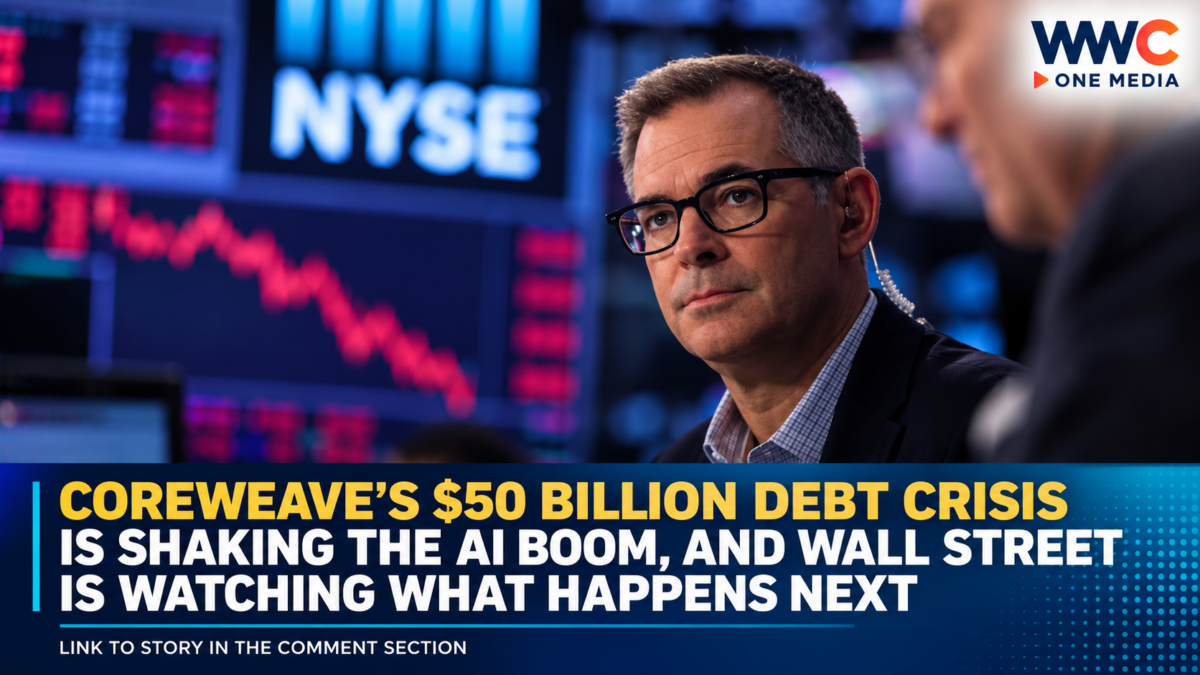
The artificial intelligence boom is facing a growing financial reality check, and Nvidia-backed cloud computing company CoreWeave has emerged as one of its biggest warning signs.
CoreWeave is coming under intense scrutiny as investors increasingly question whether the enormous investments powering the AI revolution can generate enough revenue to justify their mounting costs. Its shares and bonds have suffered a sharp selloff, raising concerns about the financial risks associated with building the infrastructure needed to support artificial intelligence.
The company’s troubles have become particularly significant because CoreWeave sits at the center of an increasingly interconnected network of AI developers, chipmakers, technology giants and financial institutions.
According to recent market developments, CoreWeave’s shares declined by more than 15 per cent during the week ending October 16, while yields on some of its bonds surged toward 16 per cent. The dramatic movement reflects growing investor anxiety about the company’s ability to finance its expansion and manage its substantial debt obligations.
A $50 Billion Debt Burden Raises Questions
CoreWeave’s biggest vulnerability is the enormous amount of capital required to maintain its rapidly expanding business.
The company has accumulated approximately US$50 billion in liabilities as it invests heavily in advanced Nvidia processors, data centers and other infrastructure required to deliver computing services to artificial intelligence developers.
Unlike traditional software companies, CoreWeave must spend billions upfront to acquire equipment and construct facilities before it can generate revenue from customers using that infrastructure.
This business model leaves the company particularly exposed to higher borrowing costs, construction delays and any slowdown in demand for AI computing capacity.
Its financial performance has also attracted attention. CoreWeave generated approximately US$5.1 billion in revenue in 2025 but recorded a net loss of US$1.2 billion.
Although revenue is expected to increase significantly, the company’s expansion requires even greater spending. Its projected capital expenditures for 2026 have been estimated at between US$35 billion and US$39 billion.
That creates a difficult financial equation: CoreWeave must continue investing heavily today while waiting for future customer contracts to generate sufficient cash flow.
Strong Customer Demand Has Not Completely Reassured Investors
Despite mounting concerns, CoreWeave maintains that demand for its computing services remains strong.
At the end of the second quarter, the company reported a revenue backlog of approximately US$104.2 billion. It subsequently secured more than US$25 billion in additional commitments early in the third quarter.
Chief Executive Officer Mike Intrator reportedly told employees that the company’s backlog was more than sufficient to cover its debt obligations, pushing back against concerns surrounding its financial position.
However, investors are increasingly distinguishing between having signed customer agreements and having enough available cash to fulfill those commitments profitably.
Building data centers, purchasing advanced chips and securing electricity require substantial financing. Even with customers waiting for computing capacity, delays in construction or higher financing costs could put additional pressure on the company’s finances.
This is becoming one of the central questions surrounding the AI infrastructure industry.
Nvidia’s Connection Adds Another Layer of Risk
CoreWeave’s relationship with Nvidia makes the situation particularly important for the broader artificial intelligence industry.
Nvidia is not simply a supplier of the advanced processors used by CoreWeave. It is also a major investor and has agreed to purchase unused computing capacity from the company through April 2032, providing an additional source of potential demand.
Nvidia CEO Jensen Huang has previously expressed confidence in CoreWeave’s financial position, arguing that its financial strength is improving.
Nevertheless, the relationship has attracted attention because several companies across the AI ecosystem are financially connected through investments, equipment purchases, infrastructure agreements and computing contracts.
Investors are increasingly examining whether this interconnected financing structure could amplify problems if one major participant encounters financial difficulties.
The concern is not necessarily that AI computing demand will disappear. Rather, it is whether the companies building the infrastructure can earn sufficient returns to support the enormous amounts of borrowed money involved.
AI Infrastructure Spending Is Becoming a Wall Street Concern
CoreWeave’s difficulties are part of a much larger reassessment of the artificial intelligence investment boom.
Major technology companies are committing extraordinary sums to data centers, specialized processors and computing infrastructure. However, the financial returns from these investments may take years to materialize.
Recent concerns surrounding data center construction delays, electricity constraints, equipment bottlenecks and rising financing costs have added pressure to the sector.
Axios has also highlighted the growing dependence of AI infrastructure expansion on borrowed money, warning that the gap between infrastructure spending and the revenue generated by AI services is becoming increasingly difficult for investors to ignore.
Business Insider has separately reported that falling prices for AI-related corporate bonds are spreading concerns across financial markets, with CoreWeave among the companies facing particularly intense scrutiny.
The consequences could extend beyond smaller AI infrastructure providers. If lenders become more cautious, companies across the industry could face higher borrowing costs or greater difficulty securing financing for future projects.
Smaller AI Cloud Companies Face an Uncertain Future
CoreWeave is part of a growing group of specialized cloud infrastructure providers known as neocloud companies.
These businesses offer access to powerful computing resources without requiring AI developers to construct and operate their own data centers.
Other companies operating in this increasingly competitive market include Nebius, Applied Digital and IREN.
However, the business model requires enormous upfront investments, and not every provider will necessarily generate enough revenue to remain financially sustainable.
Research firm Gartner has warned that approximately 80 per cent of neocloud providers could cease independent operations by 2030 as competition intensifies and the economics of AI infrastructure become more challenging.
Such a development could reshape the industry, potentially leaving the strongest companies with greater market opportunities while weaker providers struggle to survive.
Could CoreWeave Become a Warning Sign for the Entire AI Industry?
The immediate concern surrounding CoreWeave is whether its debt-heavy expansion can remain financially sustainable.
Its substantial customer backlog, relationship with Nvidia and exposure to growing AI computing demand provide important advantages. However, these factors do not eliminate the risks associated with high borrowing costs, enormous capital requirements and uncertain future profitability.
The company’s situation also highlights a broader challenge facing the technology industry: the difference between building infrastructure for a promising technology and generating enough money from that infrastructure to justify the investment.
Artificial intelligence continues to attract enormous interest from businesses, governments and consumers. But investors are increasingly demanding evidence that the companies powering the revolution can turn that demand into sustainable profits.
CoreWeave’s market troubles could therefore become an important test of confidence in the AI investment boom.
If the company successfully manages its debt and converts its massive backlog into reliable cash flow, it could demonstrate that the neocloud business model remains viable.
But if financing becomes more expensive and infrastructure spending continues to outpace actual returns, the consequences could reach far beyond one company.
The bigger question facing Wall Street is no longer simply how much money artificial intelligence can attract. It is whether the industry can generate enough real profits to justify the billions already being spent.