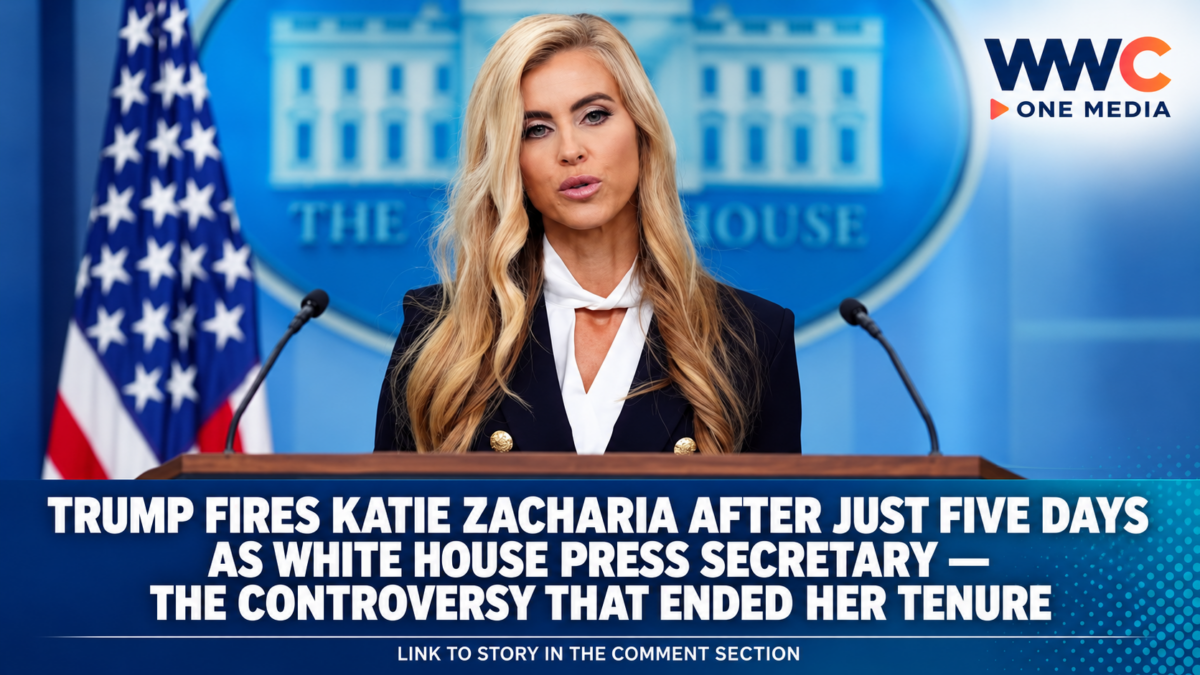
US President Donald Trump’s newly appointed White House press secretary, Katie Zacharia, has been pushed out of the high-profile position after just five days, ending one of the shortest tenures in the history of the White House press briefing room.
Zacharia’s abrupt departure on Friday, October 16, 2026, followed mounting criticism over her first press briefing, questions surrounding her professional credentials, and growing concerns about her ability to handle the intense media scrutiny that comes with speaking on behalf of the American president.
Two White House officials confirmed that Zacharia had been let go and was transitioning out of the position, according to Reuters. The announcement came shortly after Trump publicly suggested that she reconsider whether the demanding job was right for her.
Speaking to reporters as he departed the White House, Trump said he had personally advised Zacharia to think carefully about remaining in the role.
Trump explained that he did not want her to endure the intense criticism directed at her by journalists and the media. He suggested that the position might not bring her happiness, given the pressure surrounding the administration’s public communications.
The president also indicated that he was not rushing to appoint a replacement.
Zacharia’s departure came barely five days after she officially began her duties on Monday, October 12, succeeding former press secretary Karoline Leavitt, who left the administration earlier in the year.
A First Briefing That Quickly Turned Into a Controversy
The problems surrounding Zacharia began with her first official White House press briefing on Tuesday, October 13.
The briefing lasted approximately 14 minutes, during which she took questions from only three reporters representing conservative-leaning media organizations.
Her presentation focused heavily on highlighting Trump’s accomplishments, but her limited engagement with journalists and several awkward moments quickly attracted criticism.
According to the Associated Press, Zacharia appeared uncomfortable during parts of the briefing, relied heavily on prepared remarks, and stumbled over some questions about her background and the administration.
The short appearance became a major talking point among journalists and political commentators, raising questions about whether she was adequately prepared for one of Washington’s most demanding communications positions.
The White House press secretary traditionally serves as the administration’s principal public spokesperson, regularly answering questions about presidential decisions, government policies, international developments and political controversies.
For an administration frequently facing intense media scrutiny, the position requires strong communication skills, detailed policy knowledge and the ability to respond under pressure.
Questions About Her Legal Credentials Added to the Pressure
The controversy intensified when questions emerged about Zacharia’s repeated descriptions of herself as a lawyer.
Zacharia graduated from Pepperdine University School of Law in California and had previously appeared on conservative television networks as a political commentator and legal analyst.
However, she acknowledged during a Fox News interview on Thursday, October 15, that she had not passed the bar examination.
Passing a state bar examination and obtaining the necessary admission to practice are generally required before a law graduate can legally practice as an attorney in the United States.
Zacharia defended her previous descriptions of her professional background, saying she had worked in international legal-related roles and that she never intended to enter traditional legal practice.
She also explained that she had not completed the bar examination because of personal circumstances involving plans to relocate to China with her husband.
The issue attracted additional attention because Trump had introduced her as an attorney when announcing her appointment.
Reuters reported that it could not find records showing that Zacharia was registered as an attorney or admitted to the bar in any US state or the District of Columbia.
The controversy placed additional pressure on the new spokesperson at a time when she was already facing criticism over her performance in front of the White House press corps.
China Remarks Created Another Diplomatic Distraction
Zacharia also attracted attention for comments about China during an interview with conservative political commentator Jack Posobiec.
She recalled how, during an earlier period when China was increasingly viewed as a potential competitor to the United States, she questioned the country’s development and made disparaging remarks about its public infrastructure.
Her comments included a reference to China’s toilets, prompting criticism and drawing a response from Beijing.
Chinese Foreign Ministry spokeswoman Mao Ning responded by suggesting that Zacharia should visit China more often.
The exchange added another international dimension to the controversy, particularly as Trump had recently hosted Chinese President Xi Jinping in Washington.
Her remarks highlighted the challenges of balancing political messaging with diplomatic sensitivities, especially for an official responsible for communicating the administration’s position to the international community.
Trump Now Faces Another Communications Challenge Before the Midterm Elections
Zacharia’s departure creates another challenge for the Trump administration as Republicans prepare for the November 3 congressional midterm elections.
The White House needs a consistent and effective public spokesperson during a politically sensitive period when Trump is campaigning for Republican candidates and attempting to defend his administration’s record.
Reuters reported that Trump’s decision to bring Zacharia into the position was partly driven by concerns about how his administration was being portrayed in the media.
Before her appointment, Zacharia had worked as a conservative political commentator, appeared on Fox News and Newsmax, served in communications roles, and worked as a senior communications adviser at Trump Media & Technology Group.
She had also briefly worked at the Department of Homeland Security during Trump’s second administration.
Her selection was intended to strengthen the administration’s media messaging, but her rapid departure has raised fresh questions about the White House’s approach to selecting and preparing its communications officials.
The Associated Press noted that her appointment followed Karoline Leavitt, who had developed a prominent role as one of Trump’s most recognizable and combative public defenders.
Zacharia’s five-day tenure was even shorter than that of Anthony Scaramucci, Trump’s former White House communications director, who served for 10 days during the president’s first administration.
The episode also underscores the increasingly difficult environment facing officials tasked with defending Trump’s decisions before a frequently critical press corps.
For now, Trump has indicated that he is not rushing to name a successor, leaving the administration facing an important communications vacancy at a crucial moment in American politics.
What began as a surprise appointment has quickly become another high-profile White House personnel controversy, with Zacharia’s departure raising bigger questions about presidential appointments, media strategy and the pressure of serving as the public face of the Trump administration.