
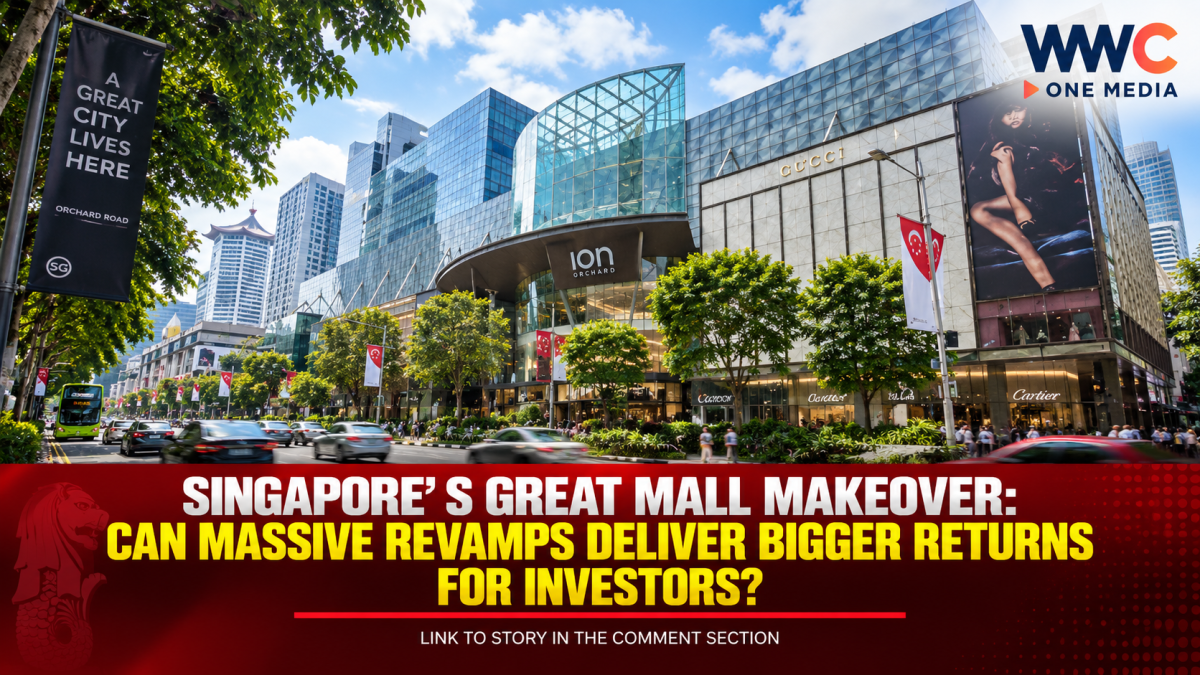
SINGAPORE — Singapore’s shopping malls are entering a major transformation phase, with property owners pouring hundreds of millions of dollars into renovations, tenant changes and full-scale redevelopments in a race to keep retail destinations relevant — and investors are watching closely to see whether the spending translates into stronger returns.
From suburban shopping centres to the Orchard Road retail belt, landlords are increasingly using asset-enhancement initiatives (AEIs) to modernise ageing properties, improve the customer experience and reposition malls around changing consumer preferences. The Business Times reported that major mall owners are investing heavily in such projects as they seek to improve asset performance and returns.
Why Singapore’s malls are getting a makeover
The retail landscape has changed dramatically. Consumers are no longer visiting malls simply to buy products. Dining, entertainment, wellness, services and experiences have become increasingly important in attracting visitors.
That is pushing landlords to rethink how shopping centres are designed and what types of tenants they accommodate.
One major example is CapitaLand Integrated Commercial Trust (CICT), Singapore’s largest listed retail-focused real estate investment trust. CICT completed a S$48 million AEI at IMM in 2026 and is due to complete a combined S$61 million revamp of Tampines Mall and Lot One Shoppers’ Mall this year.
The strategy is not simply about giving malls a cosmetic facelift. Owners are seeking to create destinations that encourage visitors to stay longer and spend more.
Orchard Road faces a different challenge
Singapore’s famous Orchard Road shopping belt is also evolving.
While the area remains a major retail destination, developers are increasingly looking at ways to introduce more offices, hospitality, residential uses and experiences rather than relying exclusively on traditional shopping.
Urban-planning discussions have also focused on making Orchard Road more of a live-work-play destination, with mixed uses potentially helping bring activity to the precinct beyond conventional retail hours.
At the same time, major transactions demonstrate that investors still see value in Singapore’s prime retail assets.
In April, CICT announced plans to acquire Paragon on Orchard Road for almost S$3.9 billion, while selling Asia Square Tower 2 for about S$2.48 billion. The deal underscored continued institutional interest in high-quality Singapore commercial property.
Marina Square shows how big the opportunity can become
Perhaps the most dramatic example of Singapore’s mall transformation is Marina Square.
The mall is scheduled to close on March 31, 2027, for a major redevelopment. The project will transform the site into a mixed-use destination featuring luxury residences, serviced apartments, offices and a 304-room hotel.
The redevelopment is targeted for completion in 2031.
DBS analyst Tabitha Foo described the redevelopment as highly anticipated and estimated a potential gross development value of approximately S$5.5 billion, excluding the existing hotels.
That illustrates why redevelopment can be attractive to property owners: the goal is not merely to make an old mall look newer, but to unlock significantly greater value from the underlying site.
HarbourFront is also being transformed
Another major project is the redevelopment of HarbourFront Centre.
Mapletree Investments plans to replace the existing centre with a 33-storey mixed-use development combining Grade A offices and retail space, alongside an elevated park and waterfront promenade.
The 123,000 sq m project is expected to be completed in the first half of 2031 and will incorporate sustainability features including solar power, smart lighting, water-management systems and electric-vehicle charging infrastructure.
The location also benefits from its connection to HarbourFront MRT and the wider Greater Southern Waterfront transformation.
But bigger spending does not guarantee bigger returns
For investors, the mall makeover boom presents an important question:
Will higher spending today actually translate into higher income tomorrow?
Redevelopment and AEI projects can potentially increase rental income, improve occupancy, attract stronger tenants and raise the value of an asset.
But they also require substantial capital.
During construction, landlords can face temporary disruption, tenant relocations and reduced income. There is also no guarantee that consumers will respond as strongly as expected once a project is completed.
That makes tenant selection particularly important. A beautifully renovated mall can still struggle if its retail mix fails to match local demand.
The real test: Can malls become destinations again?
Singapore’s mall transformation reflects a broader shift in the retail-property industry.
Online shopping has changed how consumers purchase goods, meaning physical malls increasingly need to offer something that cannot easily be replicated online — restaurants, entertainment, community spaces, services and memorable experiences.
For landlords, the winning formula may therefore be less about adding more shops and more about creating reasons for people to visit, stay and return.
The scale of current investment suggests Singapore’s property owners believe there is still substantial value in physical retail.
But for investors, the ultimate measure will be performance after the construction cranes disappear.
Singapore’s malls are getting a second life. The billion-dollar question is whether shoppers — and investors — will reward the transformation.




Leave a Reply