
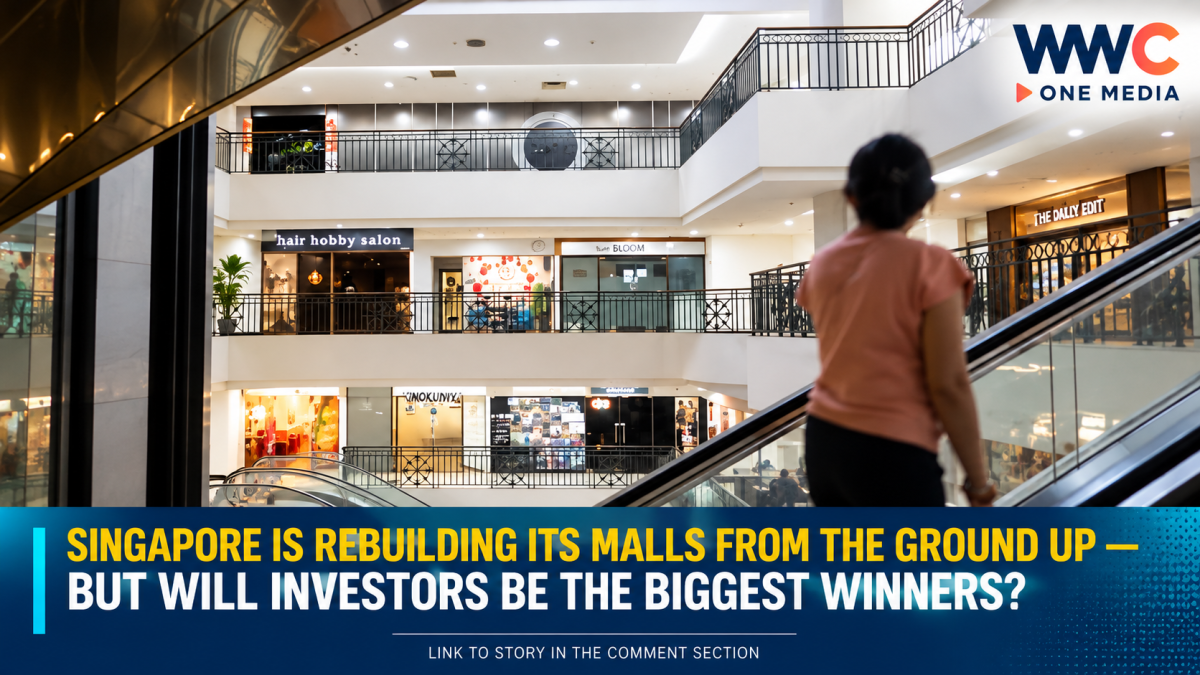
SINGAPORE — Singapore’s shopping-mall landscape is entering a major transformation, with aging retail properties being redesigned, redeveloped and repurposed in a bid to unlock more value from some of the city-state’s most prominent commercial assets.
From Marina Square to Kallang Wave Mall and NEX, owners are betting that the future of retail will be about far more than shopping.
The strategy increasingly involves combining retail with homes, offices, hotels, dining, sports, wellness and entertainment — creating mixed-use destinations designed to generate income from multiple sources while keeping visitors coming back.
For investors, that could create significant opportunities.
But it also comes with a crucial question:
Will expensive mall makeovers actually translate into stronger returns?
Singapore’s old malls are getting a second life
One of the most dramatic examples is Marina Square, the large shopping complex beside Marina Bay.
The property is scheduled to close on March 31, 2027, for a major redevelopment led by Singapore Land Group, a subsidiary of UOL Group.
The revamped development is planned to include luxury residences, serviced apartments, offices and a 304-room hotel alongside retail facilities.
That is a significant shift from the traditional mall model.
Instead of depending almost entirely on shoppers and retail tenants, the redeveloped property will have several potential income streams.
Residential units can generate sales proceeds.
Offices can provide rental income.
Hotels can tap tourism and business travel.
Retail can benefit from a much larger population of residents, workers and visitors using the development.
This is precisely why mixed-use redevelopment is becoming increasingly attractive to Singapore property owners.
Why simply running a mall is no longer enough
Singapore’s retail market remains highly competitive.
Consumers have more choices, online shopping continues to reshape purchasing habits, and older malls can struggle to maintain the same level of attractiveness they enjoyed when they first opened.
Nicholas Mak, chief research officer at Mogul.sg, told The Straits Times that keeping older malls purely focused on retail may no longer generate the financial returns landlords once enjoyed.
That creates a powerful incentive for owners to rethink what their properties are actually worth.
A mall sitting on a large and valuable piece of land may have much greater potential if part of the site can support residential or office development.
In other words, the building may be aging — but the land underneath it may still be extremely valuable.
Marina Square shows where the market is heading
Marina Square is perhaps the clearest illustration of this strategy.
The planned redevelopment will turn the existing retail-led property into a much broader mixed-use destination.
For investors, the attraction is diversification.
A retail-only asset is heavily dependent on shopper traffic, tenant demand and consumer spending.
A mixed-use project can potentially spread that risk across several property sectors.
That does not eliminate risk.
Construction costs can rise.
Interest rates can affect financing.
Residential demand can change.
Hotel performance can weaken.
And a major redevelopment can temporarily disrupt existing rental income.
But if executed successfully, the result can be a property with substantially greater long-term value.
Kallang Wave Mall is taking a different route
Not every Singapore mall needs to be demolished and rebuilt.
Kallang Wave Mall is pursuing a major asset enhancement initiative, or AEI, while continuing to operate.
The redevelopment is designed to reposition the mall as a sports, lifestyle and community destination.
Plans include new sports and wellness concepts, refreshed public areas, upgraded dining spaces, a new through-block link and experiential attractions including an indoor climbing wall and rooftop padel facilities.
The transformation is scheduled for completion in 2028.
The objective is clear: give consumers reasons to visit that cannot easily be replicated by online shopping.
Shopping alone may not be enough.
Experience can be.
NEX is betting on the suburban consumer
The redevelopment strategy is not limited to downtown Singapore.
NEX, located above Serangoon MRT station and integrated with the Serangoon Bus Interchange, is also undergoing an asset enhancement initiative.
Frasers Property says the project will add approximately 44,000 square feet of commercial net lettable area, improve circulation and introduce new tenant clusters.
The project is designed to strengthen the mall’s connection with its surrounding community while improving its long-term income potential.
Frasers Property is targeting a 7% return on investment from the NEX enhancement project.
That illustrates the central financial logic behind Singapore’s mall makeover.
Owners are not spending money simply to make buildings look newer.
They are attempting to increase rental income, improve tenant quality, raise foot traffic and ultimately increase asset value.
The biggest winners could be the owners — if the numbers work
For investors in Singapore-listed real estate investment trusts, the redevelopment cycle could create opportunities.
Asset enhancement can increase a property’s lettable space.
It can attract higher-quality tenants.
It can improve rental rates.
And it can make an aging property more competitive.
But investors should not assume every renovation automatically creates value.
The key question is whether the additional income generated by the improved property exceeds the cost of redevelopment and the income lost during construction.
That is why returns on investment, occupancy levels, tenant demand and financing costs matter so much.
Singapore is also seeing a wave of property repositioning
The mall transformation is happening alongside a wider restructuring of Singapore’s commercial-property landscape.
In April, CapitaLand Integrated Commercial Trust announced plans to acquire Paragon on Orchard Road for S$3.9 billion while selling Asia Square Tower 2 for S$2.5 billion.
The strategy was explicitly described as capital redeployment into a higher-yielding freehold integrated development.
CICT said the Paragon acquisition was expected to increase distribution per unit by 2.1%.
The transaction highlights another feature of Singapore’s property market:
Prime real estate is increasingly being treated as an asset to actively manage rather than simply hold.
Owners can sell mature assets, recycle capital into properties with stronger growth prospects and invest in redevelopment opportunities.
Investors are already betting on rejuvenated properties
The recent sale of Scotts Square also shows how investors view older Singapore malls.
Wharf Real Estate Investment sold the Orchard Road mall for S$310 million to Royal Holdings and RB Capital.
The transaction works out to about S$2,369 per square foot based on gross floor area.
The buyers are experienced Singapore property investors with portfolios spanning offices, hotels and malls.
Their involvement is significant because rejuvenating older commercial assets is increasingly becoming a specialized investment strategy.
Buy an established property.
Improve its tenant mix.
Upgrade the physical asset.
Increase its relevance.
Then capture the resulting increase in income and valuation.
That model can be highly attractive in a land-scarce city such as Singapore.
But redevelopment is not a guaranteed jackpot
There is another side to the story.
A major redevelopment can require hundreds of millions of dollars.
CapitaLand’s announcement on Paragon noted that preliminary analysis indicated a potential major asset-enhancement project could require S$300 million or more, depending on the eventual scope and timing.
That is a huge amount of capital.
Developers therefore need confidence that the upgraded property can command higher rents or attract stronger demand.
There is also the risk of changing consumer habits.
A beautifully renovated mall can still struggle if consumers do not want what it offers.
That is why the newest projects are emphasizing experiences rather than simply adding more shops.
The mall of the future may look very different
Singapore’s redevelopment trend points toward a broader change in the definition of a shopping mall.
The successful mall of the future may be less about rows of stores and more about becoming a destination where people:
- live
- work
- eat
- exercise
- socialize
- stay in hotels
- attend events
- shop
- and spend their leisure time
That model creates activity throughout the day rather than relying on shoppers arriving specifically to buy something.
It also creates more opportunities to monetize the same piece of land.
The real test begins after the ribbon-cutting
For investors, however, the most important moment will not be when the renovated malls reopen.
It will come afterward.
Will tenants pay higher rents?
Will occupancy remain strong?
Will foot traffic increase?
Will shoppers stay longer?
Will new residential and hospitality components generate enough additional income to justify the construction bill?
And ultimately:
Will the upgraded property be worth substantially more than it was before the money was spent?
Singapore’s great mall makeover is therefore much more than an architectural trend.
It is a massive experiment in how a land-scarce city can squeeze more economic value from aging commercial properties.
If the strategy works, investors could gain from stronger rental income, higher valuations and more resilient assets.
If it fails, owners could be left with expensive new buildings competing for the same consumers.
For now, Singapore’s property giants are betting heavily on transformation.
The shopping mall is not disappearing.
It is being reinvented — and the biggest question is whether investors will ultimately reap the rewards.



Leave a Reply