
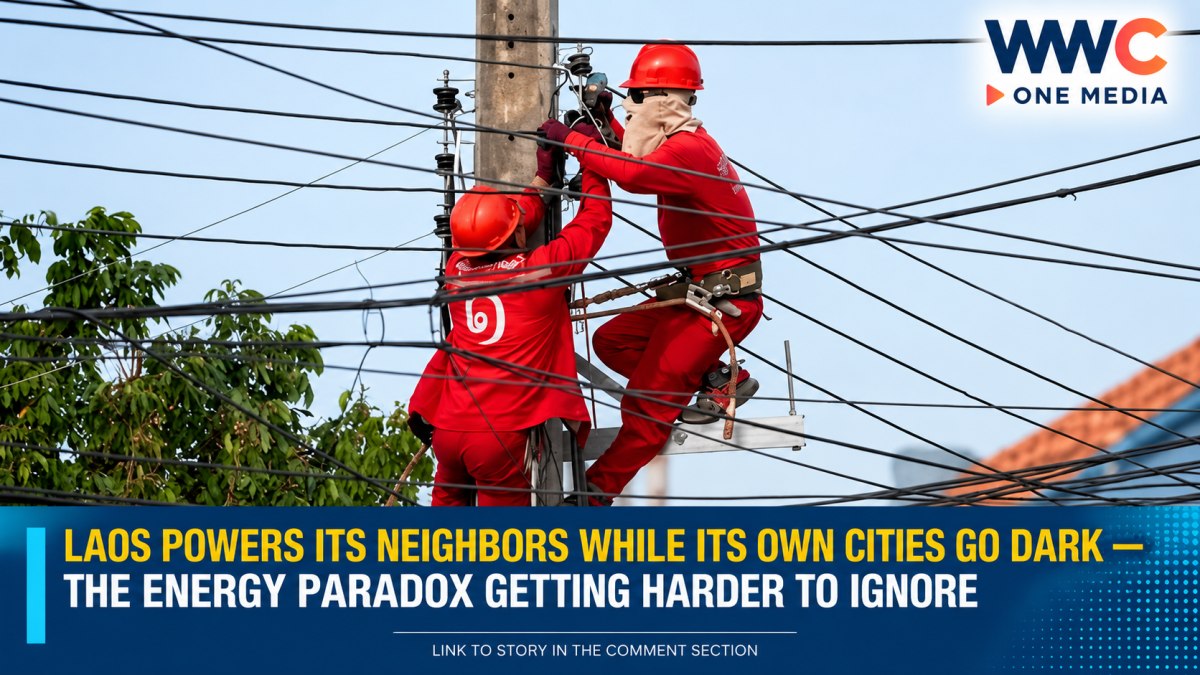
VIENTIANE — Laos has spent years building its reputation as the “Battery of Southeast Asia,” exporting huge quantities of hydropower to neighboring countries and earning billions of dollars in electricity revenue.
Yet inside Laos, some families and businesses are still experiencing regular blackouts.
In Vientiane, residents have endured power cuts during periods of intense heat. Hospitals have reported interruptions affecting medical equipment before backup generators restore electricity. In rural communities, a single damaged power line can sometimes leave an entire village without power.
The contradiction is striking.
A country exporting electricity to its neighbors can still struggle to keep its own lights on.
But the explanation is more complicated than simply saying Laos is selling electricity it needs at home.
The deeper problem involves the country’s aging domestic grid, seasonal hydropower shortages, large debts at state utility Electricité du Laos and an electricity-export model in which some power projects are connected directly to overseas customers rather than to the domestic grid.
Laos has become an electricity-export powerhouse
Hydropower dominates Laos’ electricity sector.
It accounted for about 80% of the country’s electricity production in 2024, according to AFP’s latest reporting.
Over the past decade, Laos dramatically expanded its power exports. Official figures cited by AFP show annual electricity exports rising from about 12 terawatt-hours in 2014 to 38 TWh in 2024.
In 2023 alone, electricity exports generated approximately US$2.65 billion in revenue.
The World Bank has previously estimated that roughly 80% of the electricity generated in Laos is exported, with Thailand historically taking the largest share.
In 2022, electricity was Laos’ largest export product by value, generating about US$2.38 billion.
That export strategy has become an important source of foreign currency for a country that remains one of Southeast Asia’s poorer economies.
So why are Lao families still losing power?
The answer begins with the grid.
Laos has invested heavily in generating electricity, particularly through hydropower projects, but its domestic transmission and distribution networks have not always kept pace.
Much of the distribution system dates back decades.
In rapidly growing urban areas, infrastructure designed for far fewer consumers now has to serve apartment buildings, businesses, tourism facilities and households using air-conditioning during increasingly hot weather.
In rural areas, the problem can be even more basic.
A fallen tree or damaged power line can cut electricity to an entire village because alternative transmission routes are limited.
The result is a strange imbalance:
Laos can have enormous generating capacity while still having an unreliable connection between that power and the people who need it.
Some exported power never enters the domestic grid
Another important piece of the puzzle is how many Lao hydropower projects are structured.
Some large projects were built specifically around export contracts.
Dedicated transmission lines connect certain power plants directly to customers in neighboring countries.
That means electricity generated by those facilities cannot necessarily be redirected to Lao households simply because domestic demand rises.
Grant Hauber of the Institute for Energy Economics and Financial Analysis told AFP that transmission lines from many projects are dedicated to their customers and are not connected to Laos’ domestic consumers.
This is crucial to understanding the apparent contradiction.
The issue is not necessarily that Laos has a giant pool of electricity sitting unused while people remain in darkness.
Instead, generation, transmission networks, contracts and domestic distribution are not always integrated into a single national system.
The dry season makes everything worse
Laos’ dependence on hydropower also creates a seasonal vulnerability.
The country’s rivers and reservoirs generally provide more water during the wet season.
But from roughly March through August, the dry season can reduce hydropower output just as households need more electricity for cooling.
That creates a dangerous combination:
less water for generation at the same time that demand rises.
The World Bank has warned that Laos has at times struggled to meet both domestic demand and existing export commitments, forcing the country to import electricity, sometimes at significant cost.
In 2023, for example, a drought contributed to Laos importing electricity while it remained a major exporter overall.
Vietnam is buying more Lao electricity
The regional demand for Lao electricity is not slowing.
Vietnam has significantly increased its purchases.
During the first quarter of 2026, Vietnam imported approximately 2.92 billion kilowatt-hours from Laos, nearly 120% more than during the same period in 2025, according to Vietnamese energy data cited by Laotian Times.
Vietnam has approved electricity purchases from dozens of Lao projects, with approved projects representing more than 8,260 MW of combined capacity.
That growing demand is being driven partly by Vietnam’s expanding industrial economy and rising electricity needs.
For Laos, that represents a major commercial opportunity.
For its domestic consumers, however, it makes investment in the national grid even more urgent.
Thailand remains Laos’ biggest customer
Thailand has historically been the largest buyer of Lao electricity.
The relationship is strategically important for both countries.
Thailand gets access to additional electricity without having to generate all of it domestically.
Laos gets a major source of export income.
The arrangement has helped Laos establish itself as one of mainland Southeast Asia’s principal cross-border electricity suppliers.
The model is now expanding beyond hydropower.
Laos is increasingly adding wind and solar projects, some specifically designed for export.
One of the most important examples is the Monsoon Wind Power Project, whose electricity is transmitted directly to Vietnam.
But again, that power is intended for export rather than domestic consumption.
Laos wants to be more than a hydropower exporter
The government increasingly sees electricity exports as a central pillar of national development.
The strategy has expanded from dams alone to a broader mix of hydropower, wind and solar.
The goal is to maintain Laos’ role as a regional energy hub while strengthening connections with Thailand, Vietnam, China, Cambodia and potentially other regional markets.
Recent analysis from Eco-Business describes the country as a key part of Southeast Asia’s emerging regional electricity network, although its hydropower exports are increasingly facing competition from solar and wind power elsewhere in the region.
That transition could eventually make Laos’ export model more resilient.
But it will not automatically solve the domestic-grid problem.
The state electricity utility is under financial pressure
Electricité du Laos, or EDL, is responsible for maintaining much of the country’s domestic electricity system.
But the utility has faced significant financial difficulties.
Years of investment in generation and infrastructure, combined with consumer subsidies and debt obligations, have placed pressure on its finances.
That makes it harder to modernize aging transmission and distribution infrastructure quickly.
The result is a vicious cycle.
The country needs more investment to strengthen its grid.
But the utility carrying much of the responsibility for that grid is already financially constrained.
Meanwhile, electricity exports generate valuable foreign currency but do not necessarily solve the infrastructure bottlenecks inside Laos.
The “Battery of Southeast Asia” has an uncomfortable weakness
The nickname sounds impressive.
And in one sense, it is deserved.
Laos has become a major regional electricity supplier, exporting enormous amounts of power to neighboring economies.
But a battery is only useful if the electricity can be delivered where and when it is needed.
That is where Laos’ model faces its biggest weakness.
A large hydropower plant hundreds of kilometers away does little for a Vientiane neighborhood if the local transformer is overloaded or the domestic transmission network fails.
Likewise, electricity generated for a dedicated export line cannot necessarily be redirected to domestic consumers.
That is why increasing generation alone will not solve Laos’ electricity problems.
Blackouts are becoming a development problem
For households, a blackout is an inconvenience.
For hospitals, it can become a safety issue.
For factories, it can interrupt production.
For hotels and restaurants, it can damage business.
For farmers and small businesses, repeated outages can directly affect income.
The Laotian Times reported earlier this year that hospitals experienced repeated power interruptions during extreme heat, with medical staff forced to rely on generators when equipment lost electricity.
That illustrates why the reliability of the domestic grid matters as much as the amount of electricity Laos generates.
A country cannot fully capitalize on industrialization, tourism and urban development if its electricity supply remains unreliable.
Laos is caught between two energy demands
The country’s energy strategy therefore faces a difficult balancing act.
On one side is the lucrative export market.
Thailand and Vietnam need more electricity.
New industrial projects need power.
Regional electricity trade is expanding.
And Laos needs export revenue.
On the other side is domestic demand.
More households are using air-conditioning.
Cities are expanding.
Factories and businesses require reliable electricity.
Hospitals need uninterrupted power.
And the national grid needs expensive upgrades.
The government has to satisfy both.
The regional energy map is changing
Laos’ electricity strategy is also becoming part of a much bigger Southeast Asian energy transformation.
Vietnam is expanding renewable energy.
Thailand is developing new power sources.
Malaysia and Singapore are exploring cross-border electricity arrangements.
Regional transmission networks are gradually becoming more interconnected.
That means Laos may eventually face stronger competition from solar and wind power generated elsewhere.
Eco-Business notes that the country’s traditional dominance in hydropower exports is being challenged as neighboring countries accelerate their own renewable-energy development.
Laos therefore has a limited window to make its electricity-export model more sustainable.
More dams are not necessarily the answer
Laos continues to develop new hydropower and renewable projects.
But simply adding generating capacity will not solve the country’s domestic electricity problem if transmission and distribution remain weak.
The bigger investment challenge is therefore less glamorous.
It involves transformers.
Transmission lines.
Substations.
Grid management.
Maintenance.
Storage.
And financial reform at the state utility.
Those projects may not attract the same headlines as giant dams, but they could determine whether Laos can turn its electricity wealth into reliable domestic power.
The real paradox
Laos has succeeded at something many developing countries struggle to achieve.
It has built an export industry around renewable electricity.
It has attracted foreign investment into major energy projects.
It has connected its grid to neighboring economies.
And it has generated billions of dollars in electricity exports.
Yet some of its own citizens still sit in the dark.
That does not mean Laos should stop exporting electricity.
It means the country needs to make sure the wealth created by those exports also strengthens the domestic system.
The challenge is becoming more urgent as neighboring countries demand more power.
Vietnam wants more.
Thailand remains a major customer.
Regional electricity trade is expanding.
And Laos is planning additional renewable projects.
But every additional export contract raises the same fundamental question:
Can Laos become Southeast Asia’s battery without leaving its own people short of power?
For now, the answer remains complicated.
The country is generating and exporting more electricity than ever.
But until the domestic grid catches up, the nation powering its neighbors may continue to experience an uncomfortable contradiction — selling the lights abroad while parts of Laos are still waiting for their own to stay on.


Leave a Reply