
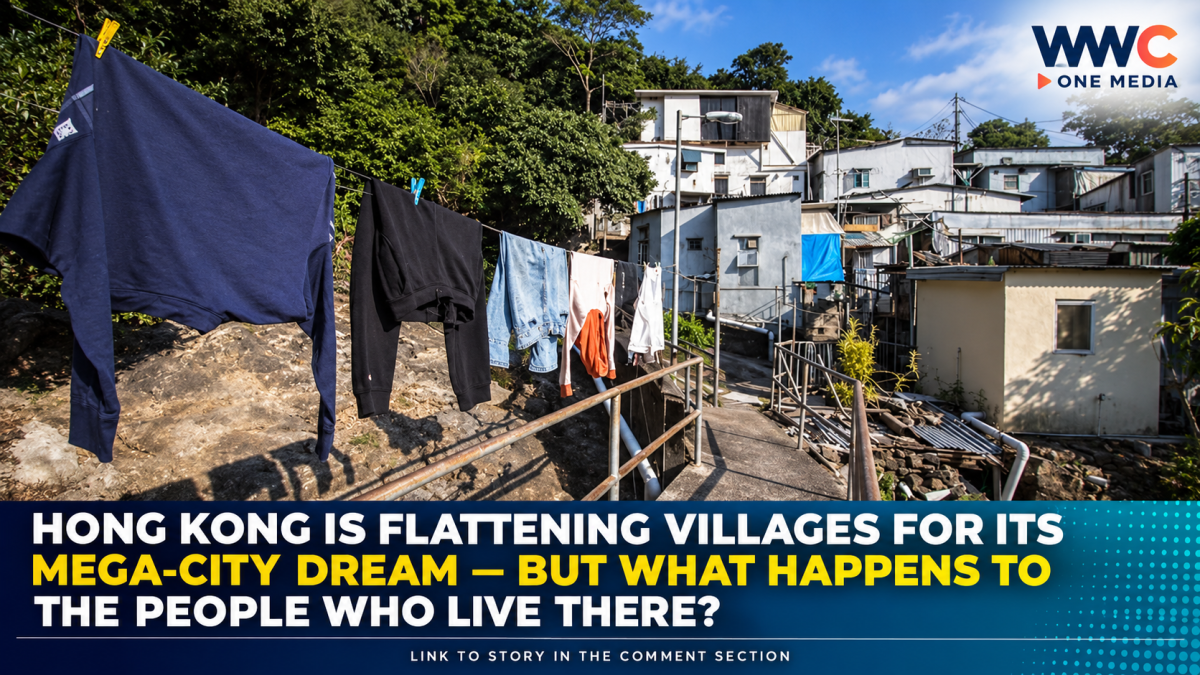
HONG KONG — Hong Kong is pushing ahead with one of its most ambitious development projects in decades, but the transformation is coming at a deeply personal cost for some residents whose homes are being cleared to make way for the Northern Metropolis.
Villages in the city’s northern New Territories are being demolished or cleared as the government acquires land for a massive new urban and technology hub near the mainland Chinese border.
For officials, the project promises thousands of homes, new industrial capacity, logistics infrastructure and jobs.
For some villagers, however, it means leaving homes and communities where families have lived for generations.
And that has turned the Northern Metropolis into more than a property and infrastructure project.
It has become a battle over development, compensation, land rights and the future of Hong Kong itself.
Villages make way for Hong Kong’s mega-project
The Northern Metropolis covers a huge area of Hong Kong’s northern New Territories and is being developed as a major new urban and economic zone.
The government’s plans include residential districts, technology parks, modern logistics facilities and supporting infrastructure.
One of the areas undergoing major transformation is Hung Shui Kiu/Ha Tsuen, where land is being cleared and prepared for redevelopment.
The Lands Department says it is responsible for land resumption and clearance across several Northern Metropolis development areas, including Hung Shui Kiu/Ha Tsuen, Kwu Tung North/Fanling North, San Tin Technopole and Yuen Long South.
The scale is enormous.
And as bulldozers move in, existing villages are increasingly being replaced by planned urban districts.
Residents have fought the clearances
The redevelopment has already produced tense confrontations.
In June, hundreds of security guards and police officers were deployed to evict residents from Tin Sam Tsuen as part of the Northern Metropolis land-clearance process.
About 60 households involving more than 70 residents were affected, according to the Development Bureau.
Some residents said they had not received satisfactory compensation or relocation arrangements. The government, however, said more than 40 of the affected households were not eligible for the relevant packages, while most of the remaining households had either received compensation or secured rehousing arrangements.
The dispute highlights one of the most difficult aspects of the Northern Metropolis plan.
The government sees the land as essential for a new generation of housing and economic development.
Residents see the same land as their home.
The government says the project will transform northern Hong Kong
The Northern Metropolis is designed to address several of Hong Kong’s long-standing challenges at once.
The city needs more housing.
It wants to strengthen its technology and innovation industries.
It needs additional logistics capacity.
And policymakers want to create a stronger economic connection between Hong Kong and the Greater Bay Area.
The northern New Territories provide something Hong Kong has very little of:
large areas of land capable of being developed at scale.
That makes the region strategically important.
The government is therefore trying to transform previously rural and industrial areas into dense, modern communities.
The first major land tender has already been awarded
The scale of the project became even clearer in August when Hong Kong awarded its first major Northern Metropolis “large-scale land disposal” tender.
The winning consortium, HSK New Development, secured a nearly 11-hectare Hung Shui Kiu site for HK$1.03 billion.
The consortium includes subsidiaries linked to China Overseas Land & Investment, China Merchants Land, China Resources Land, China Tourism Group, JD.com and Sino Land.
The government described the deal as a vote of confidence in the Northern Metropolis.
The consortium itself estimates that the overall project will require approximately HK$16.8 billion in investment and create more than 6,000 jobs.
That is the economic promise behind the demolition and land-clearance campaign.
The government is not simply creating another residential district.
It is attempting to build a new economic engine.
Thousands of new homes are planned
The Hung Shui Kiu pilot project alone will include three residential sites capable of producing approximately 3,000 flats, assuming an average unit size of around 50 square metres.
The project will also include a smart modern logistics centre with permitted gross floor area of up to 50,950 square metres.
JD.com is expected to serve as the leading enterprise for the logistics centre, with part of the facility scheduled to begin operating within 55 months.
The strategy is to put housing, employment and logistics infrastructure closer together.
Instead of forcing workers to commute long distances to established urban areas, the Northern Metropolis is intended to create new communities around emerging industries.
This isn’t just about housing
The project is also part of Hong Kong’s attempt to reposition itself economically.
For years, the city’s economy has been heavily dependent on finance, property and services.
The Northern Metropolis provides an opportunity to expand into areas including:
- advanced technology
- innovation
- modern logistics
- research and development
- strategic industries
- cross-border business
That is why the government is willing to devote enormous resources to the project.
The Hung Shui Kiu pilot area includes Enterprise and Technology Park sites, while other Northern Metropolis projects are being positioned around technology and innovation.
Beijing’s role is increasingly visible
Another defining feature is the participation of major mainland Chinese companies.
The winning Hung Shui Kiu consortium includes several mainland-linked property and business groups as well as JD.com and Hong Kong developer Sino Land.
For Hong Kong authorities, the involvement demonstrates that the Northern Metropolis can attract capital and companies from across the Greater Bay Area.
It also fits with Beijing’s broader strategy of integrating Hong Kong more closely with neighboring mainland cities.
The Northern Metropolis sits directly beside Shenzhen, making it particularly valuable as a potential cross-border economic corridor.
But the land was never empty
This is where the political and social controversy begins.
The government may describe the Northern Metropolis as a new city, but parts of the land earmarked for redevelopment are already occupied.
There are villages.
There are agricultural operations.
There are businesses.
There are homes built under Hong Kong’s long-standing small-house system.
And there are communities with histories stretching back generations.
Clearing those areas therefore involves much more than moving construction equipment onto vacant land.
It means relocating people.
Compensation remains a major flashpoint
The government says it has established compensation and rehousing mechanisms for affected residents.
But eligibility can vary depending on the legal status of properties and occupants.
That has created disputes.
During the Tin Sam Tsuen clearance, the Development Bureau said more than 40 of approximately 60 affected households were not eligible for the relevant compensation or rehousing packages.
Residents, meanwhile, have argued that government offers do not adequately reflect the value of what they are losing.
For villagers, the issue isn’t necessarily just the financial value of a building.
A house may represent decades of family history.
A village may represent an entire social network.
Once those communities disappear, they cannot simply be rebuilt somewhere else.
Environmental concerns are also part of the debate
The Northern Metropolis is being built partly on land that includes former agricultural areas, wetlands and other undeveloped spaces.
The government has sought to balance development with environmental considerations, but the scale of construction inevitably raises questions about the loss and transformation of natural and rural landscapes.
More than 30 sites in the Northern Metropolis had been rezoned for residential use by June, with potential capacity estimated at around 58,600 homes, according to The Standard.
That gives an indication of just how dramatically the northern New Territories could change.
Areas that today look rural could eventually become dense urban neighborhoods.
The government sees a long-term payoff
Officials argue that the short-term disruption is necessary for a much larger long-term benefit.
More housing could ease Hong Kong’s chronic land and housing pressures.
New technology parks could attract companies.
Modern logistics facilities could strengthen Hong Kong’s position in regional supply chains.
And new transport infrastructure could make the northern New Territories more closely connected to Shenzhen and the wider Greater Bay Area.
The government has also moved to streamline planning and land procedures to accelerate the project.
In July, it gazetted the Northern Metropolis Development Bill, designed to simplify certain planning and land processes and speed up construction.
Investors are already betting on the transformation
The first major land tender is perhaps the clearest sign that private-sector investors see potential in the government’s vision.
The winning consortium did not simply buy a small development plot.
It committed to a large-scale project involving residential development, logistics infrastructure and significant site formation.
The government estimates that the development could generate thousands of jobs.
The consortium estimates total investment of HK$16.8 billion.
That represents a substantial private-sector bet on the future of the Northern Metropolis.
But the biggest test won’t be the bulldozers
Building roads, homes and technology parks is one thing.
Creating a successful new city is another.
The Northern Metropolis will ultimately have to attract residents.
It will need businesses.
It will need transportation.
It will need schools, hospitals, parks and community facilities.
And it will have to convince people that living and working there is genuinely attractive.
A collection of new buildings does not automatically become a successful city.
Hong Kong is betting on a completely different future
The Northern Metropolis represents a fundamental shift in Hong Kong’s geography.
For generations, the city’s economic heart was concentrated around Victoria Harbour and the established urban areas.
The government now wants the northern border region to become another major center of population and economic activity.
That transformation could reshape where Hong Kong residents live, where companies operate and how the city interacts with Shenzhen.
But the price of that transformation is already being paid by people whose homes stand in the path of development.
And that creates the central dilemma.
How do you build a city for millions of future residents without losing sight of the communities already there?
Hong Kong’s Northern Metropolis may eventually become a symbol of technological ambition, economic integration and urban renewal.
But before the skyscrapers rise, the government must answer a more immediate question for the families being displaced:
When progress arrives at your front door, who gets to decide what your home is worth?



Leave a Reply