
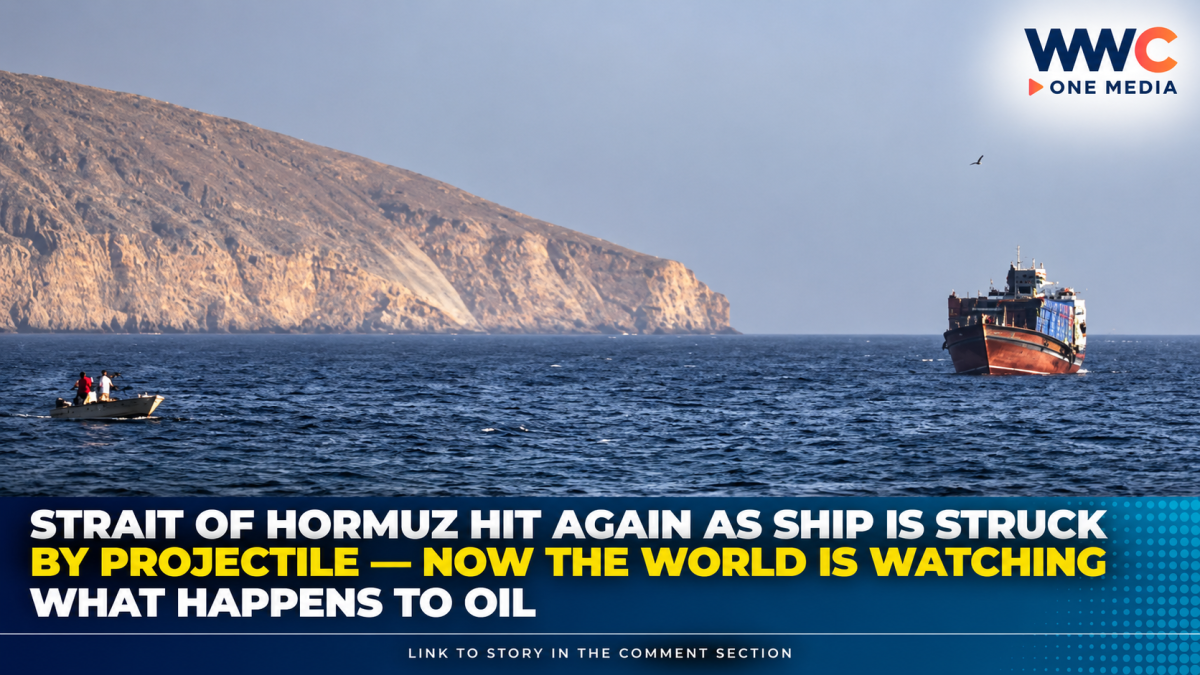
The Strait of Hormuz has been hit by another serious maritime security incident, raising fresh fears that the escalating conflict around the strategic waterway could further disrupt global oil supplies and send energy prices even higher.
The UK Maritime Trade Operations (UKMTO), a British navy-affiliated maritime security agency, reported on September 13 that a vessel was struck by a projectile while transiting the Strait of Hormuz.
UKMTO later reported that a fire had broken out and that local authorities were evacuating people from the vessel. Early reports did not establish the type of projectile, the extent of the damage or who was responsible.
The incident came as shipping activity through the waterway was already severely disrupted by months of escalating conflict involving Iran, the United States and other regional actors.
A new warning for global energy markets
The latest attack immediately revived concerns about the security of one of the world’s most important energy chokepoints.
The Strait of Hormuz connects the Persian Gulf with the Gulf of Oman and the wider Arabian Sea. A significant share of global oil and liquefied natural gas exports normally passes through the narrow waterway.
With attacks on commercial vessels increasing, traders and shipping companies are increasingly concerned that the disruption could become longer-lasting.
Reuters reported that the latest incident came after Saudi Arabia temporarily shut its East-West oil pipeline following a drone attack, adding another layer of uncertainty to regional energy flows.
Oil has already broken above $100
The shipping attacks have already shaken oil markets.
Brent crude futures moved above US$100 a barrel earlier this week as traders assessed the growing threat to Middle Eastern energy supplies.
On September 10, Reuters reported that Brent settled at US$107.63 a barrel, gaining more than 6% in one of the sharpest daily increases of the recent escalation. U.S. West Texas Intermediate crude also moved above US$100.
The jump reflects a simple market fear: if ships cannot safely move through Hormuz, less oil can reach international markets — or shipping companies will demand much higher premiums to take the risk.
Shipping traffic is already far below normal
The number of vessels passing through Hormuz has fallen dramatically.
Reuters reported that only seven vessel transits were recorded on September 10, compared with a 10-day average of about 14.
The previous day, only six commodity vessels were recorded passing through the strait.
Those figures may not capture every vessel because some ships can travel with their transponders switched off, but the available tracking data nevertheless shows how dramatically commercial traffic has been affected.
For shipping companies, the problem is no longer simply the cost of fuel.
It is the risk of sending crews and expensive vessels through an active conflict zone.
The attacks are becoming more frequent
The latest incident follows a major escalation earlier in September.
On September 9, Iran said it had attacked 10 ships near the Strait of Hormuz after the United States destroyed five Iranian oil tankers.
Reuters described the episode as the biggest declared wave of attacks against shipping by the two sides since the war began.
At least one seafarer was reported killed and another was reported missing in the attacks.
The attacks have transformed what was already a dangerous maritime environment into an increasingly unpredictable one for commercial operators.
A direct threat to the world’s oil supply
The Strait of Hormuz matters because there are limited alternatives for moving large volumes of oil out of the Persian Gulf.
Countries including Saudi Arabia, Iraq, Kuwait, Qatar and the United Arab Emirates rely heavily on maritime routes through or around the strait to reach international markets.
Any sustained reduction in shipping capacity can therefore affect not just Middle Eastern economies but fuel markets around the world.
That means a conflict involving a single vessel can quickly become a global economic problem.
Higher crude prices can eventually feed into gasoline, diesel, aviation fuel, transportation and manufacturing costs.
For countries that import most of their energy, a prolonged disruption could translate into higher inflation and pressure on household budgets.
The danger is not limited to tankers
One of the most important developments in the latest escalation is that the risk is spreading beyond conventional oil tankers.
Commercial vessels of different types are increasingly facing threats as military operations, missile attacks and maritime restrictions converge around the waterway.
AP reported that an Iranian commercial vessel was struck near Qeshm Island on Sunday, with Iranian state media reporting that one crew member was killed and several others wounded.
Iranian authorities blamed what they described as a “terrorist enemy,” but the source of the projectile had not been independently established in the initial reports.
That uncertainty is itself a problem.
When shipowners cannot determine who might attack a vessel or where the next strike could occur, they have greater incentives to delay voyages, reroute vessels or demand higher insurance and freight rates.
The United States is changing how it protects tankers
The security situation has also forced Washington to adjust how it provides protection for commercial shipping.
The Financial Times reported that U.S. authorities have narrowed the periods during which tankers travelling through the southern route of the Strait can receive air-defense protection.
The change reflects the enormous cost and operational difficulty of maintaining continuous aerial coverage in an increasingly dangerous environment.
Commercial ships therefore face an increasingly complicated calculation: sail through a dangerous chokepoint with military protection available only under certain conditions, or remain outside the waterway and wait.
Neither option is cheap.
The global economy is watching the next move
The most immediate question is whether the latest attack remains an isolated incident or becomes part of another sustained wave of attacks on commercial shipping.
That distinction could determine where oil prices go next.
If shipping continues despite the attacks, markets may eventually stabilize as traders become accustomed to the elevated risk.
But if vessels are repeatedly hit, crews are killed or major tankers stop transiting altogether, the consequences could become much more serious.
Reuters reported that tanker freight rates have already reached record levels following the recent attacks, showing that the disruption is affecting not only the price of crude itself but also the cost of physically transporting it.
A diplomatic effort is coming — but the danger remains
Regional governments are also attempting to address the crisis diplomatically.
Iran is scheduled to meet Gulf states and Iraqi representatives in Oman on September 14 to discuss maritime security and shipping through the Strait of Hormuz.
Oman is facilitating the talks as regional governments search for ways to reduce the disruption.
Whether those discussions can produce meaningful guarantees for commercial shipping remains uncertain.
For now, vessels continue to face an extremely volatile environment.
The question nobody wants to answer
The Strait of Hormuz has survived numerous geopolitical crises before.
But the current situation is different because the disruption is happening alongside direct attacks on commercial shipping, military confrontation and growing uncertainty over the ability of vessels to safely transit the waterway.
The latest projectile strike therefore matters far beyond the fate of one ship.
It is another warning to the global energy market that the world’s most important oil chokepoint remains vulnerable.
And with oil already above US$100 a barrel and commercial traffic running well below normal levels, the question is no longer whether Hormuz is affecting the global economy — it is how much worse the shock could become if the attacks continue.



Leave a Reply