
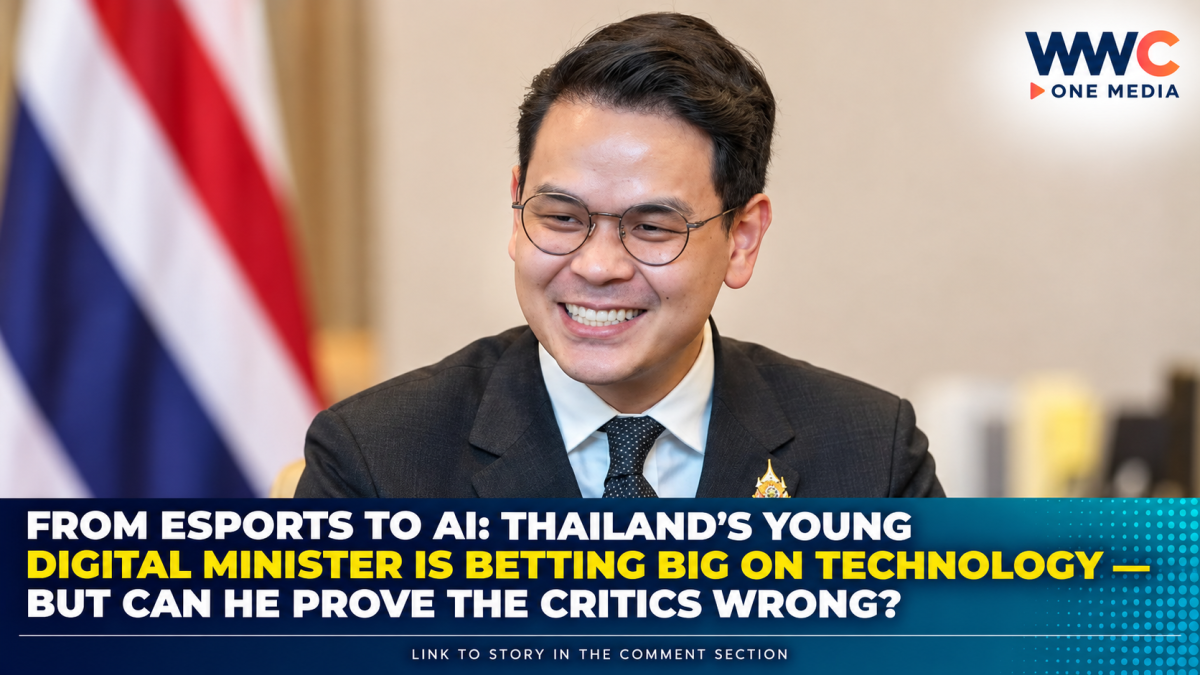
Thailand is making an aggressive push to turn technology, artificial intelligence and digital industries into engines of future economic growth — and at the center of that strategy is one of the country’s youngest Cabinet ministers, Chaichanok Chidchob.
At 36, Chaichanok, Thailand’s Minister of Digital Economy and Society, is trying to move the country beyond its traditional strengths and build a broader digital ecosystem spanning artificial intelligence, cloud infrastructure, gaming, digital services and technology skills.
But his rise comes with an unusual level of scrutiny.
The minister is the son of political heavyweight Newin Chidchob, the influential figure behind the Bhumjaithai Party. Chaichanok acknowledges that his family connections helped open doors, but argues that his performance — rather than his surname — should ultimately determine whether he succeeds.
From esports to government technology
Chaichanok’s technology ambitions are partly rooted in his previous experience in sports and esports.
Before entering the Cabinet, he was involved with Buriram United and its esports operations, giving him first-hand experience with an industry that Thai policymakers increasingly see as more than entertainment.
Thailand’s government is now seeking to develop gaming into a broader economic sector, with officials promoting the country as a potential ASEAN gaming hub and looking to connect Thai developers, programmers and creators with international companies and investors.
That experience has helped shape Chaichanok’s view that digital industries can create jobs, develop talent and generate intellectual property rather than simply consume technology produced elsewhere.
The government is also reviewing legislation intended to promote Thailand’s gaming industry, including questions about whether the definition of “games” should expand to cover areas such as board games, trading cards and related digital businesses.
AI is now the bigger bet
The minister’s most ambitious agenda, however, is artificial intelligence.
Thailand recently launched the TH-AI Passport, a program designed to give five million eligible citizens aged 15 and above access to more than 30 professional AI models from 14 providers for up to one year.
According to Chaichanok, around 1.5 million people had registered through the AiPass platform by the time of his interview with The Straits Times. The stated goal is to familiarize ordinary Thais with AI tools and help upgrade the country’s digital workforce.
The program has also become politically controversial.
Opposition lawmakers have questioned the approximately 1.6 billion baht project, raising allegations concerning procurement procedures, possible conflicts or collusion and the use of public funds. Chaichanok has rejected wrongdoing and told The Straits Times that internal investigations found the project was conducted within the law.
Those allegations remain allegations, rather than established findings of wrongdoing.
Thailand is building an AI infrastructure strategy
The government’s plans go well beyond giving citizens access to AI chatbots.
Thailand’s national AI planning committee recently approved a framework centered on four areas: infrastructure, trust, human capital and value creation.
Among the proposals are a National AI Cloud, upgrades to the LANTA II supercomputer and a National AI Data Bank. The strategy also calls for AI governance mechanisms, workforce development and support for Thai AI companies seeking international growth.
Chaichanok has separately promoted greater use of centralized cloud infrastructure for government agencies, arguing that shared digital infrastructure could improve efficiency and reduce costs.
He also wants AI to reach beyond Bangkok and Thailand’s major urban centers, including applications in disaster warnings and public services.
Thailand has already highlighted areas such as disaster management, public-service delivery and combating online scams as potential practical applications for AI.
A potential Nvidia connection?
Chaichanok also indicated that Thailand could eventually work with Nvidia to strengthen its AI ecosystem.
The minister suggested that discussions could involve more than semiconductors, potentially extending to the wider ecosystem needed to support sustainable AI development in Thailand.
He did not disclose firm details, saying plans would need to be finalized before they could be announced.
If such cooperation materializes, it could become an important component of Thailand’s attempt to attract high-value technology investment and strengthen its domestic AI capabilities.
Digital growth also comes with new risks
Thailand’s digital transformation is not solely about economic opportunity.
The government is also confronting issues surrounding online safety, data protection and the rapidly expanding influence of digital platforms.
In August, the Digital Economy and Society Ministry held discussions with Roblox about strengthening child protection, including age verification, facial age-estimation technology and AI-powered content moderation.
The ministry also proposed studying whether Thailand’s National Digital ID system could eventually be linked to Roblox accounts for identity and age verification, while emphasizing that privacy implications would need to be assessed.
That illustrates the increasingly complicated role facing Thailand’s digital ministry: encouraging rapid technological adoption while simultaneously trying to build safeguards around the technology.
The Chidchob problem
For Chaichanok, however, technology may not be the only challenge.
His political family name follows him everywhere.
His father, Newin Chidchob, is a powerful figure in Thai politics and the founder and de facto power behind the Bhumjaithai Party. The family is also closely associated with Buriram’s football and sports businesses.
Chaichanok says he understands why people question whether his rapid political rise is connected to his family background.
But he argues that inherited connections cannot substitute for results.
His message is essentially simple: give him the opportunity to perform, then judge him on what he delivers.
That puts considerable pressure on the young minister.
Because if Thailand’s AI ambitions succeed, Chaichanok could become one of the politicians associated with the country’s transformation into a major regional technology hub.
If they fail — particularly amid continuing questions over public spending and political connections — the criticism surrounding his appointment and family background could become even louder.
Thailand’s bigger technology gamble
The stakes are therefore much larger than one AI program.
Thailand is attempting to build a digital economy that can create skilled jobs, attract technology investment, develop domestic intellectual property and make AI useful across government, business and everyday life.
The country is simultaneously promoting gaming and esports, expanding cloud infrastructure, developing AI governance and preparing a new generation of technology workers.
The strategy is ambitious.
But the real test will not be how many AI accounts Thailand can register or how many technology projects it announces.
It will be whether those investments translate into stronger Thai companies, better-paying jobs, greater productivity and technology that reaches people outside the country’s biggest cities.
For Chaichanok Chidchob, that may ultimately be the hardest match of all.
Thailand is betting its digital future on AI, gaming and technology. But with billions of baht involved and political scrutiny intensifying, the question now is whether the young minister can turn that vision into results — and prove that the Chidchob name is not the only reason he is at the center of Thailand’s next technology revolution.




Leave a Reply