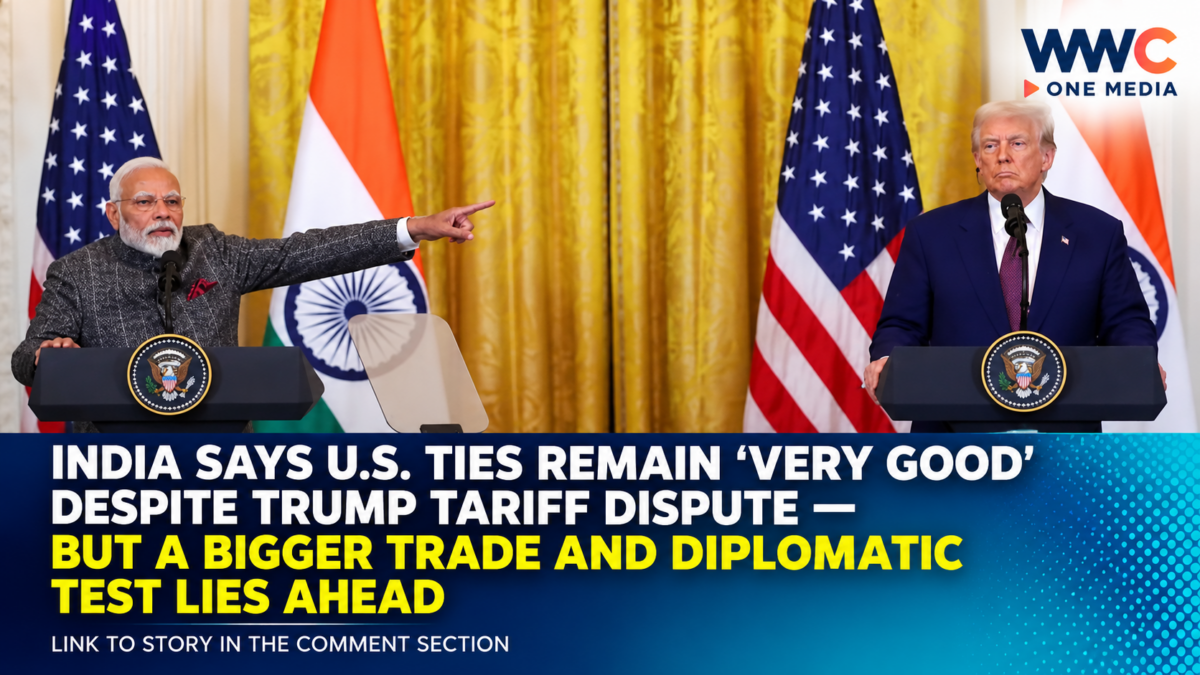
NEW DELHI, INDIA — October 14, 2026 — India is pushing back against suggestions that its strategic partnership with the United States is deteriorating, with Commerce and Industry Minister Piyush Goyal declaring that relations remain “very good” despite stalled trade negotiations, tariff uncertainty and diplomatic tensions involving President Donald Trump’s administration.
Speaking Wednesday at the Bloomberg New Economy Forum in New Delhi, Goyal portrayed the relationship between the world’s two largest democracies as stronger and more consequential than their immediate trade disagreements.
His remarks came as both countries struggled to finalize a bilateral trade agreement, with unresolved differences over market access, tariffs, energy purchases and politically sensitive industries.
For Prime Minister Narendra Modi’s government, preserving ties with Washington is particularly important as India seeks foreign investment, access to advanced technology and a larger role in global manufacturing supply chains.
But Goyal’s optimistic assessment comes with an important qualification.
Despite months of negotiations, India and the United States have yet to conclude the broader trade agreement businesses have been awaiting.
The bigger question is whether their strategic partnership can withstand increasing economic pressure without allowing unresolved disputes to damage commercial confidence.
Goyal Says India–U.S. Relations Are Already Strong
Goyal sought to reassure investors and policymakers that the bilateral relationship remains stable despite recent tensions.
“I don’t see any problem as we speak,” he said during the New Delhi forum.
He emphasized that India and the United States share a relationship whose importance extends far beyond merchandise trade.
According to Goyal, cooperation between the countries includes defense, advanced technology, critical minerals, supply-chain security and people-to-people exchanges.
He also indicated that relations would continue improving regardless of changes in political thinking or leadership in either country.
His comments suggested New Delhi is seeking to separate short-term trade disagreements from the broader strategic relationship.
That distinction matters because the United States remains a major destination for Indian exports and an important source of investment, technology and business partnerships.
At the same time, Washington views India as an important economic and strategic partner in the Indo-Pacific region.
India–U.S. Trade Talks Remain Unresolved
Behind the diplomatic reassurance lies a more difficult economic reality.
India and the United States have held extensive negotiations aimed at reaching a more comprehensive trade agreement, but progress has slowed.
The two governments announced an interim trade framework in February 2026, raising expectations that a formal agreement could follow.
However, negotiations have encountered renewed obstacles involving tariff treatment, market access and commitments by both sides.
On October 6, Reuters reported that discussions had reached a plateau, with no immediate breakthrough expected.
India’s Finance Minister Nirmala Sitharaman similarly acknowledged that further compromises were becoming increasingly difficult.
U.S. Trade Representative Jamieson Greer also indicated that signing an agreement was not imminent because significant disagreements remained.
For exporters and investors, the continuing uncertainty complicates decisions about production, sourcing and future investment.
Businesses seeking long-term access to the American market need predictable tariff rules.
Without a finalized agreement, some Indian industries remain exposed to changes in U.S. trade policy.
Trump’s Tariff Policies Continue to Pressure India
Trade tensions have intensified under Trump’s broader strategy of using tariffs to protect American industries and negotiate market concessions.
India has been among the countries affected by Washington’s shifting trade measures.
A particular source of concern is new U.S. legislation giving the administration authority to impose tariffs of up to 100% on countries involved in certain purchases of Russian oil.
India has continued purchasing Russian petroleum, making the legislation relevant to its trade negotiations with Washington.
However, the existence of tariff authority does not mean the maximum duty has already been applied to all Indian products.
Actual tariff treatment depends on the legal provisions, executive decisions, product classifications and applicable exemptions.
The threat nevertheless creates additional uncertainty for Indian exporters.
New Delhi must balance its energy-security priorities against the commercial importance of maintaining access to the American market.
For Washington, Russian energy purchases have become another pressure point in a broader geopolitical and trade relationship.
Russian Oil Becomes a Major Negotiating Challenge
India is one of the world’s largest energy importers and depends heavily on overseas supplies to meet domestic demand.
The country has purchased significant quantities of Russian crude oil in recent years, benefiting at times from discounted prices.
Indian policymakers have emphasized the need to secure affordable energy for households and businesses.
Washington, however, has increasingly connected trade relations with efforts to place economic pressure on countries supporting Russia’s energy revenues.
This creates a challenging diplomatic environment.
India must manage its relationships with major oil suppliers while seeking to protect export access and maintain cooperation with the United States.
A significant escalation of U.S. tariffs could affect Indian exporters and increase uncertainty surrounding the broader bilateral relationship.
But there is no confirmed agreement that India will stop purchasing Russian oil as a condition of concluding a trade deal.
Any such outcome would require explicit policy decisions or negotiated commitments.
India’s Export Economy Has a Lot at Stake
The United States remains India’s largest export market, making the trade negotiations commercially significant.
According to Reuters, Indian exports to the U.S. reached approximately US$42.79 billion during April through August 2026.
India also recorded an approximately US$34-billion trade surplus with the United States during its 2025–2026 financial year.
The figures underline how much Indian businesses stand to gain from stable market access.
Industries potentially affected by trade uncertainty include textiles, apparel, engineering products, chemicals, pharmaceuticals, electronics and other manufactured goods.
The effects differ by sector because U.S. duties and product-specific rules vary.
For companies planning production and investment, sudden tariff increases can make it harder to estimate costs and remain competitive.
A comprehensive agreement could help reduce uncertainty, but its benefits will depend on the final provisions.
The absence of a deal does not mean trade between the countries has stopped.
It means companies must continue operating under the existing rules while monitoring the possibility of further changes.
Diplomatic Friction Extends Beyond Trade
The relationship has also faced disagreements over security and immigration.
Trump previously claimed that his administration helped mediate an end to armed clashes between India and Pakistan in 2025.
Those claims irritated New Delhi, which has disputed the characterization of outside mediation in its bilateral conflict with Pakistan.
The issue is politically sensitive in India, where national sovereignty and foreign involvement in regional security matters are major concerns.
Another source of friction involves U.S. immigration policy.
Vice President JD Vance has urged American companies to prioritize hiring domestic workers, while U.S. authorities have increased scrutiny of some immigration programs used by international technology businesses.
The H-1B visa system is particularly important to India’s technology services industry, which maintains extensive operations in the United States.
Restrictions or greater uncertainty around skilled-worker mobility could affect recruitment and business planning.
India has expressed concern about some of Washington’s immigration-related actions and rhetoric.
These disagreements illustrate why Goyal’s reassurances do not amount to a declaration that all bilateral disputes have been resolved.
Defense, Technology and Critical Minerals Keep the Partnership Intact
Despite trade and immigration tensions, India and the United States continue to share substantial strategic interests.
Defense cooperation remains important as both countries navigate security challenges across the Indo-Pacific region.
Technology partnerships also involve semiconductors, advanced manufacturing, artificial intelligence and supply-chain resilience.
Critical minerals are another growing area of strategic importance.
Countries seeking to develop electric vehicles, advanced batteries, electronics and defense equipment are attempting to diversify access to essential raw materials and processing capabilities.
India and the United States have incentives to cooperate in these sectors even when they disagree on tariffs or energy policy.
This broader relationship helps explain Goyal’s confidence that bilateral ties will continue improving.
For both governments, allowing a trade dispute to undermine every area of cooperation would carry substantial strategic costs.
India Also Signals a Possible Reset With China
Goyal’s comments about Washington were accompanied by another important diplomatic signal.
India is working to improve economic relations with China following years of tension.
Speaking at the same forum, Goyal said New Delhi remained open to engagement with countries willing to provide fair and reliable commercial arrangements.
He acknowledged that India and China had experienced disagreements but indicated that efforts to rebuild relations were continuing.
The minister also emphasized that geopolitical conditions and predictable business relationships would influence the pace of cooperation.
The remarks suggest India is maintaining flexibility in its international economic strategy.
While strengthening ties with Washington remains a priority, New Delhi is also looking for opportunities to expand trade and investment relationships elsewhere.
China remains an important manufacturing and trading partner for India, particularly in supply chains involving electronics, industrial equipment and other intermediate goods.
However, improved economic engagement does not necessarily mean the countries have resolved their longstanding border and strategic disagreements.
Why India’s China Strategy Matters to Washington
India’s willingness to rebuild selected economic ties with China highlights the complicated balance underlying its foreign policy.
The United States considers India an important partner in maintaining a stable Indo-Pacific region and diversifying supply chains.
At the same time, India’s economy relies on international relationships that cannot easily be reduced to a single strategic alliance.
New Delhi seeks access to American technology and investment while maintaining commercial connections with countries including China and Russia.
This approach reflects India’s emphasis on strategic autonomy.
Rather than committing exclusively to one economic bloc, India attempts to preserve flexibility in responding to changing global conditions.
For Washington, that creates both opportunities and challenges.
A stronger partnership with India can advance American economic and strategic objectives, but U.S. policymakers may also seek concessions that New Delhi considers inconsistent with its domestic priorities.
The success of future negotiations will depend on whether both sides can accommodate those differences.
Can India and the U.S. Still Reach a Trade Deal?
A final agreement remains possible, but the timetable is uncertain.
Reuters reported that further high-level diplomatic engagement could help restore momentum to negotiations.
President Trump and Prime Minister Modi discussed trade, defense, energy and critical technology cooperation during a telephone conversation at the beginning of October.
Such discussions provide opportunities to address political differences that officials may struggle to resolve through technical negotiations alone.
However, high-level contact should not be confused with a completed trade deal.
Both governments still need to agree on the scope of concessions, tariff arrangements and other commitments.
For India, the main priority is securing reliable access to the U.S. market while protecting politically and economically sensitive domestic sectors.
For Washington, the negotiations provide an opportunity to pursue market-opening commitments and broader strategic objectives.
The result will depend on whether the economic benefits of compromise outweigh the domestic political costs.
What Happens Next?
Investors, exporters and policymakers will be closely watching the next round of diplomatic engagements.
The key questions concern potential tariff changes, energy-related sanctions, market-access commitments and whether the February trade framework can be translated into a more complete agreement.
Any new restrictions affecting skilled workers could also influence relations, particularly in the technology sector.
For India’s government, maintaining confidence in its relationship with Washington remains essential as the country attempts to accelerate manufacturing growth and attract international investment.
For the Trump administration, preserving cooperation with India serves wider strategic goals in Asia.
But diplomatic optimism alone cannot eliminate the commercial uncertainties confronting businesses.
Piyush Goyal’s declaration that India–U.S. relations remain “very good” sends a reassuring message to investors and political leaders — but the real test will come when New Delhi and Washington must choose between protecting their domestic interests and making the compromises required to secure a lasting trade agreement.