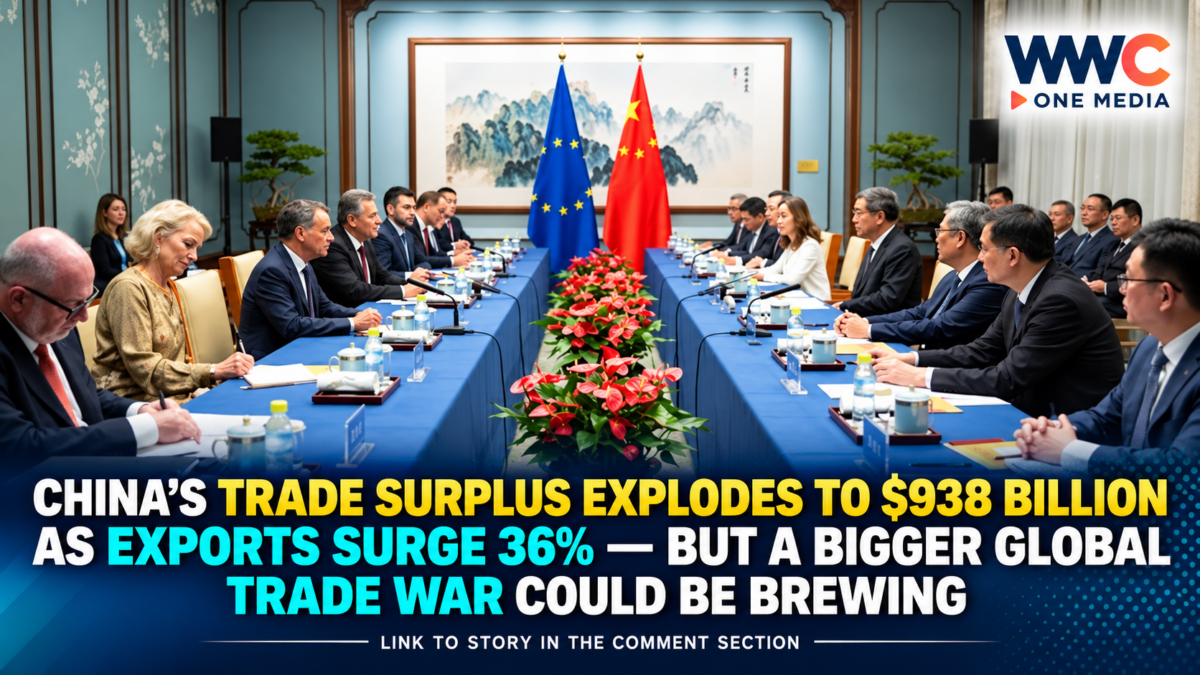
BEIJING, CHINA — October 14, 2026 — China’s massive export machine is approaching another historic milestone, with its goods trade surplus reaching US$938.11 billion during the first nine months of 2026 after overseas shipments surged at their fastest pace since February.
The latest figures from China’s General Administration of Customs showed exports jumping 36.3% in September from a year earlier, beating economists’ expectations and accelerating sharply from August’s 25% growth.
Imports also increased by 31%, but the export surge was strong enough to generate a record monthly trade surplus of US$133.53 billion.
The figures put the world’s second-largest economy on course to potentially surpass its approximately US$1.2-trillion annual goods trade surplus recorded in 2025.
But China’s extraordinary export performance is creating a growing international dilemma.
As Chinese companies gain market share in semiconductors, artificial intelligence equipment, automobiles and manufactured goods, the United States and European Union are becoming increasingly concerned about trade imbalances and competitive pressure on their domestic industries.
The question now is whether China’s booming export economy can sustain its momentum without triggering a more aggressive response from its global trading partners.
China’s Trade Surplus Approaches $1 Trillion
China’s goods trade surplus reached approximately US$938.11 billion between January and September 2026, according to customs figures reported by Reuters and Bloomberg.
September alone generated a US$133.53-billion surplus, compared with approximately US$119.1 billion in August.
The latest result also exceeded the US$117.8-billion median forecast in Bloomberg’s survey of economists.
The cumulative surplus reflects the difference between the value of China’s merchandise exports and imports. It does not mean the government earned US$938 billion in profit or collected that amount in tax revenue.
China has benefited from strong manufacturing capacity, competitive pricing and sustained international demand for goods ranging from consumer electronics to industrial machinery.
If the current pattern continues, its annual trade surplus could establish another record.
However, the final outcome will depend on shipments and imports during the remaining three months of the year, as well as changing global economic and trade conditions.
September Exports Smash Expectations
China’s September export performance was considerably stronger than analysts anticipated.
Customs data showed that overseas shipments rose 36.3% year over year to US$447.18 billion.
Economists surveyed by Reuters had expected growth of approximately 25.5%.
Meanwhile, imports increased 31% to US$313.65 billion, above forecasts and faster than August’s 28.2% increase.
The result indicates strong external demand for Chinese-made goods and a substantial recovery in the value of cross-border trade compared with the previous year.
But the growth rates also require context.
Changes in product prices, exchange rates and the previous year’s trade levels can influence year-over-year percentage increases.
Strong growth in dollar-denominated exports does not necessarily mean an equivalent increase in the physical volume of goods shipped.
This distinction is particularly important for China’s expanding semiconductor industry.
Artificial Intelligence Is Fueling China’s Export Boom
One of the most important drivers behind China’s export surge is the global race to build artificial intelligence infrastructure.
Technology companies and governments are investing heavily in data centers, computer servers, semiconductor components and networking equipment.
China’s manufacturers are benefiting from demand for many of the products and components needed to support those investments.
According to Reuters, China’s semiconductor export value surged by approximately 108.1% in September.
Exports of automatic data-processing equipment also rose by roughly 54.6%.
Financial Times reporting indicated that AI-related shipments accounted for approximately 13 percentage points of China’s overall September export growth.
However, some semiconductor categories experienced unusually large increases in export value because prices rose sharply.
Separate reporting found that integrated circuit export values jumped around 136% while shipment volumes showed much more modest growth.
This means part of the AI-related export boom reflects higher prices rather than purely stronger unit demand.
Nevertheless, the global expansion of AI computing has become a significant source of demand for Chinese technology manufacturers.
Chinese Automakers Continue Their Global Expansion
China’s automobile industry is also contributing to the export surge.
According to the Associated Press, the value of automotive exports increased approximately 54.3% in September.
Chinese manufacturers have been expanding into overseas markets as competition intensifies at home.
Electric vehicles, plug-in hybrids and conventional automobiles have become important elements of China’s export strategy.
Companies such as BYD are investing in international sales networks and manufacturing operations across multiple regions.
Southeast Asia, Latin America, Europe and other markets have become increasingly important destinations.
However, China’s automotive success is creating political resistance.
European manufacturers argue that low-cost Chinese vehicles and industrial subsidies are creating an uneven competitive environment.
The European Union has introduced trade measures affecting Chinese vehicles and recently reached an arrangement restricting certain hybrid car imports.
These actions show that expanding exports can increase sales while simultaneously creating new market-access challenges.
Europe Pushes Back Against China’s Growing Trade Surplus
China’s export strength is adding pressure to economic relations with the European Union.
Financial Times reporting showed that Chinese exports to the EU increased approximately 25.3% in September compared with the previous year.
European policymakers have expressed concern that growing imports from China are widening an already substantial trade imbalance.
Industries including automobiles, steel, industrial equipment and advanced manufacturing are at the center of the debate.
European officials argue that Chinese state support, industrial overcapacity and barriers to market access can undermine fair competition.
Beijing rejects what it considers protectionist trade restrictions and argues that its manufacturing competitiveness reflects efficiency, investment and innovation.
Both sides have strong economic incentives to preserve trade relations.
European consumers and businesses benefit from access to affordable products and components, while Chinese companies depend on international markets.
But disagreements over subsidies, industrial capacity and market access could become increasingly difficult to resolve if trade imbalances continue widening.
U.S.–China Trade Relations Remain Fragile
China’s September exports to the United States rose approximately 39.6% compared with a year earlier, according to Financial Times reporting.
However, the increase does not necessarily indicate that U.S.–China trade relations have returned to normal.
Bilateral trade has been heavily affected by tariffs, negotiations and restrictions involving strategically important products.
A relatively weak comparison period can also make subsequent year-over-year growth appear unusually strong.
Although Washington and Beijing have taken steps to ease some trade tensions, major disagreements remain over technology, industrial policy and market access.
For U.S. policymakers, China’s growing goods trade surplus reinforces concerns about competition from Chinese manufacturers.
For Chinese exporters, the U.S. market remains commercially important but politically uncertain.
A renewed escalation involving tariffs or import restrictions could affect manufacturers, retailers and consumers in both countries.
The potential economic consequences extend beyond the two largest economies because global supply chains involve businesses across Asia, Europe and the Americas.
Southeast Asia Emerges as a Major Export Destination
ASEAN is playing an increasingly important role in China’s international trade strategy.
According to The Wall Street Journal, Chinese exports to Southeast Asian economies increased approximately 52.3% in September.
The region has become closely integrated with Chinese manufacturing through supply chains involving electronics, industrial equipment, machinery and consumer goods.
China’s growing trade with ASEAN creates opportunities for local businesses.
Manufacturers may benefit from access to competitively priced components, while logistics providers, ports and industrial developers can gain from increased commercial activity.
But the impact is not entirely positive.
Industries in the Philippines, Indonesia, Malaysia, Thailand and Vietnam may face stronger competition from lower-cost Chinese products.
Local manufacturers can struggle when imports gain market share faster than domestic companies can improve productivity.
For ASEAN governments, the challenge is balancing the benefits of regional trade with the need to support domestic industries and employment.
There is also the risk that future trade restrictions imposed by major economies could disrupt production networks extending across several countries.
The Philippines Could Feel Both Opportunities and Pressure
For the Philippines, China’s export surge illustrates the changing competitive environment for Asian manufacturers.
Philippine businesses import a wide range of machinery, electronic components, industrial supplies and finished goods from China.
Affordable imports can reduce production costs and benefit some consumers.
However, domestic producers may face more intense competition in industries where Chinese manufacturers benefit from larger production volumes and lower unit costs.
The country’s electronics industry could also experience indirect effects from expanding AI infrastructure demand.
Philippine semiconductor assembly, testing and electronics manufacturers participate in global supply chains that serve international technology markets.
A sustained increase in global demand for computing equipment could create opportunities for qualified Philippine suppliers.
But any gains would depend on product specialization, customer orders, production capabilities and investment.
The September Chinese customs figures alone do not establish that Philippine exporters have already experienced a corresponding increase in sales.
Strong Exports Hide Weakness in China’s Domestic Economy
China’s international trade performance contrasts sharply with some of the challenges facing its domestic economy.
The prolonged property-sector downturn continues to weigh on household confidence, investment and economic activity.
Consumer spending has also struggled to generate the same momentum as the manufacturing export sector.
These weaknesses have increased China’s reliance on overseas demand as a source of economic growth.
According to the Associated Press, the International Monetary Fund recently lowered its 2026 growth forecast for China to approximately 4.5%.
Beijing is targeting economic growth of roughly 4.5% to 5% this year.
Strong exports could help the country achieve its objective.
However, relying too heavily on international markets may create vulnerabilities when foreign governments introduce new restrictions or overseas demand weakens.
Economists have repeatedly emphasized the need for stronger household consumption and more balanced domestic growth.
The issue is becoming especially important as China’s expanding manufacturing capacity increases pressure on international trading partners.
Why China’s Trade Success Could Become a Global Risk
China’s trade surplus demonstrates the extraordinary scale and competitiveness of its industrial economy.
But persistent imbalances can produce political and financial consequences.
When domestic companies in importing countries face sustained competition, governments may respond with tariffs, subsidies, import controls or investigations.
These measures can disrupt established supply chains and increase costs for businesses and consumers.
At the same time, affordable Chinese products can help reduce expenses for manufacturers and accelerate the adoption of technologies such as electric vehicles and renewable-energy equipment.
The effects therefore differ across industries and countries.
For China, the challenge is preserving access to international markets while expanding domestic demand.
For the United States and Europe, it is balancing economic openness with concerns about industrial competitiveness and employment.
And for ASEAN, it is finding opportunities within China’s growing manufacturing network without allowing vulnerable local industries to fall behind.
What Happens Next?
The next major milestone will be whether China’s cumulative goods trade surplus crosses US$1 trillion before the end of 2026.
Economists will also monitor October export performance, semiconductor demand, automotive shipments and trade negotiations with major markets.
China’s economic growth figures will provide another indication of whether export strength is compensating for weak domestic demand.
Investors will be paying particular attention to companies involved in AI hardware, industrial manufacturing, logistics and international shipping.
But the longer-term outlook remains uncertain.
China’s export-led economy is benefiting from strong overseas demand, yet its growing trade surplus could intensify calls for restrictions in key markets.
China’s US$938-billion trade surplus is a remarkable demonstration of manufacturing strength — but the bigger question is whether its expanding global dominance will deliver another record year or trigger a broader trade confrontation that threatens the very markets fueling its success.