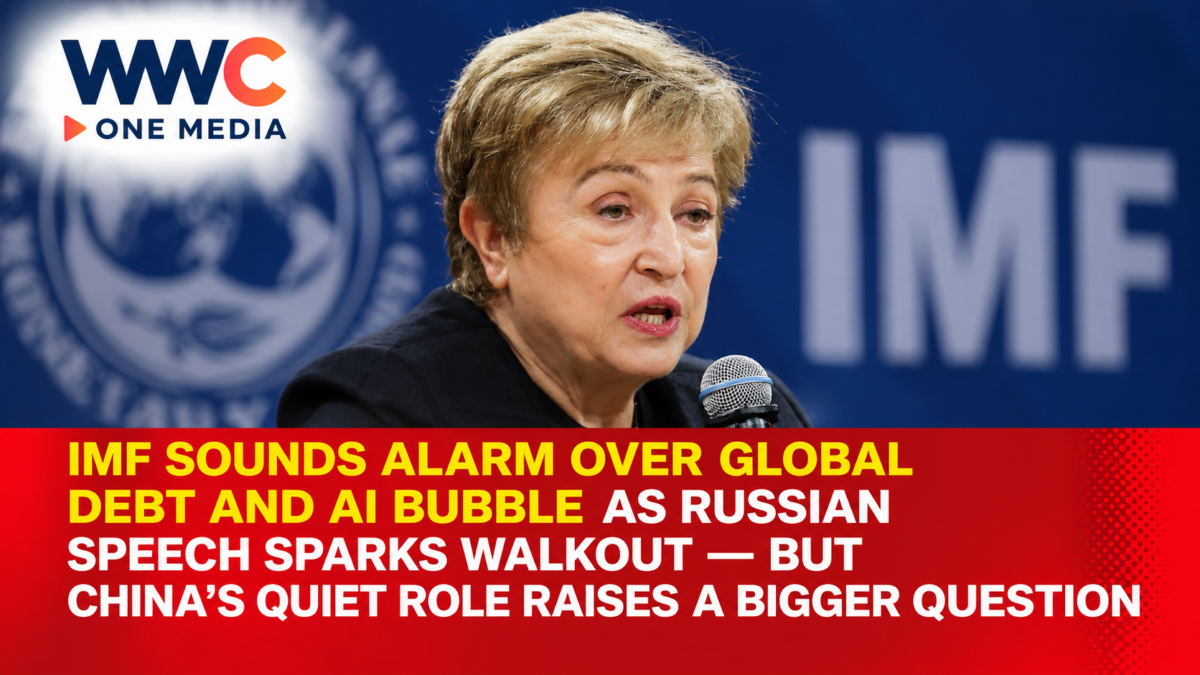
BANGKOK, Thailand — The world economy has survived another year of geopolitical shocks, expensive energy, mounting government debt and volatile financial markets—but global finance chiefs are increasingly worried that this resilience may be masking deeper vulnerabilities.
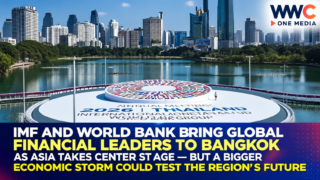
That was the central message emerging from the International Monetary Fund and World Bank’s 2026 annual meetings, held in Bangkok from October 12 to 18, where finance ministers, central bankers and international economic officials debated risks that could destabilize markets and undermine global growth.
Three developments dominated the gathering: the growing danger posed by public debt and rising bond yields, mounting concerns about artificial intelligence-related investment and borrowing, and geopolitical divisions highlighted by a walkout during remarks by a Russian official.
Meanwhile, China, long a central concern at international economic meetings, appeared to take a less prominent place in the broader debates—even as policymakers continued questioning its reliance on exports and weak domestic consumption.
For emerging economies, including the Philippines, the implications are substantial.
Higher global borrowing costs can pressure currencies, government budgets and investment flows, while geopolitical conflict and AI-driven financial volatility threaten an already uncertain global outlook.
The bigger question is whether governments can strengthen their economies before a sudden jump in borrowing costs or a major market correction exposes how vulnerable the global financial system remains.
IMF’s Warning: The Global Economy Is Resilient, but Not Safe
The IMF’s latest World Economic Outlook projects global economic growth of 3.1% in 2026 and 3.4% in 2027.
Those figures indicate that economic activity has remained relatively resilient despite high energy costs, geopolitical conflicts and uncertainty over trade policy.
But the Fund warned that the recovery is increasingly uneven.
Some economies have benefited from investment in artificial intelligence, robust corporate earnings and favorable export conditions.
Others—particularly energy-importing nations and lower-income countries—are experiencing greater pressure from inflation, debt-servicing expenses and weaker financial resources.
The IMF expects global inflation to average approximately 4.7% in 2026, partly reflecting elevated food and energy costs.
That combination creates a difficult policy environment.
Governments want to support economic growth, but expensive borrowing and inflation can limit their ability to introduce additional spending programs.
The Fund’s message was that continued growth should not be mistaken for the disappearance of financial risk.
Rising Government Debt Becomes a Global Threat
One of the most urgent concerns at the meetings was the rising cost of government borrowing.
The United States has accumulated more than $40 trillion in gross federal debt, while several other advanced economies face substantial fiscal pressures.
High debt creates an additional challenge when government bond yields rise.
As older debt matures, governments may have to refinance it at higher interest rates, increasing future debt-servicing expenses.
That leaves less fiscal capacity for infrastructure, education, healthcare and other public priorities.
IMF Managing Director Kristalina Georgieva urged advanced economies to develop credible strategies for controlling debt rather than relying solely on economic growth.
The warning was especially relevant to the United States, whose fiscal 2026 deficit reached approximately $1.99 trillion.
However, the IMF’s concerns extend beyond Washington.
Global capital markets are interconnected, meaning rising borrowing costs in major economies can affect governments and businesses around the world.
Why Higher Bond Yields Matter to Ordinary People
Government bond yields may appear to be a technical financial-market issue, but their consequences can extend to households and businesses.
Bond yields influence borrowing costs across economies.
When government bond yields climb, financing rates for mortgages, corporate loans and other long-term borrowing can also increase.
The effects are not automatic or identical in every country, because interest rates also depend on inflation, monetary policy, credit conditions and domestic market factors.
Nevertheless, rising yields can make it more expensive for businesses to invest and for households to purchase property.
Governments may face similar constraints when financing public programs.
For countries already carrying substantial debt, higher interest payments can create difficult trade-offs between servicing obligations and supporting economic development.
The IMF warned that a sharp, disorderly rise in sovereign bond yields could spread financial stress beyond government securities into banks, investment funds and other markets.
Developing Countries Face an Even More Difficult Debt Problem
The impact of global borrowing conditions is particularly serious for lower-income economies.
Reuters reported that debt-servicing costs were absorbing approximately 14% of government revenues in the most financially vulnerable countries discussed during the annual meetings.
That places pressure on governments seeking to finance essential public services.
When a substantial portion of government revenue must be directed toward debt payments, policymakers may have fewer resources available for education, healthcare, infrastructure and poverty reduction.
Lower-income countries also often face higher borrowing rates than advanced economies because investors perceive greater credit or currency risk.
This can produce an unequal outcome.
Wealthier countries may continue accessing large capital markets even while carrying significant debt.
Poorer countries can face much tighter financing conditions despite having smaller borrowing requirements in absolute terms.
The IMF and World Bank discussions highlighted calls for improved debt restructuring, greater financing transparency and stronger international support.
However, the meetings did not produce a comprehensive solution to the debt challenges confronting developing countries.
The United States Pushes Back Against IMF Criticism
The IMF’s warnings about public debt drew resistance from U.S. Treasury officials.
David Zervos, a senior U.S. Treasury counselor, challenged the Fund’s assessment of American fiscal risks during an October 15 CNBC interview.
He questioned the IMF’s forecasting record and rejected the suggestion that U.S. debt dynamics should be viewed through the Fund’s most pessimistic interpretations.
The disagreement illustrates a broader policy debate.
The IMF argues that sustained large deficits and higher interest costs can weaken fiscal resilience.
The U.S. administration emphasizes economic growth, investor confidence and the country’s capacity to finance its obligations.
Both considerations matter when evaluating fiscal sustainability.
The United States has deep financial markets and issues debt in its own currency, providing advantages that many developing economies do not possess.
Nevertheless, large deficits and rising interest payments can still create significant longer-term economic trade-offs.
AI’s $650 Billion Debt Exposure Raises New Concerns
Artificial intelligence emerged as another major issue during the Bangkok meetings.
The IMF’s October 2026 Global Financial Stability Report warned that AI-related investment is becoming increasingly interconnected with borrowing, equity financing and future revenue commitments.
Research highlighted 14 major AI-related transactions since 2023 involving approximately $300 billion in equity financing, $650 billion in debt and $1.4 trillion in future revenue commitments.
Those figures describe different forms of financing and contractual commitments. They should not be added together and described as an immediate loss or a single pool of debt.
Some transactions involve large technology companies providing financing or infrastructure support to AI businesses that then commit to future purchases of computing capacity, cloud services or equipment.
Such arrangements can create concentrated financial exposures.
If expected AI revenue growth fails to materialize, both borrowers and the companies financing them could experience financial pressure.
The IMF warned that leverage and interconnected transactions may amplify the impact of any correction in AI-related asset valuations.
However, the Fund did not declare that an AI financial collapse was inevitable.
Its concern was that overly optimistic expectations and opaque financial arrangements could magnify losses if market conditions change.
Artificial Intelligence Is Both an Opportunity and a Risk
The IMF acknowledged that AI investment has supported global economic activity.
Demand for data centers, semiconductors, electricity, computing equipment and related infrastructure has generated substantial business investment.
AI may also improve productivity across industries over time.
However, the financial returns from some of these investments remain uncertain.
Companies are spending enormous sums in anticipation of future demand.
If customers adopt AI products more slowly than expected, revenues may fall short of projections.
Investors could respond by reducing valuations, withdrawing financing or demanding lower capital spending.
The IMF’s concern is especially important because many financial institutions and investment funds hold exposures to technology-related businesses.
A significant correction could therefore affect markets beyond the technology sector.
The Fund has also highlighted cybersecurity threats as an additional systemic risk, particularly as financial services become more digitally connected.
Russia’s Appearance Sparks Dramatic IMF Walkout
The meetings were also marked by a highly visible diplomatic confrontation.
On October 17, nearly half of the delegates attending an International Monetary and Financial Committee meeting walked out during remarks by Russian Finance Minister Anton Siluanov.
The walkout included representatives from European delegations opposed to Russia’s ongoing war in Ukraine.
The incident demonstrated that geopolitical tensions continue to influence international economic cooperation.
Russia’s participation had become a divisive issue at previous international meetings following its full-scale invasion of Ukraine in February 2022.
At the Bangkok gathering, the objections were expressed through a coordinated departure from the meeting room during the Russian minister’s address.
Despite the disagreement, Saudi Finance Minister Mohammed Al-Jadaan, who chaired the IMF committee, emphasized that members had ultimately agreed on the chair’s statement.
The incident therefore did not prevent all institutional business from proceeding.
But it highlighted the difficulty of maintaining international economic cooperation while major geopolitical conflicts remain unresolved.
Ukraine Remains a Major Geopolitical and Economic Concern
Russia’s war against Ukraine has affected international discussions on economic stability, energy security and government spending.
The conflict has disrupted infrastructure, trade relationships and security arrangements while forcing European countries to confront substantial reconstruction and defense-related costs.
The continuing need for financial assistance to Ukraine remains part of wider discussions among international financial institutions and allied governments.
For the IMF and World Bank, the conflict demonstrates how wars can create financial consequences extending far beyond the countries directly involved.
Higher energy costs, damaged infrastructure, refugee needs and increased fiscal expenditure can affect regional and global economic performance.
The diplomatic confrontation in Bangkok showed that geopolitical differences can complicate agreement on broader economic priorities.
However, a walkout should not be presented as a formal decision by the IMF to expel Russia or suspend its membership.
No such institutional action was established by the reports reviewed.
China’s Quieter Presence Raises New Questions
China was notably less central to the Bangkok discussions than in some previous IMF and World Bank meetings.
Earlier gatherings frequently focused on U.S.-China trade tensions, Beijing’s economic slowdown and the stability of the Chinese financial system.
During the 2026 meetings, the debate was more heavily dominated by global debt, elevated bond yields, AI investment and geopolitical conflicts.
That shift does not mean China’s economic challenges have disappeared.
The country continues facing pressure from weak domestic consumption, property-sector difficulties and concerns about export dependence.
IMF officials have encouraged China to strengthen domestic demand and reduce its reliance on external markets for growth.
China’s economic performance remains important to commodity exporters, manufacturers and trading partners throughout Asia.
The quieter role of China in the Bangkok discussions therefore reflects a change in the immediate international economic agenda, not confirmation that U.S.-China tensions have been resolved.
Trade Imbalances Remain a Major Asian Concern
China’s export-driven economic model continues generating debate among its trading partners.
Strong Chinese manufacturing output can provide competitively priced products to international markets.
However, large trade surpluses can also create political tensions when importing countries believe domestic industries face unfair competition or limited reciprocal market access.
During the October meetings, Indian officials raised concerns about trade barriers affecting exports to China.
European policymakers have also questioned the impact of Chinese industrial overcapacity on their manufacturing sectors.
These disputes illustrate the challenge of balancing international trade with domestic economic security.
For Asia, the issue matters because regional supply chains are highly interconnected.
Changes in Chinese exports, domestic consumption or trade policy can influence businesses across Southeast Asia.
What the IMF Warnings Mean for the Philippines
The IMF’s warnings carry direct implications for the Philippine economy, although they do not predict a specific domestic crisis.
The Philippines is exposed to international capital markets, global energy prices and shifts in investor sentiment.
If major government bond yields rise, borrowing costs across global financial markets can increase.
That may affect financing conditions for Philippine corporations and the government.
Higher oil prices can also put pressure on transportation expenses, electricity costs and imported goods.
The country is additionally linked to global technology demand through electronics production, IT services and business process outsourcing.
Changes in AI investment may therefore create both opportunities and challenges for Philippine businesses and workers.
However, the IMF’s global financial stability warnings should not be interpreted as evidence that Philippine banks are facing imminent failure or that the peso is certain to weaken.
The actual effects will depend on domestic economic fundamentals, monetary policy, foreign investment flows and the severity of any international shock.
The Bigger Question: Can the World Avoid Another Financial Shock?
The 2026 IMF and World Bank meetings ended with a mixed message.
Global economic activity has continued expanding despite wars, inflation and financial uncertainty.
But that resilience has been supported by conditions that may prove difficult to sustain.
Government debt is rising, bond markets are sensitive to inflation and fiscal concerns, and AI-related investments are becoming more financially interconnected.
At the same time, geopolitical disagreements are complicating international cooperation.
The walkout during Russia’s remarks demonstrated how far political divisions can extend into financial diplomacy.
China’s less prominent role revealed how quickly the international economic agenda can shift as new risks emerge.
For policymakers, the challenge is to strengthen public finances, improve debt transparency, manage financial leverage and prepare for unexpected shocks.
For investors, the lesson is that strong markets do not eliminate underlying financial vulnerabilities.
The IMF’s message from Bangkok was not that another global financial crisis has already begun. It was that governments and investors may be underestimating the risks accumulating beneath a resilient world economy. With sovereign debt mounting, AI financing becoming more complex and geopolitical divisions deepening, the bigger question is which pressure point could become the next trigger for global market turmoil.