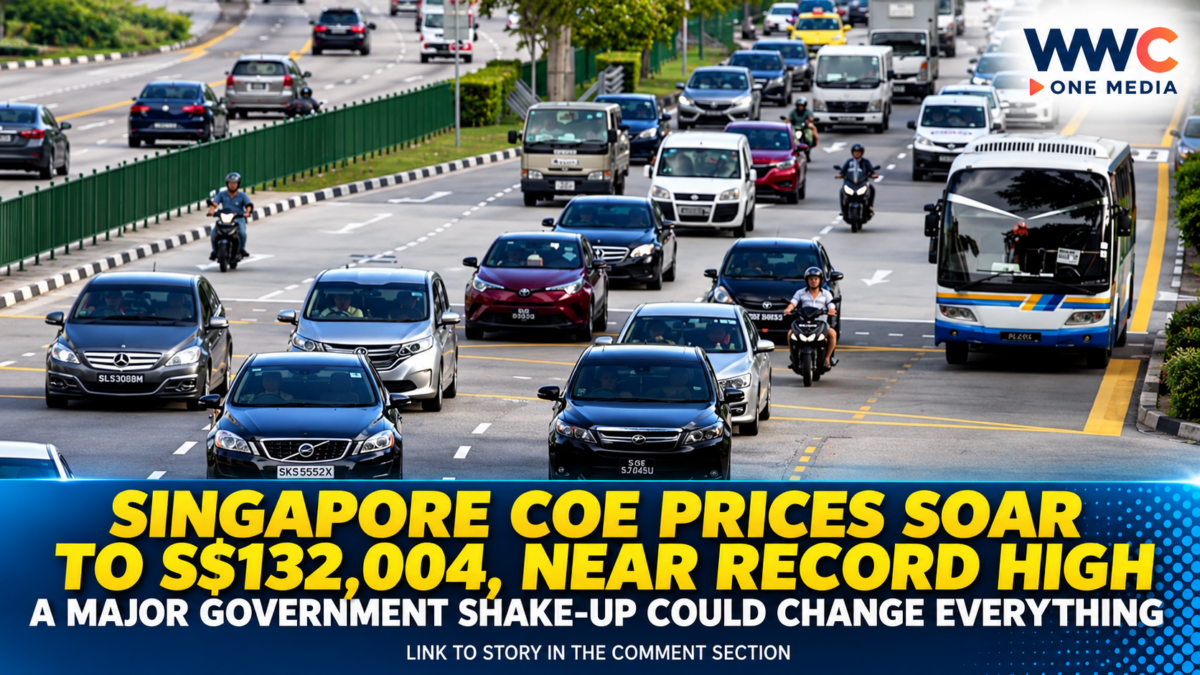
SINGAPORE, October 21, 2026 — Owning a car in Singapore is becoming even more expensive after Certificate of Entitlement (COE) premiums for smaller vehicles climbed to S$132,004, the second-highest level ever recorded for Category A, intensifying concerns over affordability in one of the world’s most expensive car markets.
The latest bidding exercise on Wednesday delivered mixed results, with premiums increasing for smaller cars, larger vehicles and commercial transport, while motorcycle and Open category premiums declined.
The results come at a critical moment as Singapore’s Land Transport Authority (LTA) considers a sweeping overhaul of the COE system that could change how drivers pay for the right to own and operate their vehicles.
Smaller Cars Face Another Price Shock
Category A COE premiums rose from S$130,001 on October 7 to S$132,004 on October 21, an increase of S$2,003, or approximately 1.54%.
The category covers smaller and less powerful cars, including qualifying electric vehicles.
The latest price is approaching the Category A record of S$133,009 recorded in September 2026, underscoring how expensive even mass-market vehicle ownership has become.
Meanwhile, Category B premiums, which cover larger and more powerful cars, increased to S$131,901 from S$130,100.
That produced an unusual market situation: the COE premium for smaller Category A cars exceeded the premium for larger Category B vehicles by S$103.
For motorists considering more affordable cars, the numbers highlight a growing problem: choosing a smaller vehicle does not necessarily mean paying a lower COE premium.
October 21 COE Results: Winners and Losers
The latest bidding exercise produced the following closing premiums:
| Category | October 21, 2026 | Change |
|---|---|---|
| A — Smaller cars | S$132,004 | +S$2,003 |
| B — Larger cars | S$131,901 | +S$1,801 |
| C — Commercial vehicles | S$92,200 | +S$311 |
| D — Motorcycles | S$10,778 | −S$234 |
| E — Open category | S$135,790 | −S$1,210 |
A total of 4,226 bids were received for 3,231 available certificates, meaning demand exceeded the available quota.
While the decline in motorcycle and Open category premiums provided some relief, the renewed increases in both major passenger-car categories reinforced the financial pressure facing prospective motorists.
Why Singapore’s COE System Matters
Singapore requires motorists to secure a Certificate of Entitlement before registering a vehicle. A COE generally gives the owner the right to use the vehicle for 10 years, subject to the country’s registration and renewal rules.
The system is designed to regulate vehicle population growth in the land-scarce city-state, where road space is limited and traffic management remains a major public-policy priority.
However, the COE premium is only one component of a vehicle’s total purchase price.
Buyers must also account for the vehicle’s underlying value, registration taxes, applicable fees and other ownership costs.
This means a COE premium exceeding S$130,000 can contribute to an exceptionally high final purchase price even before insurance, maintenance, parking and other running expenses are considered.
Government Considers Major COE Overhaul
Beyond the latest price increases, a potentially more significant development is unfolding.
On October 8, Singapore’s Land Transport Authority launched a public consultation on proposals to merge Category A and Category B COEs into a single passenger-car category.
Instead of distinguishing cars primarily through engine capacity and power output, the proposed framework would introduce rebates and surcharges linked to a vehicle’s Open Market Value.
Under the proposed system, buyers of lower-value cars could receive rebates, while those purchasing higher-value models could face additional charges.
One framework under discussion could create a price difference of up to S$30,000 between certain mass-market and higher-end vehicles.
The proposals reflect an emerging challenge: electric vehicles and modern automotive technology have blurred traditional distinctions between smaller cars and more powerful or premium models.
Importantly, the proposed merger has not been implemented, and there is no guarantee that the changes will make overall COE premiums cheaper.
Buyers Face a Difficult Decision
For prospective car owners, the current market presents a dilemma.
Purchasing now could mean accepting historically elevated COE costs. Delaying a purchase could allow buyers to evaluate any future regulatory changes, but there is no assurance that premiums will decline.
Some dealers have already reported quieter showrooms as consumers adopt a wait-and-see approach following the reform announcement.
The Business Times has also reported that COE premiums have remained resilient despite softer market conditions, with existing orders and competitive bidding helping sustain elevated prices.
This suggests that price movements may continue to depend on a complex combination of available quotas, dealer activity, outstanding orders and consumer demand.
What Happens Next?
The LTA’s public consultation remains open until November 2, 2026, at 11:59 p.m.
Officials expect to release their findings and recommendations by the first half of 2027.
Until then, prospective vehicle buyers will continue operating under the existing COE structure, where premiums are determined through competitive bidding.
The latest results illustrate how unpredictable that market can be: smaller-car premiums are closing in on record territory even as some other vehicle categories become marginally cheaper.
The bigger question is no longer simply how high Singapore’s COE premiums can climb — but whether an overhaul of the system will meaningfully change the cost of car ownership for ordinary motorists.