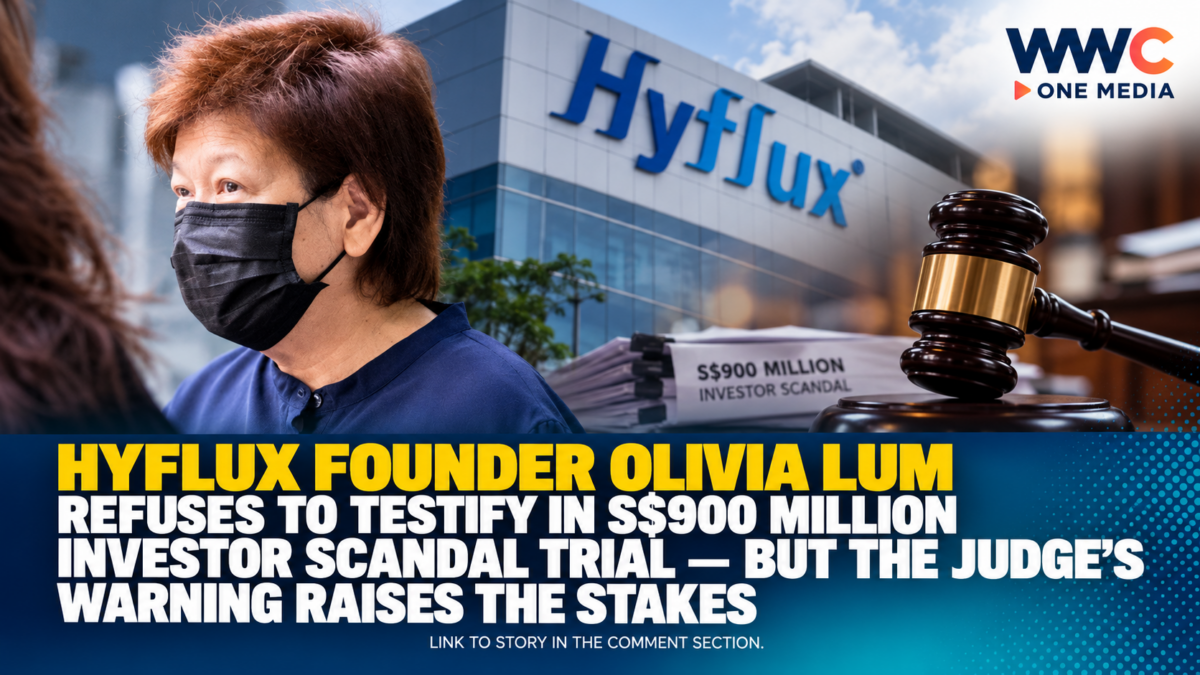
SINGAPORE — October 21, 2026. Olivia Lum, the founder and former chief executive of collapsed Singapore water-treatment giant Hyflux, has made a significant decision in one of the country’s most closely watched corporate criminal trials: she will not take the witness stand to defend herself against allegations involving the company’s failure to disclose crucial investment risks.
Lum and five other former Hyflux executives and directors confirmed in court on Wednesday that they would not testify after Principal District Judge Toh Han Li ruled that the prosecution had presented a sufficient case requiring a defence.
The decision marks a turning point in the long-running proceedings, which center on whether Hyflux withheld material information about its multibillion-dollar Tuaspring water and power project from investors.
But the biggest development may be the judge’s warning.
The court cautioned that declining to testify could allow an adverse inference to be drawn against the accused when determining whether the prosecution has proven its case.
The six defendants have not been convicted, and their lawyers maintain that the prosecution has failed to establish guilt beyond reasonable doubt.
The case now moves toward its next phase, with an expert witness expected to play a key role.
Olivia Lum and Five Co-Accused Choose Not to Take the Witness Stand
The October 21 proceedings came after prosecutors concluded their evidence in September following 54 days of trial and testimony from 22 witnesses.
The trial began in August 2025 and concerns alleged disclosure failures dating back to 2011.
The six defendants are:
- Olivia Lum Ooi Lin, 65, Hyflux’s founder and former chief executive.
- Cho Wee Peng, 57, former chief financial officer.
- Teo Kiang Kok, 70, former independent director.
- Gay Chee Cheong, 70, former independent director.
- Christopher Murugasu, 67, former independent director.
- Lee Joo Hai, 70, former independent director.
All six elected not to submit a formal argument that there was no case to answer, a legal procedure through which defendants can seek acquittal before presenting their defence.
After the judge called for their defence, their lawyers informed the court that the accused would not give evidence personally.
Instead, they intend to jointly call an expert witness, Dr Chris Decker, whose evidence will address matters raised by the prosecution.
A court conference has been scheduled for November 23 to determine subsequent trial dates.
Why the Judge’s Warning Matters
The defendants’ decision not to testify has drawn attention because of its possible legal consequences.
In a criminal trial, defendants generally have the right to choose whether to give evidence.
However, Singapore law permits courts, in certain circumstances, to draw an adverse inference when an accused person declines to testify after being called upon to present a defence.
Such an inference is not automatic and does not independently establish guilt.
The prosecution must still prove the charges beyond reasonable doubt.
Lum’s lawyer, Senior Counsel Davinder Singh, emphasized that his client believes the prosecution has not met that standard.
The defence argues that proceeding directly toward the final determination of the evidence, rather than spending additional time arguing that there is no case to answer, could allow the litigation to conclude more efficiently.
Cho’s lawyer similarly maintained that his client was not conceding that the prosecution had established a convincing case.
The central question remains whether the prosecution’s evidence is sufficient to secure convictions once all relevant evidence and legal submissions have been considered.
The S$900 Million Hyflux Collapse That Shocked Singapore
To understand the importance of the criminal proceedings, it is necessary to revisit the spectacular collapse of Hyflux, once regarded as one of Singapore’s leading homegrown water-technology companies.
Founded by Olivia Lum in 1989, Hyflux built a reputation for water treatment, filtration and desalination technology.
The company expanded internationally and became closely associated with Singapore’s efforts to develop advanced water infrastructure.
However, its ambitious Tuaspring integrated desalination and power project exposed the company to major commercial risks.
The project combined a desalination facility with a large electricity-generating plant.
According to the prosecution, the company had offered water to Singapore’s national water agency PUB at a low price and expected revenue from electricity sales to play a major role in supporting the project’s financial performance.
When the electricity business encountered difficulties, Hyflux’s financial position deteriorated.
The company suspended trading in its shares in May 2018, entered a prolonged restructuring process, was placed under judicial management in November 2020 and was eventually ordered to be wound up in 2021.
The collapse left approximately 34,000 holders of preference shares and perpetual securities facing an estimated S$900 million in unpaid investments, according to figures cited in the court proceedings.
For many retail investors, the downfall became a cautionary example of the risks associated with complex corporate financing instruments.
Prosecutors Say Investors Were Not Told About Crucial Electricity Risks
At the center of the criminal case are allegations that Hyflux failed to disclose material information about Tuaspring’s electricity business.
The prosecution argues that disclosures made in March 2011 and in connection with an April 2011 securities offering did not adequately explain important elements of the project’s economics.
Specifically, prosecutors allege that investors were not properly informed that:
- Tuaspring represented Hyflux’s entry into the electricity-generation business.
- A substantial majority of the project’s revenue was expected to come from electricity sales.
- The project’s profitability depended significantly on those electricity sales.
The case includes allegations involving an offering of S$200 million in preference shares.
Prosecutors contend that this information was material to investors evaluating Hyflux securities and that the omissions created a misleading impression of a project principally focused on water desalination.
Lum is accused of consenting to Hyflux’s intentional failure to disclose material information.
Former CFO Cho faces an allegation of conniving in one of the disclosure failures, while the four former independent directors face charges involving alleged neglect and omissions.
These remain prosecution allegations, not established findings of criminal misconduct.
What Penalties Could Olivia Lum Face?
Lum is standing trial on two charges under Singapore’s Securities and Futures Act.
One relates to allegedly consenting to Hyflux’s intentional failure to notify the securities exchange of material information.
If convicted on that charge, she could face imprisonment of up to seven years, a fine of up to S$250,000, or both.
The second charge concerns an offer of securities containing alleged omissions about electricity sales.
That charge carries a possible sentence of up to two years’ imprisonment, a fine of up to S$150,000, or both.
Four additional Companies Act charges against Lum have been stood down during the current trial.
The former CFO and independent directors face their own charges and potential penalties.
No sentence has been imposed on Lum or the five defendants in this trial.
Former Hyflux Director Already Fined S$90,000
The proceedings are not the first to result from the Hyflux investigations.
Former independent director Rajsekar Kuppuswami Mitta previously pleaded guilty to an offence involving neglect connected to the company’s disclosure failures.
In 2025, he was fined S$90,000 and disqualified from serving as a company director or participating in company management for five years.
His case provides additional context to the wider investigation, but his guilty plea does not establish the guilt of Lum or the six defendants now on trial.
Their cases must be decided separately on the evidence applicable to them.
Why the Hyflux Trial Matters Beyond Singapore
The significance of the case extends beyond a single failed company.
Across Asia, infrastructure businesses frequently raise money from institutional investors, banks and the public to finance capital-intensive projects.
These projects can involve complicated revenue structures, financial forecasts and market risks.
When those risks are not adequately communicated, investors may struggle to understand how vulnerable a business is to changing market conditions.
The Hyflux proceedings therefore raise broader questions about corporate governance, directors’ duties, financial disclosure and protection for retail investors.
For the Philippines and other ASEAN markets, the case offers a reminder of the importance of examining business risks and securities disclosures before making investment decisions.
However, any regulatory or market impact outside Singapore would depend on decisions by the relevant authorities.
What Happens Next in the Olivia Lum Trial?
The court has scheduled a conference for November 23, 2026, to arrange the next stage of the proceedings.
The defence is expected to call Dr Chris Decker to provide expert evidence.
The court will then consider the remaining evidence and legal arguments before making its determination.
Although the defendants have elected not to testify personally, this does not mean the defence has abandoned its case or accepted the prosecution’s allegations.
Their lawyers continue to dispute whether the evidence meets the criminal standard of proof.
For Singapore’s corporate and investment community, the trial remains an important test of how disclosure requirements are applied to complex infrastructure businesses.
The next major question is whether prosecutors can prove that crucial financial risks were unlawfully withheld from investors — or whether the defence can convince the court that the evidence falls short of a criminal conviction.
The answer could become one of the defining legal outcomes of Singapore’s long-running Hyflux scandal.