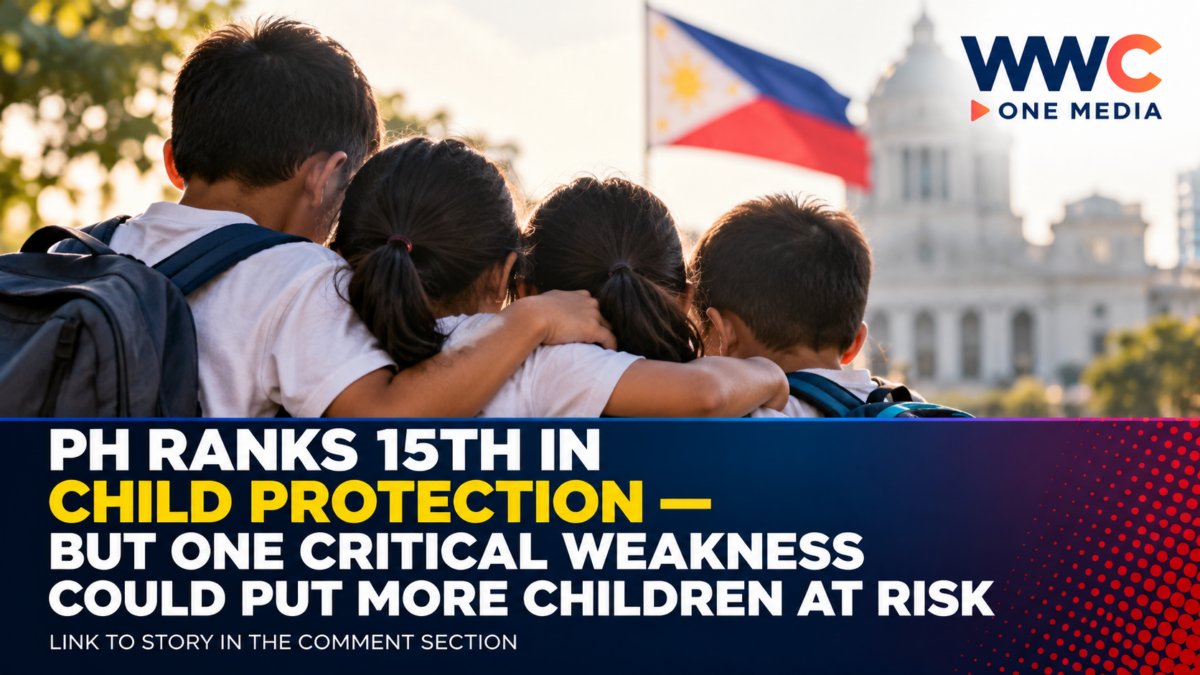
MANILA, Philippines — The Philippines has earned a place among the world’s top 15 countries in efforts to address sexual violence against children and adolescents, but a closer look at the latest international assessment reveals a significant weakness: preventing abuse before it happens.
The country ranked 15th out of 60 countries, with an overall score of 60.8 out of 100, in the 2026 Out of the Shadows Index, researched and developed by Economist Impact, with advocacy and engagement led by Together for Girls.
The Philippines also placed fifth in East Asia and the Pacific. However, its relatively weaker performance in prevention highlights the need to strengthen child protection programs, early intervention, public awareness and support for families and caregivers.
The index assesses government action against sexual violence involving children and adolescents. It examines laws, policies, programs and services—not the actual prevalence of abuse in each country.
Prevention emerges as a critical weakness
The Philippines received the following scores across the index’s four pillars:
- Justice: 69.2 out of 100
- Healing: 60 out of 100
- Governance and accountability: 51.1 out of 100
- Prevention: 46.7 out of 100
The results show a substantial gap between the country’s performance in justice-related measures and its efforts to prevent abuse.
While laws and justice mechanisms are essential for holding offenders accountable, prevention requires sustained action before children become victims. This includes education for students, support for parents and caregivers, background checks, training for health professionals and accessible helplines.
The prevention score is the lowest of the Philippines’ four pillar scores, making it a key area for improvement.
The index’s findings also reflect a broader international challenge: governments must do more than respond to reported abuse. They need effective systems that help stop violence before it occurs.
Philippines has strengthened laws against online child abuse
Despite the gaps, the country has made progress in strengthening its legal framework against sexual exploitation, particularly online.
The Anti-Online Sexual Abuse or Exploitation of Children Act, or Republic Act No. 11930, and the Anti-Child Sexual Abuse or Exploitation Materials Act, or Republic Act No. 11930’s companion legislation, Republic Act No. 11930 and Republic Act No. 11930 should not be confused with Republic Act No. 11930’s separate implementation measures. The principal laws addressing these offenses are Republic Act No. 11930 and Republic Act No. 11930’s companion law, Republic Act No. 11930.
The Philippines’ legal framework also includes measures addressing trafficking and other forms of exploitation. Republic Act No. 11862, the Expanded Anti-Trafficking in Persons Act of 2022, strengthens protections against trafficking-related offenses.
The Out of the Shadows Index specifically recognizes the Philippines as one of only six countries that clearly define and criminalize online grooming of children for sexual purposes.
The country has also launched its First Philippine Strategic Plan Against Online Sexual Abuse or Exploitation of Children and Child Sexual Abuse or Exploitation Materials for 2025–2028.
However, strong laws must be backed by effective implementation, adequately resourced investigations, cross-border cooperation and accessible services for survivors.
Why the ranking does not tell the whole story
A country’s position in a global index should not be interpreted as proof that children are safe from abuse—or that a lower-ranked country necessarily has more victims.
The 2026 Out of the Shadows Index measures government action and the systems in place to address sexual violence against children and adolescents. It does not rank countries according to the actual number or percentage of children experiencing abuse.
The distinction matters because a country may have strong laws but still face serious enforcement challenges, gaps in prevention services or barriers that discourage survivors from seeking help.
For the Philippines, the assessment points to the importance of making child protection services more accessible and coordinated across communities, schools, health facilities and law enforcement agencies.
UNICEF highlights the need for stronger child protection systems
A separate UNICEF Philippines report published in April 2026, Strengthening Child Protection Systems, examines multidisciplinary service delivery models in Valenzuela City and hospital-based Women and Children Protection Units.
The report highlights the value of integrated, child-focused and survivor-centered services, bringing together the support children may need when violence occurs.
Such approaches can help improve coordination among local governments, health professionals and other service providers. They also underline why protection should not end with reporting an incident: children and their families may need medical care, psychosocial support, legal assistance and long-term recovery services.
What needs to happen next?
The Out of the Shadows Index identifies several priorities for the Philippines, including strengthening implementation and long-term funding for its national strategy against online child sexual abuse, improving digital investigations and international cooperation, and expanding survivor participation in policymaking.
Advocates have also called for reforms to limitation periods for sexual violence offenses against children and for the establishment of a government-supported National Survivors Council.
These recommendations point to a broader challenge: ensuring that children can access protection regardless of their location, family circumstances or ability to seek help.
The government, schools, communities, technology companies and families all have roles to play. Stronger reporting mechanisms, age-appropriate safety education, responsible online platforms and properly trained frontline workers can contribute to earlier intervention and safer environments.
A stronger ranking must translate into safer childhoods
The Philippines’ 15th-place ranking reflects progress in its formal response to sexual violence against children, but the prevention score shows that significant work remains.
The challenge now is to turn policies and legal protections into practical safeguards that reach children in their homes, schools, communities and online spaces.
Ultimately, the measure of success is not simply where the country stands in an international ranking. It is whether children are safer, survivors receive appropriate support and abuse is prevented before more lives are affected.