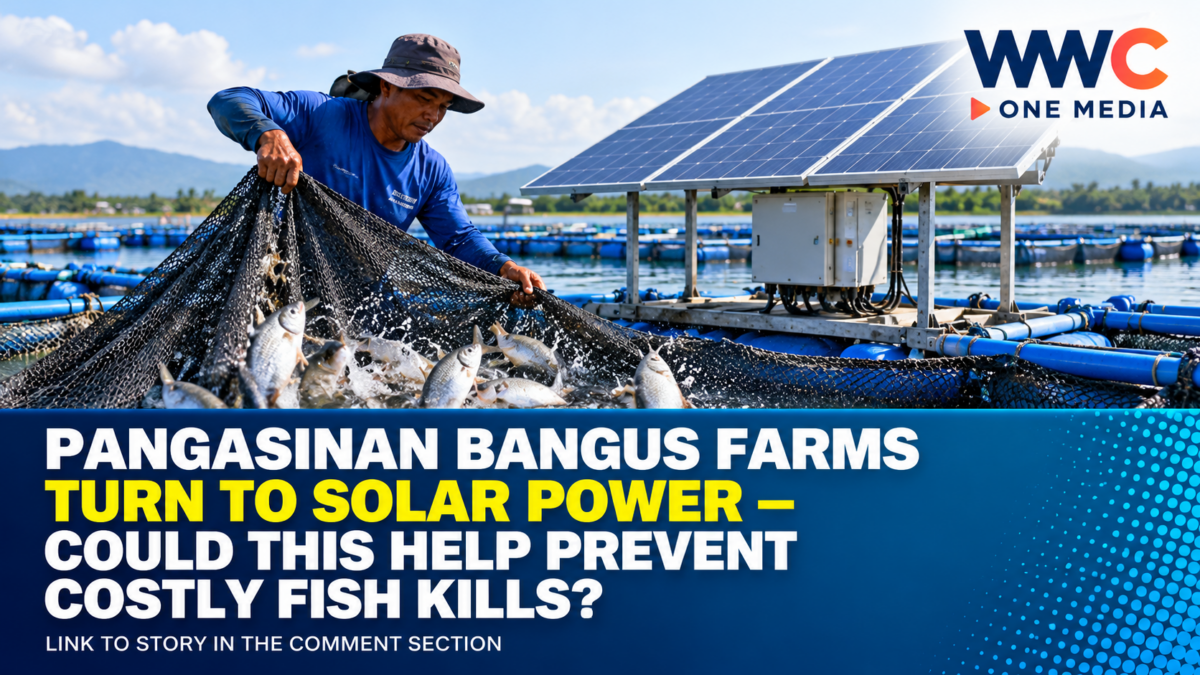
PANGASINAN, Philippines — Solar-powered aeration systems are drawing renewed attention as a possible way to help protect the province’s bangus industry from oxygen shortages, fish kills and the rising cost of operating fishponds.
The development comes as milkfish growers face mounting challenges from extreme heat, changing weather conditions and expensive fuel needed to run conventional aerators.
The Philippine Daily Inquirer reported on plans to use solar power to operate aeration systems for bangus farms in Pangasinan. The full text of the original report could not be independently retrieved during verification, so the specific project details, including the number of systems, installation locations, funding and implementation schedule, require confirmation before publication.
Why solar-powered aeration matters to bangus growers
Aerators help circulate water and increase the amount of dissolved oxygen available to fish. This becomes especially important when water temperatures rise or fishpond conditions contribute to oxygen depletion.
Without sufficient dissolved oxygen, milkfish may rise toward the surface and gasp for air. Severe oxygen shortages can cause fish kills, leaving farmers with substantial financial losses.
In a May 3, 2026, report, the Philippine Daily Inquirer described how Pangasinan fishpond operators were struggling with temperatures exceeding 40 degrees Celsius, high feed prices and costly fuel. Christopher Sibayan of the Samahan ng Magbabangus sa Pangasinan said some growers were limiting the number of fish stocked in their ponds to reduce risks.
The report also noted that the cost of diesel and gasoline had caused some operators to use their aerators less frequently, potentially worsening the challenge of maintaining adequate oxygen levels.
Solar energy could help reduce operating costs
Solar-powered aerators use energy generated by solar panels to operate equipment that circulates and oxygenates pond water. Depending on the system’s design, battery storage and backup power may also help maintain operations when sunlight is insufficient.
For fish farmers, the potential advantages include reduced dependence on diesel or grid electricity, more predictable operating expenses and additional flexibility in managing pond conditions.
However, actual savings will depend on installation costs, equipment capacity, maintenance requirements, battery life and the amount of energy needed to operate the aerators.
Solar technology alone cannot eliminate fish-kill risks. Farmers still need to monitor water quality, stocking density, weather conditions and dissolved oxygen levels.
Government agencies are also exploring solar-powered solutions
In an August 2026 report, the Philippine Daily Inquirer said the Department of Agriculture planned to provide fingerlings to fishpond operators affected by fish kills and acquire solar-powered aerators for small fishpond owners.
Agriculture Secretary Francisco Tiu Laurel Jr. announced the planned assistance during a visit to the rehabilitated Sual Fish Port in Pangasinan.
Separately, the Department of Agriculture’s National Fisheries Research and Development Institute reported in October 2026 that its AERATE project combines solar-powered aeration, real-time water-quality monitoring and underwater cameras to help prevent fish mortality associated with low dissolved oxygen in fish cages.
These are related developments in fisheries technology, but they should not be confused with the specific Pangasinan aeration initiative without confirmation that the projects are connected.
A timely development as climate risks grow
In October 2026, Bombo Radyo Dagupan reported that Pangasinan bangus growers were preparing for the potential effects of a projected strong El Niño, including extreme heat and possible oxygen shortages in fishponds.
The report cited Christopher Aldo Sibayan of the Samahang Magbabangus sa Pangasinan, who discussed preparations that included using water pumps and aerators and reducing stocking density.
These challenges underscore the importance of improving fishpond management and exploring technologies that could help farmers adapt to changing weather conditions.
What happens next?
The effectiveness of solar-powered aeration will ultimately depend on whether the systems can provide reliable oxygenation when fish need it most, while remaining affordable for small-scale growers.
Important details still to be established include the project’s coverage, the number of participating fishponds, its funding source, and whether the systems will be distributed, installed or tested as a pilot initiative.
For Pangasinan’s bangus industry, the promise is clear: better oxygen management and lower energy costs could help protect livelihoods. The next step is determining how widely the technology can be deployed and how much measurable benefit it delivers to local fish farmers.