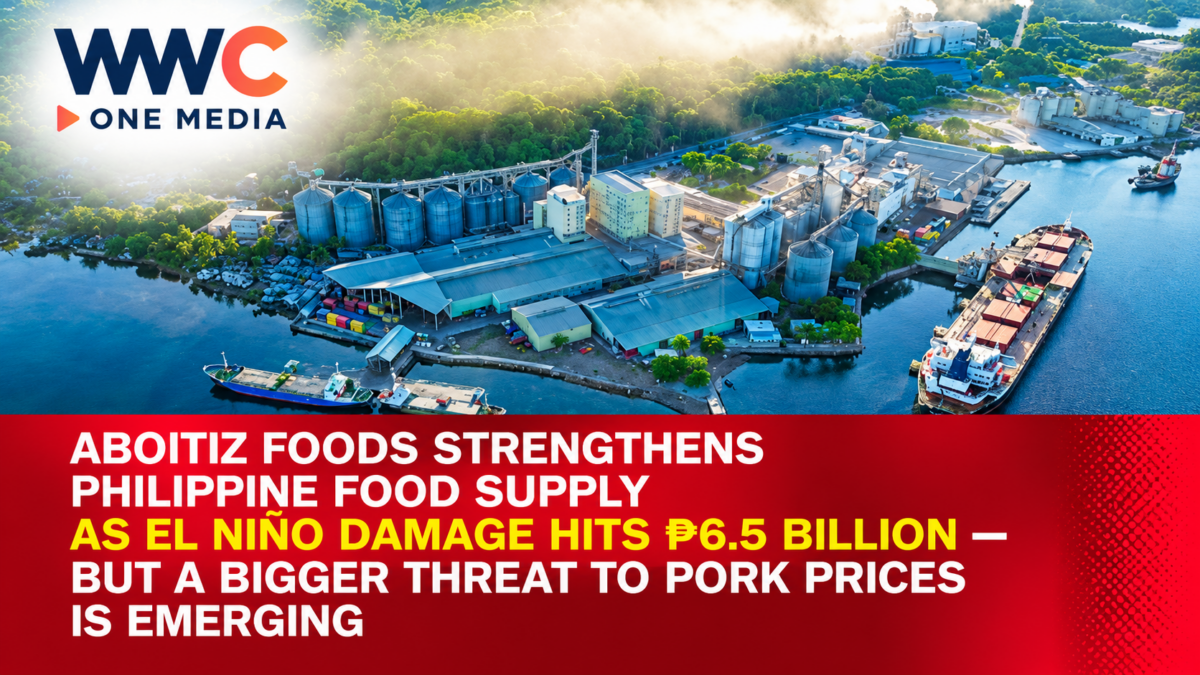
MANILA, Philippines — Aboitiz Foods is reinforcing its food supply chain and expanding its Philippine production network as the country faces a worsening agricultural crisis driven by El Niño, rising operating expenses and instability in global commodity markets.
With agricultural damage from the prolonged dry conditions estimated at approximately ₱6.5 billion by mid-October 2026, the Aboitiz Group’s regional agribusiness arm is intensifying efforts to protect animal feed supplies, coordinate raw-material purchases and strengthen production capabilities.
The company is also advancing plans for a new Pilmico feedmill in Balamban, Cebu, while working with partners to bring a meat-cutting facility in Butuan City back into operation.
The strategy comes as farmers and livestock producers confront a difficult combination of climate disruption, costly logistics, uncertain raw-material supplies and squeezed profit margins.
For Filipino consumers, the issue reaches beyond agricultural production. Feed prices and livestock costs can influence the price and availability of pork, poultry and other food products.
But while Aboitiz Foods is investing in a more resilient supply network, the bigger question is whether these measures can protect Filipino households from future food price pressures.
El Niño Hits Philippine Agriculture as Losses Climb
El Niño has become one of the country’s most serious agricultural challenges in 2026.
Prolonged dry conditions have affected farming communities, placed additional pressure on water resources and disrupted agricultural activities in several regions.
According to National Disaster Risk Reduction and Management Council figures reported in mid-October, agricultural damage and production losses reached approximately ₱6.5 billion.
More than 451,000 people were reported affected, including hundreds of thousands of farmers and fisherfolk.
Separate reports identified Cagayan Valley as one of the hardest-hit areas, with agricultural losses approaching ₱5 billion.
The Philippine Atmospheric, Geophysical and Astronomical Services Administration has warned that El Niño conditions could persist into early 2027.
These developments create uncertainty for businesses that rely on agricultural commodities, livestock production and the reliable transportation of essential supplies.
Aboitiz Foods is responding by preparing for disruptions before they affect its manufacturing and distribution operations.
Aboitiz Foods Moves to Protect Its Supply Chain
Aboitiz Foods operates across eight countries and maintains an integrated agribusiness network involving animal nutrition, food production and associated supply-chain activities.
Its latest measures focus on strengthening purchasing arrangements, monitoring global commodity markets and improving coordination across business units.
The company is tracking raw-material availability, international shipping conditions and price movements to identify potential supply risks.
It is also reviewing inventory requirements for selected commodities, arranging purchases in advance where practical and managing operational needs such as water availability and feed quality.
Teddy Deocares, first vice president for supply chain at Aboitiz Foods, emphasized that food security requires planning beyond immediate production needs.
“Food security is not just about having enough food available today,” Deocares said.
His broader message was that dependable production, distribution and cooperation among suppliers are essential to keeping food available during disruptions.
For Aboitiz Foods, these preparations are designed to maintain continuity across its operations while supporting livestock customers who depend on reliable animal nutrition products.
Why Animal Feed Is Critical to Philippine Food Prices
Animal feed is a major input in livestock and poultry production.
Farmers require consistent supplies of feed ingredients to maintain the growth, health and productivity of animals.
When ingredient prices increase, feed manufacturers may face higher production costs.
Those increases can eventually affect livestock raisers, particularly smaller producers operating with limited financial reserves.
The consequences may include narrower farm profit margins, reduced production plans or higher selling prices when market conditions permit.
For consumers, these pressures can contribute to changes in meat prices, although retail prices also depend on supply, demand, imports, disease conditions and other factors.
Aboitiz Foods’ supply-chain preparations are particularly relevant because its Pilmico businesses supply animal nutrition products used by agricultural producers.
The company’s objective is to reduce avoidable disruptions while keeping its operations responsive to changing market conditions.
However, better inventory management cannot eliminate all commodity price risks or guarantee stable retail food prices.
New Cebu Feedmill Targets Stronger Visayas and Mindanao Supply
One of the company’s most important planned investments is a new Pilmico feedmill at West Cebu Estate in Balamban, Cebu.
The project is intended to expand Aboitiz Foods’ domestic manufacturing capabilities and strengthen its presence in the Visayas.
According to an October 9 announcement by Aboitiz Economic Estates, the partnership was formalized through a ceremonial signing earlier that month.
The first phase of the feedmill is expected to begin operations in 2028.
Once operational, the facility is intended to provide additional animal feed production capacity and support the company’s distribution network.
The new Cebu operation will complement Pilmico’s existing feedmill in Iligan City, which serves customers across the Visayas and Mindanao.
Establishing additional manufacturing capacity could improve production flexibility and reduce dependence on a smaller number of facilities.
It may also help Aboitiz Foods serve customers more efficiently across the central and southern Philippines.
However, the company has not disclosed in the reports reviewed a definitive investment cost or quantified production capacity for the new facility.
Its contribution to national feed supply will therefore become clearer as construction progresses and operations begin.
Butuan Meat Facility Could Strengthen Local Pork Distribution
Beyond animal feed manufacturing, Aboitiz Foods is also working to strengthen meat-processing operations.
Through subsidiary Pilmico Animal Nutrition Corporation, the company is coordinating with partners to reopen a meat-cutting facility in Butuan City.
Once operational, the facility is expected to supply fresh pork products to restaurants, food businesses and households.
The project could improve the company’s ability to connect livestock production with downstream food distribution.
That is particularly relevant to the Philippines, where pork remains an important source of animal protein.
However, the reopening is still being pursued, and no confirmed operational date or facility throughput has been established in the reporting reviewed.
The proposed project should therefore be treated as planned additional processing capability rather than completed production expansion.
Philippine Hog Raisers Face a Difficult Profit Squeeze
While climate conditions threaten agricultural output, Aboitiz Foods has identified another significant risk: the financial pressure facing local hog producers.
The company warned that farmgate prices can fall below production costs, leaving hog raisers struggling to maintain profitable operations.
This creates a difficult situation for producers who must continue paying for feed, labor, veterinary care, utilities and transportation.
When producers cannot recover their expenses, they may reduce investment or scale back operations.
Over time, that can weaken the industry’s ability to maintain and rebuild domestic pork production.
The situation also creates an important distinction between farm profitability and retail food affordability.
Low farmgate prices do not necessarily mean consumers are paying equally low prices at supermarkets or wet markets.
Distribution expenses, processing costs and market conditions can affect the final prices paid by households.
This is why Aboitiz Foods has emphasized that food security requires solutions benefiting farmers, businesses and consumers together.
Middle East Tensions Add Another Cost Pressure
Aboitiz Foods is not dealing with climate risks alone.
The company also identified geopolitical tensions in the Middle East as a source of higher fuel, freight and raw-material expenses.
International disruptions can affect shipping routes, insurance costs, transport availability and the price of commodities used in food production.
For an agribusiness with operations across several countries, these changes can create additional uncertainty around procurement and delivery schedules.
Higher freight charges can make imported ingredients more expensive, while rising fuel prices can increase domestic transportation and manufacturing costs.
The company’s response includes closer monitoring of commodity markets, advance logistics planning and coordination with suppliers.
Such measures can improve preparedness but cannot completely insulate the business from international price volatility.
The wider challenge is to maintain reliable supply without creating unsustainable costs for agricultural customers.
Aboitiz Foods Wants a Stronger Farm-to-Consumer Network
The company’s strategy reflects what it describes as a mill-to-meal approach.
Rather than viewing raw-material procurement, feed manufacturing, livestock production, meat processing and distribution as separate activities, Aboitiz Foods aims to strengthen coordination across the food value chain.
The approach is intended to reduce the impact of disruptions at any single stage.
For example, reliable feed manufacturing can support livestock producers, while adequate meat-processing capability can help move finished products toward customers.
Stronger inventory systems and logistics planning can also help the company respond when weather conditions or global supply routes change unexpectedly.
But building a resilient food system requires more than corporate investment.
Government agencies, farmers, transport providers, distributors and consumers also play important roles in maintaining food availability.
Why Government and Business Cooperation Matters
Aboitiz Foods is calling for stronger cooperation between public institutions and private agribusinesses.
Climate adaptation, irrigation, transportation infrastructure, farm productivity and disaster preparedness all influence how reliably food reaches Filipino households.
Private companies can strengthen their production systems, but public infrastructure and agricultural support remain essential.
For example, reliable roads and ports help move food between regions, while water management and irrigation systems can reduce some effects of prolonged drought.
Agricultural financing and technical support can also help producers maintain operations when costs rise or harvests decline.
Aboitiz Foods has urged consumers to contribute by limiting food waste, conserving water and avoiding unnecessary stockpiling.
Although these actions cannot solve national supply problems by themselves, they can support more responsible food consumption during periods of uncertainty.
What This Means for Filipino Families
For households, Aboitiz Foods’ preparations matter because food affordability depends on a complicated network extending from farm inputs to grocery shelves.
A disruption in animal feed supplies can affect livestock production.
Higher fuel prices can increase transportation costs.
Drought can damage crops and reduce agricultural output.
Financial pressure on farmers can weaken future food production.
The combined effect may eventually influence the availability and prices of everyday food products.
However, there is no evidence that Aboitiz Foods’ latest announcement represents an immediate price increase for its products or guarantees a particular change in pork prices.
The company’s measures are primarily aimed at reducing supply risks and strengthening its ability to respond to disruptions.
The actual benefits will depend on implementation, climate developments and broader market conditions.
The Bigger Question: Can Philippine Food Supplies Withstand a Prolonged El Niño?
Aboitiz Foods’ latest initiative highlights a central challenge for Philippine agriculture.
Food security depends not only on producing sufficient food during favorable conditions but also on keeping production and distribution functioning when disruptions occur.
The company’s planned Cebu feedmill, proposed Butuan processing operations and enhanced procurement systems may strengthen its long-term capabilities.
Yet the Philippines continues to face pressure from drought, international price volatility, high production costs and the financial difficulties of local farmers.
Those risks are unlikely to disappear through a single corporate expansion project.
The lasting measure of success will be whether investments in manufacturing, logistics and agricultural partnerships can improve supply reliability while helping maintain affordable food.
Aboitiz Foods is preparing its operations for another period of climate and market uncertainty. But with billions of pesos in agricultural losses already reported, the bigger battle is whether the Philippine food system can protect both struggling farmers and the millions of households depending on them.