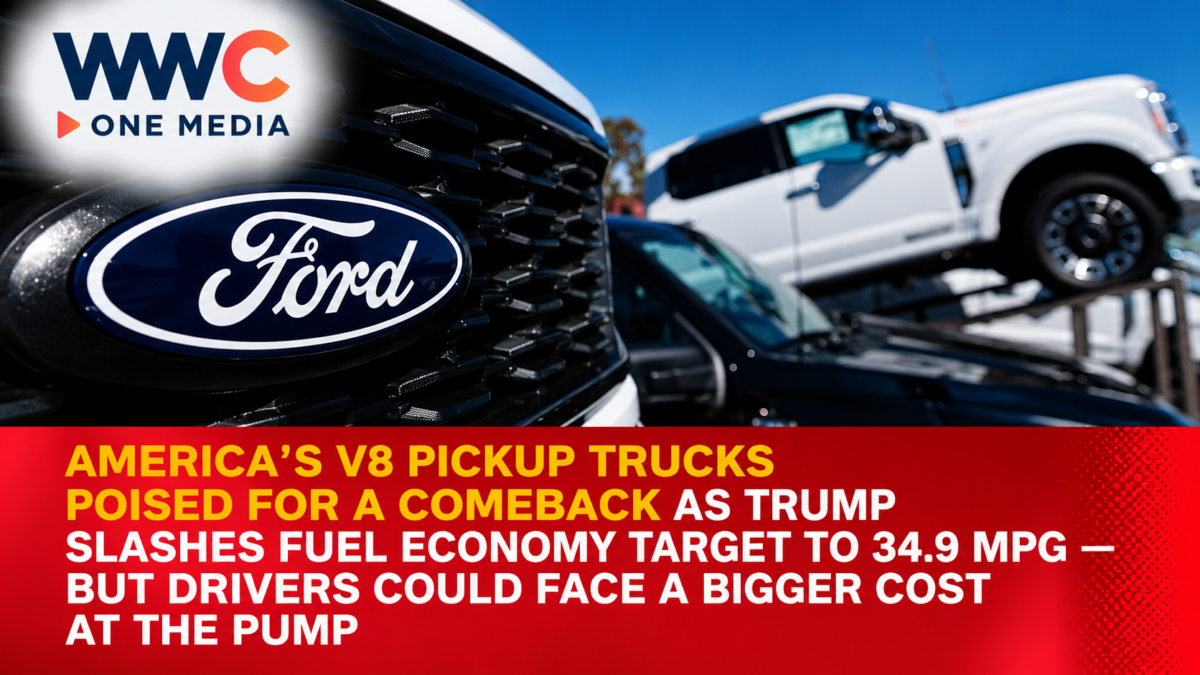
WASHINGTON, United States — America’s love affair with powerful V8 engines and full-size pickup trucks could be entering a new chapter after the Trump administration finalized sweeping changes to federal fuel-economy regulations, potentially giving Ford, General Motors and Stellantis greater freedom to expand their gasoline-powered vehicle lineups.
The policy shift, finalized by the National Highway Traffic Safety Administration (NHTSA) in September 2026, substantially reduces the fuel-efficiency requirements that automakers were previously expected to meet by 2031.
Under the revised framework, the projected industrywide fuel-economy requirement for passenger cars and light trucks falls to approximately 34.9 miles per gallon by model year 2031, compared with the roughly 50.4 mpg projection associated with the earlier Biden administration standards.
The changes are expected to reduce regulatory pressure on manufacturers to prioritize smaller engines, electrification and other technologies designed primarily to improve fleetwide fuel economy.
That could encourage automakers to maintain or introduce additional high-powered gasoline vehicles, particularly profitable pickup trucks equipped with V8 engines.
But a potentially significant trade-off is emerging.
Although regulators estimate the revised standards could reduce vehicle manufacturing costs, government projections also indicate that motorists may spend substantially more on fuel during the lifetime of their vehicles.
The bigger question is whether Americans will benefit from cheaper and more powerful trucks today—or face higher ownership expenses for years to come.
Trump Administration Rolls Back Fuel Economy Rules
The Corporate Average Fuel Economy program, commonly known as CAFE, has shaped the American automotive industry for decades.
Established following the energy crises of the 1970s, the program requires manufacturers to meet fuel-efficiency standards across their passenger car and light-truck fleets.
The rules influence how companies develop engines, transmissions, hybrid systems, electric vehicles and other technologies.
In June 2024, the Biden administration finalized standards expected to raise the industry’s average light-duty fuel economy to approximately 50.4 mpg by model year 2031.
The Trump administration reversed that approach.
In September 2026, NHTSA finalized a new regulatory framework, formally called the Safer Affordable Fuel-Efficient Vehicles Rule III.
The revised standards significantly lower projected fuel-efficiency requirements for future model years.
The rule was published in the Federal Register on September 30 and is scheduled to take effect on November 30, 2026.
The administration argues that the changes will reduce compliance costs and give automakers greater flexibility to produce vehicles that meet customer demand.
However, environmental advocates and several state governments contend that the rollback will increase fuel consumption and undermine long-term energy conservation.
Why V8 Engines Could Make a Major Comeback
The biggest beneficiaries of the policy shift could include manufacturers of full-size pickup trucks and large sport utility vehicles.
V8 engines remain popular among American drivers who value towing capability, strong acceleration, durability and traditional gasoline-engine performance.
But larger engines can consume more fuel than smaller or electrified alternatives under comparable driving conditions.
Stricter fuel-economy rules have historically encouraged automakers to develop smaller turbocharged engines, hybrid powertrains and electric vehicles to reduce fleetwide fuel consumption.
By reducing that regulatory pressure, the new standards could make it easier for manufacturers to offer more large-engine vehicles while meeting federal requirements.
CNBC’s October 15 analysis highlighted expectations that the rollback could encourage renewed investment in pickup trucks and V8 powertrains.
The opportunity is particularly attractive because trucks and large SUVs are among the most profitable products sold by major American automakers.
However, a regulatory change does not automatically guarantee higher V8 sales.
Manufacturers must still consider consumer demand, fuel prices, production costs, emissions requirements and competition from alternative powertrains.
Ford, General Motors and Stellantis Face a New Opportunity
Detroit’s three major automakers have different strategies for competing in the pickup market.
Ford continues offering its 5.0-liter V8 engine in selected F-150 configurations while also selling turbocharged V6 engines and the hybrid F-150 PowerBoost.
General Motors is preparing redesigned Chevrolet Silverado and GMC Sierra pickup trucks, with plans that include updated V8 engines and diesel technology.
Stellantis has also renewed its emphasis on powerful gasoline engines within its Ram truck portfolio.
The regulatory rollback gives these companies greater flexibility when determining the mix of trucks they manufacture.
That could support production of vehicles favored by buyers who prioritize towing, payload capacity and engine performance.
For manufacturers, the commercial opportunity is substantial.
Pickup trucks command relatively high transaction prices and often generate stronger margins than smaller passenger cars.
But the strategies are not identical.
Ford continues investing in hybrids, General Motors is expanding diesel offerings, and Stellantis is developing electrified truck options alongside combustion engines.
The industry’s next phase may therefore involve more powertrain choices rather than a complete abandonment of electrification.
General Motors Doubles Down on Pickup Trucks
Recent reporting by Reuters illustrates the direction of competition.
General Motors is preparing next-generation Chevrolet Silverado and GMC Sierra trucks with an upgraded 3.0-liter diesel engine and newly developed V8 powertrains.
The company is positioning the redesigned models around towing performance, driving range and improved capability.
Its upgraded diesel option is expected to offer more than 900 miles of highway driving range in certain configurations equipped with the appropriate fuel tank.
However, diesel fuel prices remain a significant consideration.
Higher fuel costs can reduce or eliminate some of the financial advantages of a more fuel-efficient diesel engine.
General Motors’ strategy demonstrates that automakers are looking beyond a simple gasoline-versus-electric choice.
Manufacturers are increasingly offering combinations of gasoline, diesel, hybrid and electric technologies depending on customer needs.
The $1,289 Savings Promise Comes With a Catch
One of the Trump administration’s central arguments is that weaker fuel-economy regulations can help make new vehicles less expensive to manufacture.
According to regulatory estimates cited by Reuters, the revised framework could reduce vehicle costs by approximately $1,289.
The underlying logic is that manufacturers may no longer need to invest as heavily in certain technologies solely to meet the previous fuel-efficiency requirements.
But lower manufacturing costs do not automatically translate into equally lower showroom prices.
Retail prices depend on market demand, production expenses, competition, dealer inventories and manufacturer pricing strategies.
Automakers could also use part of the savings to improve profit margins rather than fully passing them on to buyers.
More importantly, the same regulatory analysis indicates that motorists could face over $1,600 in additional lifetime fuel expenses.
That creates a potential conflict between purchase affordability and long-term operating costs.
A driver might pay less for a vehicle initially but spend more on gasoline over several years of ownership.
The actual outcome will depend on the vehicle purchased, fuel prices, annual mileage and driving conditions.
U.S. Fuel Prices Make the Decision More Complicated
The fuel-economy rollback comes during a period of substantial volatility in global energy markets.
Geopolitical tensions and disruptions to energy supply have pushed some transportation fuel prices higher.
Reuters reported on October 15 that rising diesel prices were increasing costs across freight transportation, agriculture and manufacturing.
Fuel expenses matter for pickup owners, especially drivers who regularly tow heavy loads, travel long distances or use trucks for business.
Vehicles with larger engines may deliver strong performance, but their operating expenses can become increasingly important when energy prices rise.
For consumers, calculating total ownership costs is therefore essential.
Purchase price, insurance, maintenance, financing, depreciation and fuel consumption all contribute to the overall cost of owning a truck.
The regulatory changes may expand consumer choice, but they do not eliminate those financial considerations.
Environmental Groups Warn of Higher Emissions
The rollback has triggered strong opposition from environmental organizations and state governments.
Critics argue that reducing fuel-efficiency requirements will result in greater gasoline consumption and higher carbon emissions.
According to Reuters, the government’s analysis projected that the revised standards could increase fuel consumption by approximately 4.6% through 2050.
The changes could also make it more difficult for the United States to reduce transportation-related greenhouse gas emissions.
Supporters of the rollback counter that stricter regulations can make vehicles more expensive and may pressure manufacturers to develop products that consumers are not ready to purchase.
They argue that preserving gasoline-powered vehicle choices can support affordability and domestic automotive employment.
The dispute reflects different priorities.
One side emphasizes consumer choice and manufacturing flexibility.
The other emphasizes long-term fuel savings, energy security and environmental protection.
The long-term effects will depend on the vehicles manufacturers actually sell and how consumers respond.
More Than Two Dozen States and Local Governments Challenge the Rules
The policy is also facing legal opposition.
On October 2, 2026, a coalition of more than two dozen state and local governments filed lawsuits challenging the revised fuel-economy standards.
The coalition includes jurisdictions such as California, New York, Michigan and Washington.
The challengers argue that the federal government failed to establish standards consistent with its statutory responsibility to pursue the maximum feasible fuel economy.
They also warn that weaker rules could increase petroleum consumption, reduce projected fuel savings and undermine public health goals.
The Transportation Department maintains that the new standards appropriately balance technological feasibility, economic practicability and energy conservation.
The litigation introduces uncertainty about the durability of the new regulatory framework.
However, filing a lawsuit does not automatically overturn the rule.
The legal outcome will depend on subsequent court proceedings.
Hybrid Vehicles Could Still Win Despite the V8 Revival
One important complication is the continued strength of hybrid vehicles.
Even as regulations become more favorable toward gasoline-powered vehicles, many consumers remain interested in better fuel efficiency without committing to fully electric transportation.
Hybrids combine combustion engines with electric motors and battery systems to reduce fuel consumption in certain driving conditions.
They may appeal to truck buyers who want additional efficiency while retaining familiar refueling options.
Recent Reuters reporting indicated that hybrid vehicles have expanded their share of the U.S. market, creating competitive challenges for manufacturers with fewer hybrid offerings.
Ford’s F-150 PowerBoost is an example of a pickup that combines gasoline power with hybrid technology.
The existence of these products demonstrates that reduced regulation does not necessarily mean the disappearance of fuel-saving innovation.
Consumer demand and competitive pressure can continue encouraging manufacturers to improve vehicle efficiency.
Electric Vehicles Are Not Automatically Finished
The renewed interest in V8 engines does not mean electric vehicles are disappearing.
Electric trucks and SUVs continue to offer potential advantages such as high torque, lower direct tailpipe emissions and reduced reliance on gasoline.
However, their commercial performance depends on affordability, charging availability, battery costs, driving range and customer demand.
Some manufacturers have scaled back or adjusted their electric vehicle investment plans in response to market conditions.
Others remain committed to electrification while introducing more hybrid models.
The regulatory rollback changes the incentives influencing those decisions, but it does not dictate a single outcome for the entire automotive industry.
For consumers, the result could be a wider selection of gasoline, hybrid, diesel and electric trucks.
The challenge for manufacturers will be identifying the right mix of vehicles without overcommitting to technologies whose demand remains uncertain.
What the Changes Mean for Filipino Car Buyers
The revised CAFE standards apply to the United States and do not directly change Philippine vehicle regulations.
However, they could influence global automotive product development over time.
American manufacturers may allocate more resources toward large gasoline engines and pickup truck platforms if demand strengthens.
Some of those decisions could affect vehicle availability in export markets, although no specific Philippine rollout is guaranteed.
For Filipino motorists, the broader lessons involve fuel efficiency and total ownership cost.
Pickup trucks and SUVs remain popular choices for families, businesses and drivers who need additional cargo or towing capability.
But fuel prices, maintenance expenses, registration costs and local vehicle taxes can strongly influence affordability.
A vehicle that appears attractive based on power or purchase price may carry significantly higher long-term operating expenses.
The U.S. rollback therefore provides industry context rather than evidence that Philippine fuel-economy rules or vehicle prices are about to change.
The Bigger Question: Will Powerful Pickup Trucks Win America’s Next Auto Battle?
The Trump administration’s decision to reduce fuel-economy requirements represents a significant change in American automotive policy.
For Ford, General Motors and Stellantis, it may create opportunities to expand profitable gasoline-powered trucks and continue developing V8 engines.
For drivers, it could preserve access to powerful vehicles and potentially reduce some costs associated with regulatory compliance.
But it also raises questions about fuel spending, environmental impacts and the long-term direction of automotive technology.
Hybrid vehicles continue gaining interest, electric vehicles remain part of manufacturers’ product strategies, and lawsuits could affect the regulatory environment.
The market’s future is therefore unlikely to be decided by regulation alone.
It will depend on what customers want, what automakers can produce profitably and how much drivers are willing to spend on fuel.
America’s V8 engines may be heading toward a renewed era of popularity, but the real question is whether the freedom to buy bigger and more powerful trucks will deliver better value—or leave millions of drivers paying more at the pump long after the initial excitement fades.