SINGAPORE — October 20, 2026 — Singapore is pushing employers to give lower-wage workers salary increases of up to 8% as the city-state seeks to turn its stronger-than-expected economic performance into bigger paychecks, raising a crucial question: Will businesses share their gains with employees, or will workers continue waiting for their fair share?
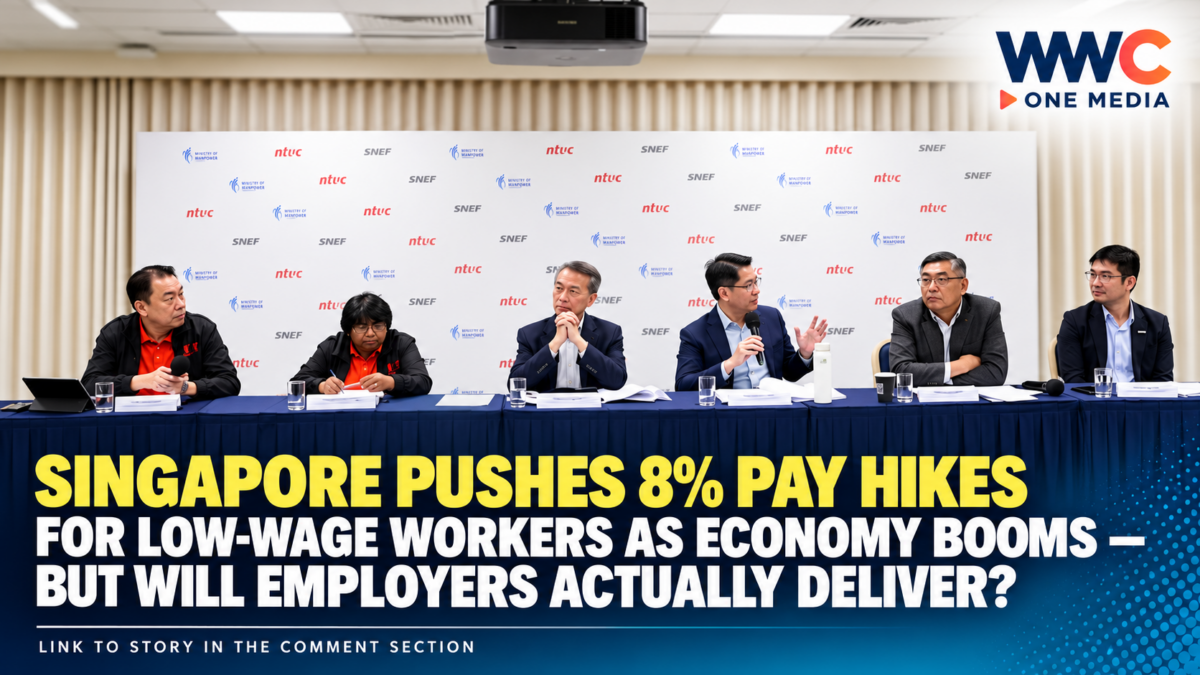
The National Wages Council (NWC) unveiled its latest salary guidelines on October 19, recommending higher wages for lower-income employees, greater rewards from productivity gains, and stronger investment in artificial intelligence (AI) training.
The recommendations cover the period from December 1, 2026, to November 30, 2027.
Under the new guidelines, employees earning gross monthly salaries of up to S$2,800 are recommended to receive built-in wage increases of 6% to 8%, with specific minimum dollar increases depending on their employers’ financial performance.
The Singapore government has accepted the recommendations, strengthening the national push to ensure economic growth benefits workers across different income groups.
Bigger Paychecks: Who Gets the Highest Increases?
The latest guidelines distinguish among companies based on profitability and business prospects.
Employers performing well with positive business outlooks are encouraged to provide raises toward the upper end of the 6% to 8% range, or minimum increases of S$135 to S$170, whichever is higher.
Businesses performing well but facing uncertain prospects are advised to provide increases around the middle of the recommended range, subject to the same minimum-dollar guidance.
Companies that remain profitable despite weaker performance are urged to give increases toward the lower end of the range, or at least S$120, whichever is higher.
For the first time, the council is also recommending a built-in monthly increase of at least S$120 for lower-wage employees at companies that have performed poorly and are unprofitable.
The move reflects an effort to protect lower-income workers even when business conditions become difficult.
However, these are wage recommendations rather than an automatic, legally mandated 8% salary increase for every eligible employee.
The Bigger Problem: Employers Are Not Fully Following the Guidelines
Despite Singapore’s push for higher wages, implementation remains a significant challenge.
According to Channel NewsAsia, the Ministry of Manpower disclosed that adoption of the previous year’s guidelines stood at only slightly above 25%, compared with a historical peak exceeding 70%.
NWC chairman Hsieh Fu Hua clarified that the low adoption figure did not necessarily mean the remaining employers provided no wage increases. Instead, many companies had not met the council’s recommended increases.
The latest framework aims to improve compliance with the recommendations by giving businesses more flexibility according to their financial position.
For workers, however, the critical issue remains whether suggested pay increases will translate into actual salary adjustments.
AI Is Becoming Part of Singapore’s Wage Debate
Beyond pay raises, the National Wages Council is urging businesses to prepare their workforces for an economy increasingly shaped by artificial intelligence.
The council believes AI can boost productivity, create new business opportunities, and strengthen Singapore’s international competitiveness.
However, workers will need access to relevant training and new skills to benefit from those changes.
Employers are being encouraged to redesign jobs, invest in upskilling and reskilling, and help employees develop AI literacy alongside human judgment and other complementary capabilities.
The council’s broader message is that technological improvements should benefit both companies and their employees.
Without meaningful training opportunities, lower-paid workers could face difficulties adapting to changing job requirements.
Singapore’s Wage Strategy Goes Beyond a Single Pay Increase
The NWC is also urging companies to adopt flexible wage structures combining fixed pay with monthly and annual variable components.
Such arrangements can help companies reward employees during periods of strong business performance while giving employers greater flexibility during downturns.
The objective is to help businesses protect jobs when conditions deteriorate without permanently sacrificing their ability to attract and retain workers.
The council also wants lower-wage employees’ salaries to grow faster than median wages over time, helping narrow Singapore’s income gap.
What This Means for Workers and Employers
For employees earning up to S$2,800 monthly, the guidelines signal continued national pressure for higher incomes and a greater share of economic prosperity.
For employers, the recommendations create additional expectations around wage competitiveness, productivity improvement, workforce training, and fair compensation.
But the policy’s ultimate effectiveness will depend on how widely businesses adopt the recommendations.
The low adoption rate reported for the previous guidelines raises a difficult question about whether the newest wage proposals will achieve stronger results.
The Bigger Picture: Growth Means Little If Workers Are Left Behind
Singapore’s latest salary recommendations highlight a growing challenge for advanced economies: ensuring that productivity gains, technological investment, and economic expansion translate into meaningful improvements in workers’ lives.
As companies accelerate AI adoption and seek greater efficiency, the pressure to share the financial benefits with their employees is likely to intensify.
For Singapore, the next test will not be whether the National Wages Council can recommend higher salaries.
It will be whether employers deliver them — and whether workers can secure a fairer share of Singapore’s economic success.