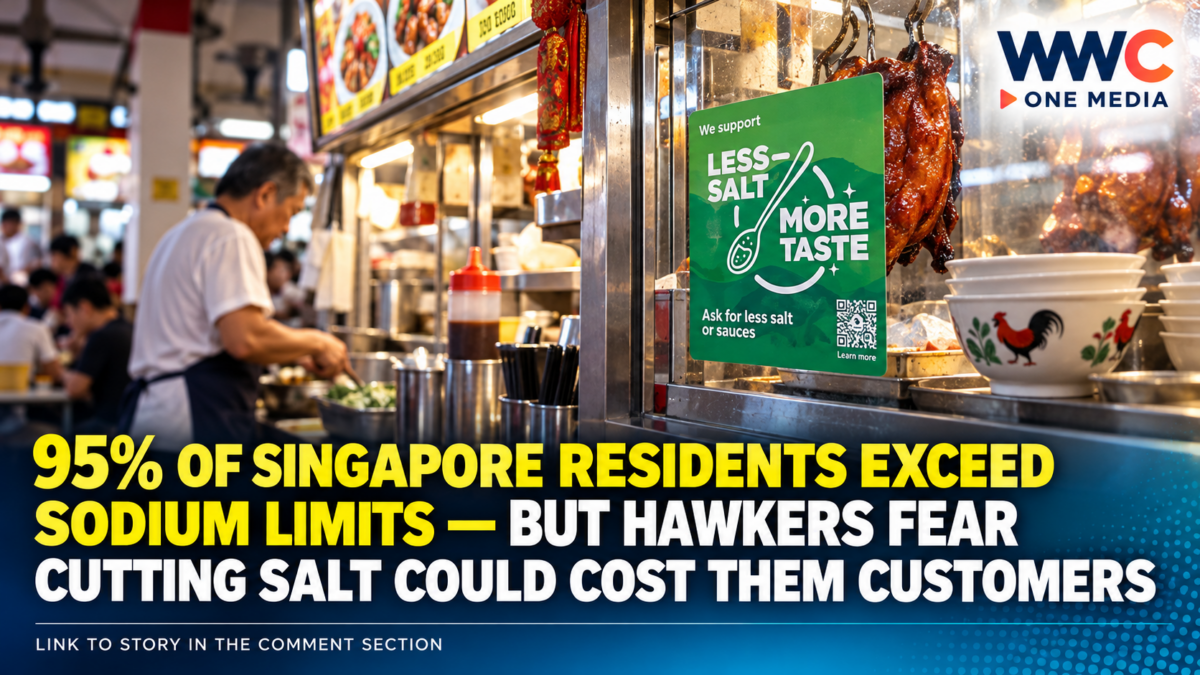
SINGAPORE, October 20, 2026 — Singapore is confronting a growing public health challenge as nearly 95% of residents exceed recommended daily sodium limits, even as hawkers warn that reducing salt in popular dishes could threaten their businesses.
New findings from the country’s 2025 National Nutrition Survey reveal that average daily sodium intake has climbed to 4,000 milligrams, twice the recommended limit of 2,000 milligrams, equivalent to approximately one teaspoon of salt.
The figures highlight an uncomfortable contradiction: Singaporeans are becoming more physically active, but their diets are moving in a less healthy direction.
For the country’s iconic hawker industry, however, the challenge is far more complicated than simply removing salt from recipes.
Hawkers Fear Losing Customers Over Less Salty Food
A Channel NewsAsia report published on October 20 found that many hawkers hesitate to adopt lower-sodium ingredients because they fear customers will reject changes to familiar flavours.
At Xiang Ji Wanton Mee in Bedok Food Centre, second-generation hawker Ringo Yen discovered that cutting salt from his noodle soup did not necessarily result in healthier eating.
Some customers complained that the broth lacked flavour and compensated by adding more soy sauce and condiments.
Other stall operators expressed similar concerns, warning that altering recipes passed down through generations could discourage loyal diners from returning.
Price is another major consideration.
According to CNA, lower-sodium salt costs approximately S$5 per kilogram at major retailers, more than twice the cost of conventional salt.
For small businesses operating on thin margins, healthier ingredients may mean higher expenses without any guarantee that customers will accept the changes.
Singapore’s Sodium Consumption Keeps Rising
The latest government data indicates that the problem extends beyond individual hawker stalls.
Average daily sodium intake increased from 3,480mg in 2019 to 4,000mg in 2025, while the proportion of residents exceeding the recommended limit climbed from 88% to 95%.
Singapore’s Health Promotion Board also found that the sodium content of commonly consumed dishes rose by approximately 20% between 2010 and 2023, followed by another 10% increase between 2023 and 2025.
Dining habits are contributing to the challenge.
Seven in 10 residents reported eating out at least once daily in 2025, compared with six in 10 in 2019.
This matters because sauces, seasonings, soups and ingredients used during food preparation can contain substantial amounts of sodium, even when meals do not taste excessively salty.
Health experts warn that sustained high sodium consumption increases the risk of high blood pressure, which can contribute to heart disease and stroke.
Only 650 Hawker Stalls Have Made the Switch
Singapore has been encouraging food operators to use lower-sodium salt, sauces and seasonings through its Healthier Ingredient Promotion Programme.
By June 2026, the Health Promotion Board had approached around 4,000 hawkers across 146 hawker centres and coffeeshops.
However, only 650 stalls had switched to lower-sodium ingredients, although that represented progress from slightly more than 300 stalls in December 2024.
The figures illustrate how slowly healthier cooking practices are spreading through a food industry built around affordability, convenience and customer preferences.
Nevertheless, some businesses are showing that change is possible.
Sin Kok Kin, who operates Ah Kiat Wanton Mee in Bedok, switched to lower-sodium potassium-based salt after being diagnosed with high blood pressure in 2023.
He also began using other ingredients, including sugarcane stems and small fish, to give his soup flavour without relying as heavily on salt.
Although some customers initially resisted the changes, they gradually became more accepting.
Larger operators are also experimenting with reformulation.
Broadway Food Centre, whose central kitchen supplies more than 48 economical rice stalls, replaced regular salt with lower-sodium alternatives in 2024 after adjusting its recipes.
Singapore Launches New Push to Change Eating Habits
The government is attempting to shift the responsibility beyond hawkers by encouraging customers to actively request healthier food.
Through the “Ask for Less” movement launched in September 2026, residents are encouraged to request less salt, sauce and gravy when dining outside their homes.
The Health Promotion Board is also promoting lower-sodium options through public awareness campaigns, industry partnerships and incentives.
Singapore has separately announced that expanded Nutri-Grade requirements covering certain packaged food ingredients, including salt, sauces, seasonings, instant noodles and cooking oils, will take effect in 2028 under its revised implementation timeline.
The policy is intended to make nutritional information easier to understand and encourage manufacturers to reformulate products.
Health authorities are also reviewing whether additional regulatory measures may be needed to reduce sodium consumption.
A Healthier Singapore, but a Growing Food Problem
The findings come alongside other troubling dietary trends.
Average calorie intake increased from 2,360 kilocalories daily in 2019 to 2,460 in 2025.
Around 57% of residents exceeded their recommended calorie intake after accounting for physical activity.
At the same time, Singapore has achieved progress in reducing sugar consumption, with average daily intake declining from 60 grams in 2018 to 48 grams in 2025.
That contrast suggests changing national eating habits is possible, but reducing sodium may prove more challenging because salt is deeply embedded in the flavours, recipes and affordability expectations surrounding everyday meals.
For hawkers, the dilemma is commercial as much as nutritional: customers must continue enjoying the food for businesses to survive.
For health authorities, the stakes are considerably broader.
Reducing sodium intake could help lower long-term cardiovascular risks, but success may depend on changing customer preferences as much as reformulating recipes.
The bigger question is whether Singapore can persuade millions of diners to embrace less salty meals before rising sodium consumption creates an even greater public health burden.