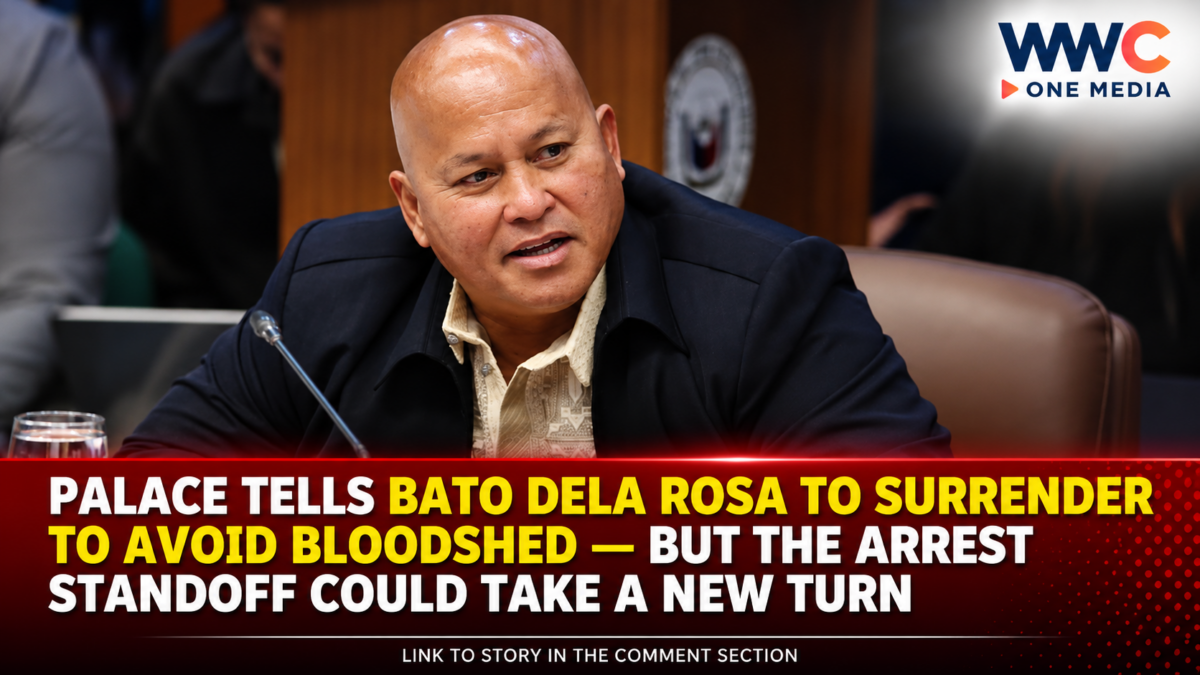
Malacañang is pressing Senator Ronald “Bato” dela Rosa to surrender peacefully as the government weighs how to enforce an International Criminal Court arrest warrant without triggering a potentially deadly confrontation.
Palace Press Officer Claire Castro said dela Rosa should face the cases against him rather than risk bloodshed. She also warned individuals allegedly sheltering the senator against helping him evade authorities.
The latest appeal comes as Interior and Local Government Secretary Jonvic Remulla has raised concerns that a forced arrest could result in serious casualties and potentially wider unrest.
The situation places authorities in a difficult position: enforcing an outstanding arrest warrant while attempting to prevent violence involving people who might resist the operation.
Why the Palace is urging Bato dela Rosa to surrender
The government’s appeal follows Remulla’s October 20 remarks that authorities would prefer negotiations over an operation that could put the lives of police officers and civilians at risk.
According to the Daily Tribune, Remulla warned that a confrontation could be exploited by extremist groups and compared the potential for escalating unrest to the 2017 Marawi siege. His remarks described a feared scenario, not a confirmed intelligence assessment that such violence will occur.
Remulla also acknowledged that negotiating a surrender could raise questions about the enforcement of justice. He nevertheless argued that preventing possible loss of life should be a priority.
The Palace’s position reflects the government’s stated preference for a peaceful surrender, but the appeal does not itself resolve the legal and operational questions surrounding the warrant.
What is the ICC accusing dela Rosa of?
The ICC unsealed its arrest warrant against dela Rosa on May 11, 2026. The warrant had originally been issued under seal on November 6, 2025.
According to the court, there are reasonable grounds to believe that dela Rosa may bear criminal responsibility for the alleged crime against humanity of murder in connection with killings during the Philippines’ anti-drug campaign. The warrant identifies alleged incidents involving at least 32 deaths between July 2016 and April 2018. These are allegations, not a final judicial determination of guilt.
Dela Rosa was chief of the Philippine National Police during part of former President Rodrigo Duterte’s administration and played a prominent role in implementing its anti-drug campaign.
The senator has denied wrongdoing and has challenged the legal basis for the ICC proceedings, arguing that the Philippines’ withdrawal from the court affects its authority over him. The ICC, however, is investigating alleged crimes committed during the period covered by its jurisdiction.
Supreme Court ruling adds another layer to the dispute
In May, dela Rosa sought temporary legal protection from possible arrest. The Supreme Court denied his request for a temporary restraining order and a status quo ante order.
The ruling concerned the provisional relief he requested; it did not, by itself, settle every issue raised in his underlying petition. The distinction matters because a denial of temporary protection should not be described as a final ruling on all questions concerning the ICC’s jurisdiction or the merits of the case.
The Palace had also stated in May that it considered the warrant valid, while leaving the Department of Justice to assess the legal implications.
How the standoff developed
The current situation traces back to May 2026, when dela Rosa reappeared at the Senate after months out of public view. Authorities sought to enforce the ICC warrant, but he remained under Senate protection during the initial standoff.
The episode drew national attention after gunfire was reported inside the Senate complex, although accounts of the incident and the involvement of authorities were disputed. Dela Rosa subsequently left the Senate and remained out of public view, according to reporting by Reuters and the Associated Press.
Remulla later said he regretted not arresting the senator when he had the opportunity to do so at the Senate, explaining that he had honored an agreement not to make an arrest while dela Rosa remained there.
The immediate question is whether dela Rosa will surrender and how authorities will proceed if he does not.
The Palace’s public appeal signals a preference for avoiding a violent confrontation, while Remulla’s comments suggest officials are considering the risks of different approaches. However, neither statement establishes that a surrender agreement has been reached or that an arrest operation has been scheduled.
The case also raises broader questions about accountability for alleged crimes during the anti-drug campaign, the limits of political protection, and the Philippines’ legal obligations concerning alleged crimes committed while it was an ICC member.
For now, the outcome remains uncertain. What is clear is that authorities face pressure to enforce the warrant while preventing a confrontation that could endanger the public.