
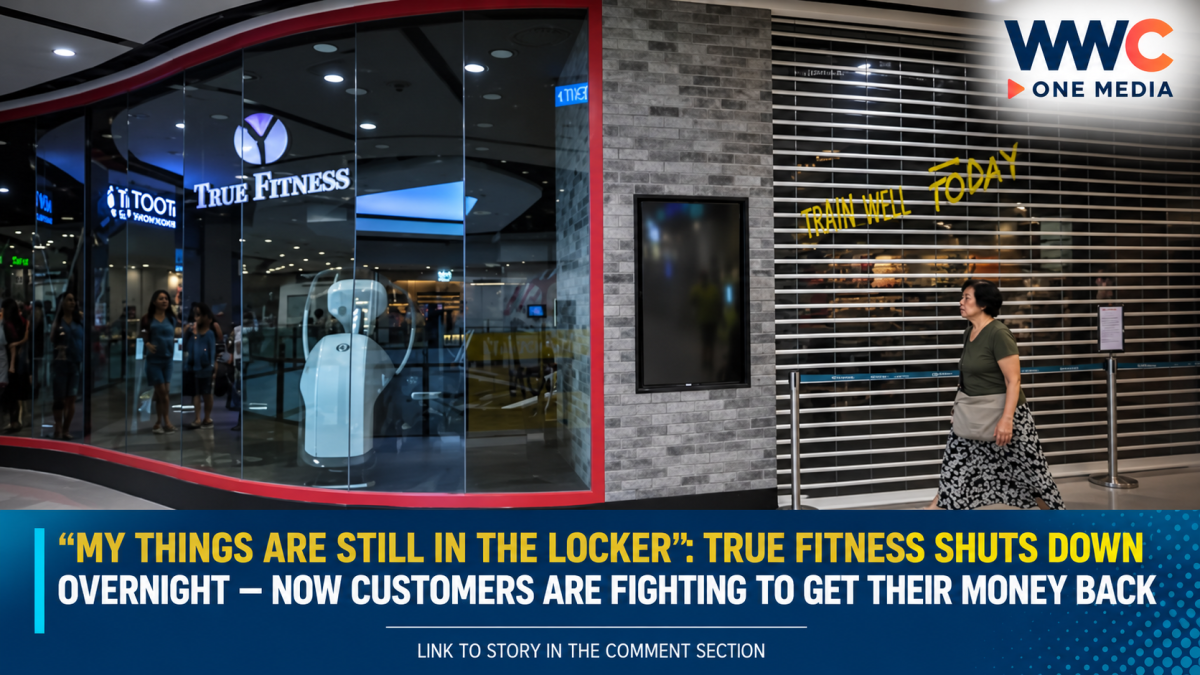
SINGAPORE — For some True Fitness and True Yoga members, the warning came too late.
They arrived expecting another workout, yoga class or training session — only to find locked doors.
For one longtime member, the shock was even more personal: her belongings were still inside a gym locker she could no longer access.
The abrupt shutdown of True Fitness and True Yoga across Singapore has left customers scrambling for answers over their belongings, unused memberships and prepaid packages, while employees and instructors have suddenly found themselves without work.
The companies entered provisional liquidation after their Hong Kong-listed parent, Kontafarma China Holdings, said the Singapore fitness businesses could no longer continue because of mounting liabilities, intense competition and rising costs.
And the financial fallout is already substantial.
As of Sept. 11, Singapore’s Consumers Association of Singapore, or CASE, said it had received 241 complaints involving more than S$609,000 in reported losses tied to unused memberships, packages and services.
Members woke up to locked doors
The shutdown took effect on Sept. 11.
Many customers were caught completely off guard.
At the Great World outlet, longtime member Yang arrived for a yoga class and instead found the premises shuttered.
She had been a member since 2014 and had paid between S$8,000 and S$9,000 for a lifetime membership, along with an annual maintenance fee.
Now she does not know whether she will recover the unused value of that membership — or when she will be able to retrieve the belongings left inside her locker.
Other members reported similar experiences.
Some had purchased memberships only months earlier. Others had prepaid for packages that they could no longer use.
The sudden closure transformed what had been routine gym memberships into potential creditor claims.
The numbers behind the collapse
The financial picture helps explain why the shutdown happened.
Kontafarma reported that the True Singapore Group generated approximately HK$181.2 million in revenue in 2025, but still recorded a loss of about HK$34.3 million.
At the end of 2025, the group had approximately HK$555.5 million in liabilities, compared with assets of about HK$149.7 million, leaving net liabilities of approximately HK$405.8 million.
The situation deteriorated further this year.
For the first eight months of 2026, the group recorded a loss of about HK$19.1 million.
By Aug. 31, its total liabilities had risen to approximately HK$633.8 million, while net liabilities reached about HK$429.3 million.
The group also owed its parent company about HK$309.7 million as of Aug. 31.
Why the fitness giant failed
Kontafarma pointed to several pressures hitting the Singapore fitness market.
Competition has intensified.
Boutique gyms have become increasingly popular, offering more specialized and personalized experiences than traditional large fitness chains.
Condominium gyms and facilities inside residential developments have also reduced some consumers’ need to pay for separate commercial gym memberships.
Then there is the digital competition.
Online fitness programs, mobile applications, video platforms and virtual coaching have made it possible for people to exercise at home or outdoors without signing a traditional gym contract.
For a large fitness chain carrying substantial fixed operating costs, that combination can be devastating.
Kontafarma said the Singapore fitness operations continued to underperform despite financial support from the parent company.
Eventually, the business faced significant liquidity pressure.
Employees were caught off guard too
The customers were not the only ones blindsided.
Former employees told Singapore media that they were informed of the shutdown only shortly before operations ceased.
Around 50 former employees attended a meeting with the provisional liquidators on Sept. 11, according to The Business Times and The Straits Times.
More than 200 employees and freelancers have since sought assistance from the Singapore Fitness Alliance.
As of Sept. 13, about 235 affected staff and freelancers had reached out to the industry association for help finding new employment.
The alliance is working with NTUC-linked organizations and the Employment and Employability Institute, or e2i, to help affected workers find new opportunities.
However, the organization has made clear that it will not handle claims for unpaid salaries or commissions.
Those issues will have to be addressed through the liquidation process.
What happens to customers’ money?
This is now the biggest question facing members.
CASE has contacted the provisional liquidators to seek clarification on the arrangements for affected consumers, including what information customers will need to submit claims.
But liquidation changes the situation dramatically.
Customers who paid in advance are no longer simply consumers waiting for a service.
They may become creditors seeking recovery from the company’s remaining assets.
How much they ultimately recover — and how quickly — will depend on the liquidation process and the assets available for distribution after claims are assessed according to Singapore’s legal priority rules. Kontafarma has specifically said recovery will depend on assets realized during liquidation and the statutory order of priority.
That means a refund is not automatically guaranteed.
What about the belongings left in lockers?
For members whose clothes, shoes, bags and other possessions remain inside shuttered facilities, access is another immediate concern.
The abrupt closure means customers cannot simply walk into their usual gym and collect their things.
The liquidation process now determines how the premises and company property are handled.
Members therefore need instructions from the provisional liquidators on how and when personal belongings can be retrieved.
That uncertainty is adding another layer of frustration to an already chaotic situation.
True was once a major fitness name
The collapse marks a dramatic reversal for a brand that had been a familiar presence in Singapore’s fitness industry for years.
True Singapore Group operated several fitness and wellness brands, including True Fitness, True Yoga, TFX and Yoga Edition.
CNA reported that the group operated 10 fitness and yoga outlets across three brands before the shutdown.
Its downfall also echoes the collapse of another major fitness chain.
Some True Fitness customers had previously moved to the company after California Fitness collapsed in 2016.
For those customers, the latest shutdown is an especially painful case of history repeating itself.
The industry itself is changing
The True Fitness collapse points to a broader transformation in Singapore’s fitness industry.
Traditional large gyms once competed primarily on equipment, location and membership price.
Today, consumers can choose from boutique studios, specialized strength-training facilities, yoga centers, condominium gyms, personal trainers, digital subscriptions and free online workouts.
That fragmentation makes it much harder for large operators to maintain the economics of the old membership model.
One former instructor told The Straits Times that the traditional large-gym model is no longer working as well, with more consumers gravitating toward smaller boutique facilities.
Rival gyms are already moving in
While former True customers are dealing with uncertainty, competitors are moving quickly to attract them.
Other fitness chains in Singapore have begun offering incentives to former True Fitness and True Yoga members, including waived joining fees and free classes.
For rival operators, the collapse represents an unusual opportunity.
Thousands of people who already have a strong fitness habit suddenly need a new gym or studio.
But for former True customers, switching gyms is not necessarily the main concern.
Many are still waiting to find out whether they will recover money they already paid.
The bigger warning for consumers
The True Fitness collapse highlights a risk that consumers often overlook when buying long-term memberships.
A multi-year or lifetime package may appear attractive because it locks in a lower cost.
But the longer the contract, the more the customer is exposed if the company later experiences financial problems.
The same lesson applies across industries where customers pay large amounts upfront for services to be delivered over years.
A company’s brand reputation today does not guarantee its financial stability tomorrow.
The next battle is now happening in liquidation
The gyms may already be closed.
But the dispute is far from over.
Provisional liquidators have taken control of the affected companies, and creditors, employees and consumers now face the process of establishing what they are owed and what can ultimately be recovered.
For customers, the immediate priorities are simple:
Retrieve personal belongings.
Document unused memberships and prepaid packages.
Keep receipts, contracts, payment records and correspondence.
Follow official instructions from CASE and the provisional liquidators regarding claims.
The exact recovery process and timeline will depend on the liquidation proceedings.
For now, the once-familiar True Fitness doors remain shut.
Inside some of those locked facilities are still gym bags, shoes, clothes and personal belongings.
Outside are hundreds of customers wondering what happened to money they paid in advance.
And behind the closure is a much bigger question for Singapore’s fitness industry:
If one of the country’s established gym chains could collapse this suddenly, which business model will survive the next wave of competition?



Leave a Reply