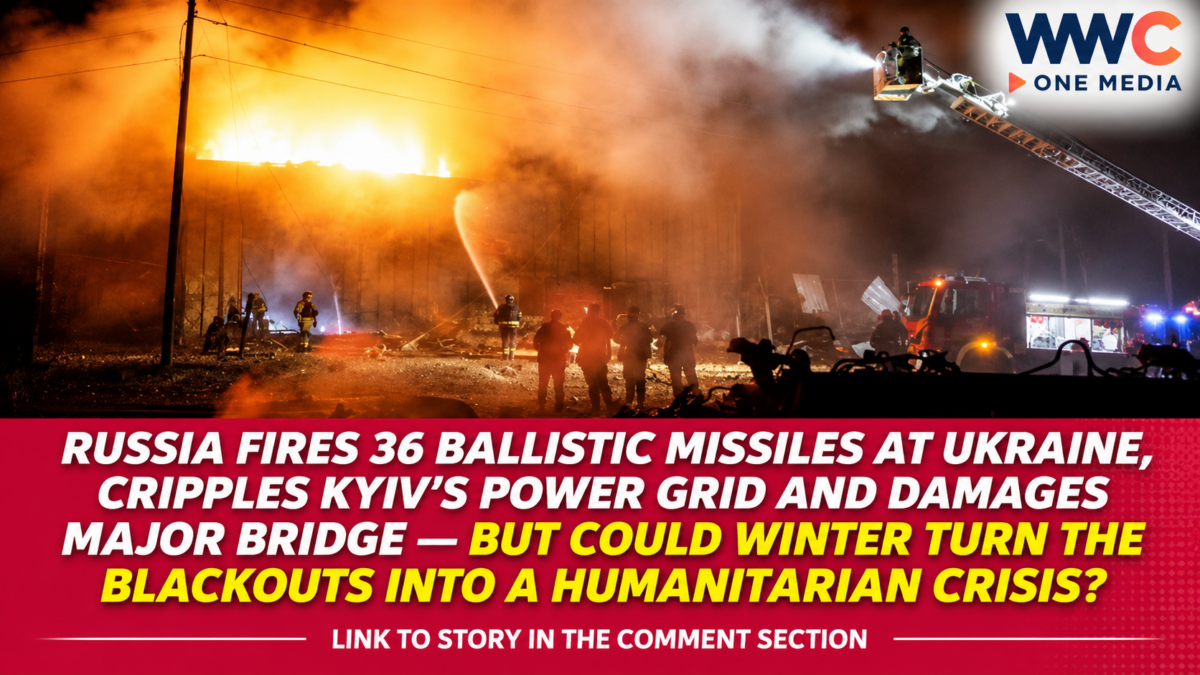
KYIV, UKRAINE — Russia has unleashed another devastating wave of ballistic missiles and attack drones against Ukraine, severely damaging critical power infrastructure around Kyiv and striking a major bridge across the Dnipro River just days before a new round of US-brokered peace negotiations.
The overnight attacks on November 7 disrupted electricity, water and heating supplies in the Ukrainian capital as temperatures approached freezing.
According to Ukrainian President Volodymyr Zelenskyy, Russia launched 36 ballistic missiles, but Ukrainian air defences intercepted only four.
Ukraine’s air force also reported shooting down 149 of 172 attack drones.
At least two people were killed and approximately a dozen others wounded across Ukraine, according to Reuters’ November 7 reporting.
The strikes damaged homes, businesses, energy infrastructure and transportation facilities.
But the most alarming development may be the damage to electrical systems that carry power from two of Ukraine’s nuclear plants to Kyiv and other central regions.
The situation has intensified fears that Moscow is attempting to weaken Ukraine’s ability to sustain essential civilian services as winter approaches.
And with Russian and Ukrainian representatives scheduled to meet US negotiators in Abu Dhabi on November 10 and 11, the timing has raised another question.
Is Russia escalating its attacks to strengthen its negotiating position before the next peace talks?
Russia Launches Massive Missile and Drone Assault on Kyiv
Explosions shook Kyiv and surrounding communities overnight as Russian forces launched successive waves of missiles and drones.
Ukrainian authorities reported significant damage in several locations.
Kyiv Mayor Vitali Klitschko said ballistic missiles struck the Northern Bridge, an important crossing over the Dnipro River.
The attack also damaged energy installations supplying the capital.
Ukraine’s Energy Ministry reported serious damage to facilities involved in transmitting electricity from two nuclear power plants.
President Zelenskyy warned that the consequences extended beyond ordinary power interruptions.
Electricity shortages were affecting water and heating systems, creating further pressure on residents.
Substations in five additional regions were also damaged.
The strikes came as Ukraine was already struggling to maintain essential services following months of attacks on its power network.
For civilians, the latest assault has increased uncertainty over whether their homes will remain warm and their basic services operational during the colder months.
Only Four of 36 Ballistic Missiles Were Intercepted
One of the most concerning aspects of the attack was Ukraine’s reported difficulty intercepting ballistic missiles.
According to Zelenskyy, Russian forces launched 36 ballistic missiles.
Ukrainian air defences destroyed four.
That represents an interception rate of approximately 11.1% for the ballistic missiles reported in this attack.
The figure should not be interpreted as Ukraine’s overall interception rate across the war.
Air-defence performance varies depending on missile type, flight path, available systems and the locations targeted.
Ukraine also reported intercepting 149 of 172 drones, a substantially higher percentage.
The contrast highlights the difficulty of defending against different categories of airborne weapons.
Ballistic missiles can travel at high speeds and follow trajectories that make them especially challenging to intercept.
Specialized systems are needed to counter many of these threats.
Ukraine has repeatedly requested additional air-defence missiles and equipment from Western allies.
The latest attack underscores the urgency of those requests.
Zelenskyy also said some of the missiles used were manufactured in North Korea.
That allegation reflects Kyiv’s assessment of the weapons involved and should be attributed accordingly.
Kyiv’s Northern Bridge Suffers Another Major Strike
The Northern Bridge was one of the most prominent targets in the November 7 assault.
The crossing connects areas on opposite sides of the Dnipro River.
It plays an important role in everyday travel and the movement of goods through Kyiv.
Mayor Klitschko confirmed that missiles damaged the bridge.
Russian officials also acknowledged striking it.
However, the two sides described its significance differently.
Russia’s Defence Ministry claimed the bridge was being used to transport weapons, military equipment and vehicles for Ukraine’s armed forces.
That claim has not been independently established in the reporting reviewed.
For Kyiv residents, damage to the crossing creates immediate transportation problems regardless of the military allegations.
Bridge closures can redirect traffic onto other routes, increasing congestion and slowing essential journeys.
Emergency services, businesses and ordinary commuters may all be affected.
AP subsequently reported that repairs were underway and city authorities had begun stabilizing some affected services.
There was no confirmed finding that the bridge had been completely destroyed.
Why Russia Is Increasingly Targeting Kyiv’s Bridges
The Northern Bridge strike is part of a broader pattern of attacks affecting Kyiv’s transportation network.
In recent weeks, Russian strikes have damaged multiple crossings over the Dnipro River.
These incidents have complicated travel in a city whose population exceeds three million.
As WWC ONE MEDIA previously reported in its investigation into worsening security conditions in Kyiv, repeated attacks on bridges, residential neighbourhoods and critical infrastructure have disrupted daily life.
The consequences extend beyond the immediate physical damage.
If a bridge is closed, vehicles must use alternative crossings.
That can delay emergency responses and commercial deliveries.
Transportation disruptions can become especially severe when combined with electricity shortages and repeated air-raid alerts.
For residents already coping with years of war, the attacks add another source of uncertainty.
Russia Damages Electrical Links Serving Two Nuclear Power Plants
The latest energy strikes are particularly serious because of their reported effects on electricity transmission infrastructure.
Ukraine’s Energy Ministry said the attack damaged systems carrying electricity from two nuclear power plants to Kyiv and central Ukraine.
This does not mean the nuclear reactors themselves were directly struck.
The distinction is essential.
Nuclear power stations depend on extensive transmission networks to deliver electricity to consumers.
Damage to substations and high-voltage equipment can interrupt power distribution even when electricity-generating facilities remain operational.
Such disruptions can also create additional challenges for managing the grid safely.
Ukraine relies heavily on nuclear generation because years of warfare have damaged substantial portions of its other electricity infrastructure.
The loss or disruption of transmission connections can therefore have effects extending across multiple regions.
The November 7 attacks demonstrate that securing electricity supply requires protecting both power-generation facilities and the infrastructure connecting them to homes and businesses.
Kyiv Faces Blackouts, Water Shortages and Heating Problems
The immediate consequences were felt across the capital.
Electricity disruptions affected water services and heating systems as temperatures approached zero degrees Celsius.
Water utilities often depend on electric pumps to maintain pressure.
Heating networks also require electricity to operate equipment and distribute heat.
When electrical infrastructure fails, multiple essential services can be disrupted simultaneously.
That makes attacks on the power grid particularly dangerous during winter.
Residents may lose lighting and refrigeration.
Public transportation can be interrupted.
Businesses may be forced to suspend operations.
Hospitals and emergency services may need to rely on backup generators.
For elderly residents, children and people with health vulnerabilities, prolonged heating interruptions can be especially concerning.
The severity of these consequences depends on the duration and geographic extent of the outages.
Authorities were working to restore services, but the latest strikes placed additional pressure on already damaged systems.
Ukraine’s Power Grid Has Been Under Attack for Months
The November barrage followed a prolonged campaign against Ukraine’s energy infrastructure.
Russian missiles and drones have repeatedly targeted power stations, substations and transmission facilities.
Some installations have required multiple rounds of repairs.
As WWC ONE MEDIA reported in its October 3 analysis of Russia’s attacks on Ukraine’s power grid, repeated damage creates the risk of cumulative infrastructure failure.
A repaired substation can be damaged again.
Replacement equipment may take time to manufacture or obtain.
Temporary power arrangements can help maintain essential services, but they do not necessarily restore full capacity.
The problem becomes more severe during winter, when electricity and heating demand increase.
Ukraine’s engineers have developed considerable experience restoring systems during wartime.
However, repeated strikes can make reconstruction more expensive and difficult.
The latest attack adds pressure to a grid already operating under extraordinary conditions.
Russia Says It Targeted Military and Industrial Facilities
Moscow confirmed carrying out a major strike on November 7.
Russia’s Defence Ministry said its forces targeted Ukraine’s military-industrial sector, energy infrastructure and transportation facilities.
It specifically identified the Northern Bridge and a facility called the Meridian plant in Kyiv.
The ministry claimed the Meridian plant was involved in manufacturing Flamingo cruise missiles.
Russia also said it struck a power plant, an electrical substation and other facilities in the Kyiv region.
Additional targets reportedly included infrastructure in Zhytomyr.
These are Russian military claims.
They have not all been independently verified.
Ukraine reported civilian casualties and damage to residential and commercial properties during the same series of attacks.
International humanitarian law distinguishes between military objectives and civilian objects.
Even when a target qualifies as a military objective, attacks must comply with rules concerning distinction, proportionality and precautions to protect civilians.
Whether a particular strike violated those rules requires detailed evidence about the target, expected military advantage and foreseeable civilian harm.
The available reporting does not establish a comprehensive legal assessment of each November 7 strike.
Civilian Deaths and Injuries Add to Ukraine’s Humanitarian Emergency
The attacks caused further casualties across Ukraine.
Reuters’ November 7 report said at least two people had been killed and approximately a dozen wounded.
Earlier reports carried lower figures before additional information became available.
The Associated Press reported injuries, damage to buildings and continuing rescue operations across several areas.
The casualty figures remain preliminary and should not be treated as a final nationwide accounting.
For affected families, however, the immediate consequences are already devastating.
Homes and businesses were damaged.
Residents faced disruptions to electricity and water.
Emergency responders worked in areas exposed to the threat of further attacks.
The November 7 assault also came during a particularly dangerous week for civilians elsewhere in Ukraine.
AP reported that rescue workers recovered additional bodies from an earlier strike on a former school being used as an aid shelter in Komyshuvakha, southern Ukraine.
Those deaths belong to a separate incident.
They should not be combined with the casualty count from the November 7 Kyiv-area attacks.
Zelenskyy Accuses Russia of Using Attacks to Pressure Peace Negotiations
The timing of the latest strikes has intensified diplomatic tensions.
Ukraine and Russia are scheduled to participate in US-mediated talks in Abu Dhabi on November 10 and 11.
Zelenskyy accused Moscow of increasing military pressure ahead of those discussions.
His argument is that Russia is seeking to improve its position by damaging Ukraine’s critical infrastructure while negotiations remain unresolved.
That interpretation reflects the Ukrainian government’s position.
Russia has not acknowledged that the attacks were intended to influence the negotiations.
Moscow maintains that its operations target military and supporting infrastructure.
The competing explanations demonstrate the difficult relationship between battlefield developments and diplomacy.
Military operations can continue even while governments discuss a ceasefire.
But sustained attacks can weaken confidence and make compromise more difficult.
Trump-Backed Abu Dhabi Peace Talks Face a Major Test
The upcoming negotiations represent another attempt to find a path toward ending the war.
The meetings are expected to involve representatives from Ukraine, Russia and the United States.
According to Reuters, Russia’s delegation will include senior officials from its military, foreign ministry and intelligence services.
Kremlin aide Vladimir Medinsky is expected to lead Moscow’s team.
The negotiations are scheduled for Tuesday and Wednesday, November 10–11.
As WWC ONE MEDIA reported in its November 3 preview of the Abu Dhabi discussions, the talks are expected to address security arrangements, possible de-escalation and humanitarian measures.
However, no breakthrough has been confirmed.
The parties remain divided over important political and territorial issues.
The latest missile and drone strikes could complicate those negotiations by increasing pressure on Ukraine to demand stronger protections for civilians and essential infrastructure.
The talks may still proceed as scheduled.
But their success will depend on whether the parties can move beyond public statements and agree on measures that can be implemented.
Ukraine Calls for Stronger Support From the US Congress
Zelenskyy also appealed for greater American support following the latest attacks.
The appeal comes after the November 3 US midterm elections, which shifted control of Congress toward the Democratic Party.
The Ukrainian president expressed hope that the incoming Congress would give more attention to Ukraine’s security needs.
However, the new congressional majorities will not assume office until January 2027.
Any immediate changes in American military assistance would depend on existing funding arrangements, executive decisions and legislative procedures.
Ukraine’s most urgent defence requirements include systems capable of intercepting ballistic missiles.
As WWC ONE MEDIA examined in its coverage of Washington’s planned NATO push for additional Ukrainian weapons, the challenge involves not only obtaining financial commitments but also delivering equipment quickly enough to protect cities.
Some advanced interceptors require lengthy manufacturing periods.
That makes immediate supplies and existing stockpiles particularly important.
The November 7 attack underscores the cost of shortages.
Ukraine Also Launches Attacks Against Russian Regions
The overnight fighting was not limited to Ukrainian territory.
Russian regional officials reported Ukrainian drone and missile attacks against several parts of Russia.
Reuters said Moscow’s initial account described relatively minor damage and no casualties in those incidents.
Later AP reporting described additional attacks and reported a fatality in Russia’s Belgorod region.
These reports reflect different incidents and reporting updates.
Ukraine has repeatedly attacked Russian military and energy-related targets as part of its broader strategy.
Kyiv argues that those operations are intended to undermine Moscow’s capacity to sustain the war.
Russia condemns the strikes and presents them as attacks on its territory.
The continuing exchanges show how the conflict has extended beyond the immediate frontline.
Even if ground operations slow, long-range strikes can maintain pressure on both countries.
Could Ukraine Face Its Most Difficult Winter Yet?
The greatest concern is that Russia may continue striking essential infrastructure as temperatures decline.
A single attack can often be repaired.
But repeated strikes can exhaust supplies of replacement equipment, reduce reserve capacity and create prolonged interruptions.
The cumulative effects can be substantial.
Electricity shortages can affect water distribution.
Heating interruptions can make homes and public buildings unsafe during severe cold.
Businesses may struggle to operate.
Schools may need to change schedules or move activities to shelters.
Repeated air-raid warnings also place psychological pressure on residents.
The November 7 strike illustrates how these problems can overlap.
Bridge damage complicates transport.
Power damage affects multiple services.
Air-defence shortages expose critical facilities to additional attacks.
That combination creates a serious humanitarian risk.
However, it would be premature to claim that Kyiv’s entire power system has collapsed permanently.
Authorities were carrying out repairs, and some services had already begun stabilizing.
The extent of the winter crisis will depend on further attacks, available equipment, weather conditions and the success of restoration efforts.
What Happens Next?
Several developments will determine how serious the latest escalation becomes.
The first is whether Ukrainian engineers can restore damaged substations and stabilize electricity supplies.
The second is whether the Northern Bridge can resume normal operations following repairs and inspections.
The third is whether Russia continues launching large missile and drone attacks against critical infrastructure.
The fourth is the availability of additional air-defence interceptors.
And the fifth is the outcome of the November 10–11 peace talks in Abu Dhabi.
A meaningful diplomatic breakthrough could reduce the threat of further attacks.
But negotiations alone do not guarantee a ceasefire.
For civilians, the most important immediate concerns remain electricity, heating, water and personal safety.
The Bottom Line: Russia’s Winter Offensive Threatens Kyiv’s Essential Services
Russia’s November 7 missile and drone attacks dealt another major blow to Ukraine’s critical infrastructure.
According to Ukrainian authorities, the assault involved 36 ballistic missiles and 172 drones.
Only four ballistic missiles were intercepted, while 149 drones were reportedly destroyed.
The Northern Bridge across the Dnipro River was damaged.
Energy infrastructure serving Kyiv and central Ukraine also suffered serious damage, disrupting electricity, water and heating.
At least two people were reported killed and approximately a dozen wounded across Ukraine in Reuters’ initial nationwide assessment.
Russia confirmed a major strike but said it targeted military-industrial, energy and transport infrastructure.
The attacks occurred just days before scheduled US-mediated peace talks in Abu Dhabi.
For Ukraine, the timing raises concern that Moscow is seeking additional leverage through military pressure.
For Russia, the operations form part of its continuing campaign against facilities it claims support Ukraine’s war effort.
For the international community, the immediate concern is the safety of civilians as winter approaches.
And as Kyiv faces another wave of blackouts, damaged bridges and increasingly difficult-to-intercept missiles, one question now hangs over the coming peace negotiations: Can diplomacy stop Russia’s attacks before winter deepens Ukraine’s humanitarian emergency—or could the next barrage push the country’s already battered power grid closer to a wider crisis?