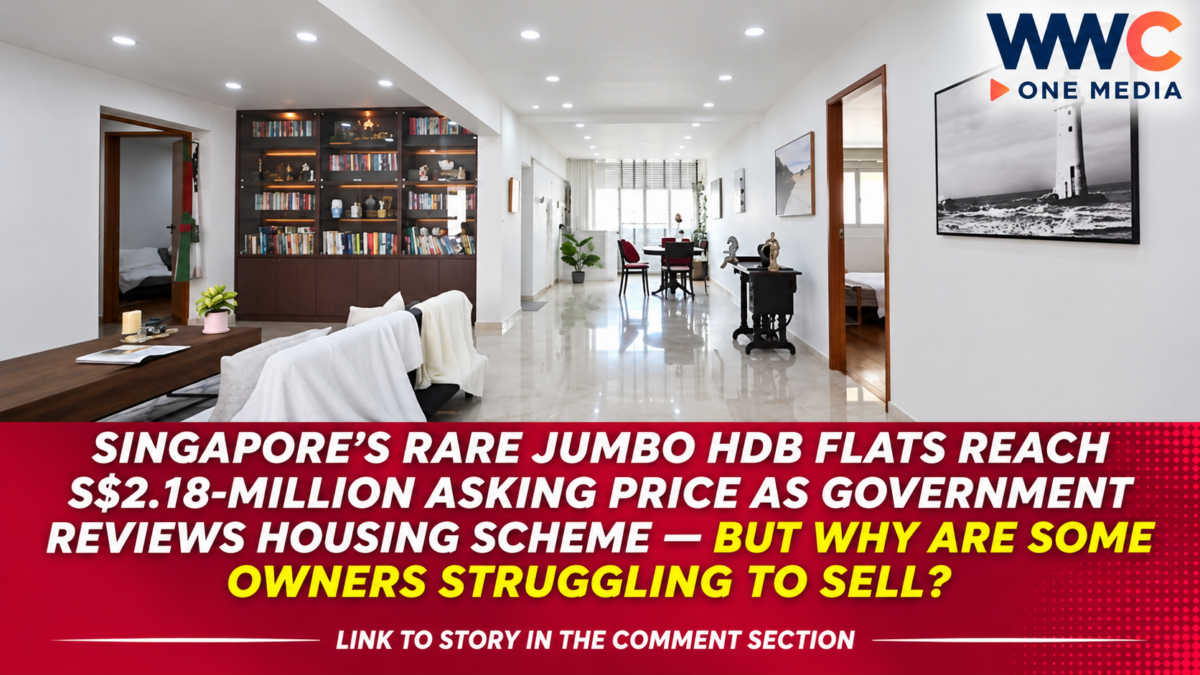
SINGAPORE — Singapore’s public housing market has developed an unusual luxury segment where some government-built flats offer nearly 2,000 square feet of living space, multiple bathrooms and the flexibility for several generations to live together.
These homes are known as jumbo HDB flats.
With an estimated 2,900 such units across Singapore, they account for only about 0.25% of the country’s more than 1.1 million public housing flats.
Their rarity has helped attract attention from buyers seeking unusually spacious homes without purchasing private landed property.
But a controversial listing in Telok Blangah has exposed a difficult reality.
A jumbo flat may be worth millions to its owner, yet finding someone willing and financially able to buy it can be surprisingly difficult.
In September, a 1,465-square-foot jumbo flat at Block 93B Telok Blangah Street 31 was advertised for S$2.18 million.
The extraordinary asking price prompted Singapore’s Housing and Development Board (HDB) to announce a review of its flat conversion scheme.
The seller subsequently reduced the asking price to S$1,999,999.
Meanwhile, other jumbo-flat owners have reported spending months, and sometimes more than a year, searching for suitable buyers.
The contrast raises an important question about Singapore’s housing market.
Are jumbo HDB flats becoming highly sought-after premium properties—or are their owners discovering that bigger homes can come with bigger financial risks?
Why Singapore’s Jumbo HDB Flats Are So Rare
Unlike conventional three-room, four-room or five-room HDB flats, jumbo units were generally created by combining two complete adjoining apartments.
That arrangement can produce significantly more living space than a standard flat.
Some include multiple kitchens, separate living areas and enough rooms to accommodate extended families.
The concept emerged during a very different period in Singapore’s housing history.
During the late 1980s, HDB faced an oversupply of smaller flats in several new towns, including Woodlands, Yishun and Bedok.
Combining adjacent units provided a practical way to use available housing stock.
In 1993, HDB introduced its Conversion Scheme.
The programme allowed eligible owners of three-room or smaller flats to acquire an adjoining qualifying unit and combine the two apartments into a larger home.
The objective was to support households needing more space while allowing them to remain in familiar neighbourhoods.
Today, the supply is extremely limited.
HDB no longer routinely offers jumbo flats as a standard new housing type.
Additional converted units depend on eligible owners obtaining adjoining flats, satisfying scheme requirements and securing structural approval.
That makes their availability very different from conventional HDB resale properties.
The S$2.18-Million Listing That Sparked a Government Review
The debate intensified after a jumbo unit in Telok Blangah appeared on PropertyGuru in September.
Located at Block 93B Telok Blangah Street 31, the property was created by merging two three-room flats.
Its floor area is approximately 1,465 square feet.
One of its main attractions is its relatively long remaining lease of about 91 years.
That distinguishes it from many older jumbo flats constructed or converted decades ago.
The unit was initially marketed for S$2.18 million.
As previously reported by WWC ONE MEDIA in its coverage of the Telok Blangah jumbo HDB listing, the extraordinary price generated debate over whether Singapore’s public housing market was approaching its first completed S$2-million resale transaction.
But HDB questioned the pricing.
The authority noted that comparable individual three-room flats in the area had transacted for approximately S$673,000 to S$771,000.
At the upper end, two such flats would have a combined price of approximately S$1.54 million.
That made the original S$2.18-million listing more than S$600,000 higher, or over 40% above that comparison.
HDB warned that buyers could face substantial cash-over-valuation requirements if the eventual agreed purchase price exceeded the property’s assessed value.
The advertised price was later reduced to S$1,999,999.
The reduction did not represent a loss on a completed sale. It was a change in the seller’s asking price.
HDB Reviews Its Flat Conversion Scheme
Following public concern about the listing, HDB announced on September 25 that it would review the Conversion Scheme.
The agency reiterated its commitment to maintaining affordable and accessible public housing.
The review matters because the scheme was created during a period of housing oversupply.
Today’s market operates under very different conditions.
Singapore has experienced substantial demand for larger resale flats, with some premium homes selling for more than S$1 million.
Allowing adjoining units to be combined reduces the number of separate apartments available within an estate.
A completed conversion also creates a larger and potentially more expensive property.
These effects raise questions about how the scheme should operate in a market focused on housing affordability.
National University of Singapore real estate professor Sing Tien Foo told CNA that tightening the scheme could help prevent unusual converted flats from influencing prices in surrounding resale markets.
However, HDB has not announced the outcome of its review.
There is no confirmed decision to abolish the programme.
Nor has the authority released a completion date for the review.
For now, any changes remain uncertain.
A Clementi Owner’s S$1.15-Million Flat Has Been Listed for Over a Year
The real challenges of owning a jumbo flat become clear in the experience of Aileen Tan.
The 61-year-old retiree owns a 1,615-square-foot jumbo flat in Clementi.
Her father acquired the property in 2018 after moving from a semi-detached house.
He wanted enough room for grandchildren to play and for the family to gather during weekends.
The apartment was created by combining a two-room and a three-room flat.
It now contains four rooms and three bathrooms.
After inheriting the property, Tan continued living there.
She also rents out two bedrooms for a combined S$3,300 each month.
That rental arrangement provides income while allowing her to retain substantial living space.
But her circumstances have changed.
Her children live overseas, and she expects to spend more time travelling to visit them.
She therefore decided to sell.
The apartment has approximately 56 years remaining on its lease and is listed for S$1.15 million.
Despite its size and rental potential, the property has remained on the market for more than a year.
During its first five months on the market, it reportedly attracted just two enquiries and two viewings.
Interest later improved following changes to Singapore’s housing eligibility rules.
Still, the extended marketing period reveals the difficulty of selling a highly specialized property.
Why a Big Apartment Does Not Guarantee a Big Buyer Pool
Jumbo flats appeal to particular types of households.
Large families may want additional bedrooms.
Multigenerational households may appreciate separate living areas.
Some buyers may want extra rooms for hobbies, storage or permitted rental arrangements.
But those same features can make a property less attractive to other purchasers.
A young couple may find a 1,900-square-foot flat unnecessarily large.
Older homeowners seeking to downsize may prefer a more compact apartment.
Buyers with limited financing capacity may be unable to afford the purchase.
Some may prefer a newer home with a longer remaining lease.
The result is a small and selective market.
Professor Sing warned that the market for jumbo flats could be relatively illiquid.
In property terms, illiquidity means an owner may find it difficult to sell quickly at the desired price.
A property can have attractive features and still remain unsold for a prolonged period.
For jumbo-flat owners, that creates a significant financial consideration.
A Woodlands Family Spent S$100,000 Creating Two Living Areas
Another example involves Rafael Shah and Ann Baki.
The couple purchased a jumbo flat in Woodlands for approximately S$650,000 in 2012.
They later spent around S$100,000 renovating the roughly 1,900-square-foot property.
Their goal was to create separate living areas for themselves and Shah’s mother.
The renovated home features two kitchens, two living areas and separate entrances connected through a shared corridor.
This arrangement provides privacy while allowing the family to remain close together.
But the design created challenges when the owners attempted to sell.
Some prospective buyers were interested in the large floor area but did not want the dual-key-style configuration.
Others appreciated the arrangement because it could potentially accommodate extended families or support permitted room rentals.
The couple eventually received an offer close to their expected S$1.2 million price.
However, the transaction did not proceed because the buyer’s intended moving timeline did not match the family’s needs.
The owners subsequently decided to retain the home.
They now plan to rent out part of the property for approximately S$3,500 monthly while living in a private residence closer to their daughter’s school.
Their experience demonstrates why demand alone does not guarantee a completed sale.
The buyer’s financing, preferred layout, price expectations and moving schedule must all align.
One Buyer Paid S$940,000 for a Flat With Only 46 Years Left on Its Lease
Not every jumbo-flat buyer is primarily focused on resale value.
Interior designer Vivian Wang purchased a 1,600-square-foot jumbo flat in Bendemeer for S$940,000 earlier in 2026.
The property has approximately 46 years remaining on its lease.
Wang, a permanent resident, wanted a home that could accommodate her husband and his parents.
The family has different daily routines and preferred a layout providing some separation between generations.
For them, the jumbo flat offered a practical living arrangement.
The shorter lease did not discourage the purchase because they intended to remain in the property rather than sell it.
That decision highlights a fundamental difference between buying a property as a long-term home and buying it primarily as an investment.
A household planning to remain in a flat may prioritize space and comfort.
Someone hoping to resell in several years must pay greater attention to future demand and financing constraints.
The appropriate decision depends on the buyer’s circumstances.
Why Remaining Lease Length Can Become a Financial Trap
Most HDB flats have 99-year leases.
As those leases shorten, financing conditions can become more restrictive.
Banks assess factors such as the remaining lease and the borrower’s financial position.
CPF usage is also subject to rules concerning the remaining lease and whether it can cover the youngest buyer to the required age.
This can reduce the pool of buyers capable of financing an older property.
For example, a jumbo flat with 91 years remaining may appeal to a wider range of purchasers than one with only 46 years left.
However, lease length is not the only factor influencing value.
Location, condition, layout, transport connections and demand also matter.
A shorter lease does not automatically mean a flat will become worthless in the near term.
But buyers need to understand that HDB property interests are leasehold and that the remaining term is an important part of the purchase.
That risk may be especially significant when a buyer pays a high premium for an older jumbo apartment.
How Much Do Jumbo HDB Flats Actually Sell For?
The most reliable evidence comes from completed transactions rather than property advertisements.
During a parliamentary sitting on October 7, National Development Minister Chee Hong Tat disclosed that 408 converted HDB flats were resold between 2016 and 2025.
The median resale price for converted flats in 2025 was S$910,000.
That is considerably below the original S$2.18-million Telok Blangah asking price.
However, the median does not represent the value of every jumbo flat.
Properties differ in location, size, remaining lease and condition.
A relatively new jumbo apartment near a desirable transport corridor may command a higher price than an older property in a less central estate.
The figures nevertheless provide an important reality check.
The existence of one multimillion-dollar advertisement does not mean jumbo HDB flats generally transact at that level.
For buyers, completed resale data remain more useful than attention-grabbing asking prices.
Singapore’s Million-Dollar HDB Market Is Changing
The jumbo-flat debate is taking place against a broader transformation in Singapore’s public housing market.
Premium resale transactions have become increasingly common.
In August, 201 HDB resale flats reportedly changed hands for at least S$1 million.
As WWC ONE MEDIA reported in its coverage of Singapore’s record August million-dollar HDB transactions, high-priced deals increased even as overall resale activity moderated.
The trend demonstrates how different housing-market segments can move in different directions.
Some buyers are paying substantial premiums for location, space, long leases or unusual layouts.
Meanwhile, the broader resale market has experienced softer prices.
As WWC ONE MEDIA examined in its October 26 analysis of nearly 600 million-dollar HDB sales during the third quarter, the premium end of the market can remain active even when the overall resale price index declines.
That is why it would be misleading to interpret a jumbo flat’s asking price as proof that all public housing is becoming unaffordable.
Singapore’s HDB resale market contains many different segments with different demand patterns.
Tampines’ S$1.275-Million Executive Flat Offers Another Comparison
Large HDB homes are attracting attention beyond the jumbo-flat segment.
In November, a 1,528-square-foot executive flat in Tampines reportedly sold for S$1.275 million.
As WWC ONE MEDIA reported in its November 4 coverage of that transaction, the sale established a new benchmark for executive flats in the town.
The property has approximately 61 years remaining on its lease.
Its sale shows that some buyers are prepared to pay substantial sums for larger homes, even when those homes are not especially new.
But there is an important difference between that transaction and the Telok Blangah listing.
The Tampines figure represents a reported completed sale.
The Telok Blangah figure represents an advertised asking price.
Comparing those figures without distinguishing their status could create a misleading picture of the market.
Removing the 15-Month Wait-Out Period May Increase Interest
A policy change introduced in July could affect demand for larger HDB resale flats.
Singapore removed the 15-month wait-out period for private property owners and former owners seeking to buy eligible non-subsidised HDB resale flats without an HDB housing loan.
That gave some homeowners greater flexibility to move from private housing into public housing.
For example, an owner selling a condominium may be able to purchase a spacious resale flat without waiting 15 months, provided all relevant conditions are met.
CNA reported that the change appeared to increase viewings for some jumbo-flat owners.
However, more enquiries do not necessarily translate into more completed sales.
Prospective buyers must still evaluate remaining leases, financing rules and asking prices.
The change also does not guarantee that every private-property owner is eligible to purchase any HDB flat without restrictions.
Individual eligibility requirements remain important.
Could HDB Tighten the Rules for Combining Flats?
The review of the Conversion Scheme introduces uncertainty for owners considering a future merger.
Under the current framework, eligible owners may apply to combine adjoining three-room or smaller flats.
They must satisfy HDB’s requirements, including an assessment of structural feasibility.
After the conversion, the resulting home is held as a single flat under one lease.
The owners must also satisfy the applicable minimum occupation requirements before reselling.
The scheme does not give homeowners unrestricted permission to acquire any adjacent flat or remove structural walls.
HDB approval is necessary.
Professor Sing suggested that policymakers could consider tighter rules to reduce the risk of excessive price increases.
But the government has not confirmed what changes, if any, will be introduced.
Possible future restrictions should therefore be treated as speculation until HDB publishes its review findings.
For households considering a conversion, checking the latest official rules is essential.
Should Buyers Choose a Jumbo Flat or a Conventional HDB Home?
There is no universal answer.
A jumbo flat may be attractive for a household that values privacy, multigenerational living and flexible room arrangements.
The large floor area can provide room for children, elderly parents or other family members.
Some owners may also generate income through permitted room rentals.
However, buyers must consider the financial implications.
A larger property may require more extensive renovation.
Older buildings can have different maintenance needs.
The remaining lease can affect financing and resale prospects.
And the market for an unusual layout may be smaller than the market for conventional apartments.
A standard five-room or executive HDB flat could offer a simpler alternative for buyers who need additional space without the complexities of a converted unit.
Buyers should evaluate actual transaction prices, rather than relying on individual advertisements.
They should also consider how long they intend to live in the property.
The best home for long-term family use may not necessarily be the property with the strongest resale prospects.
The Future of Jumbo HDB Flats Depends on More Than Scarcity
Scarcity can increase the appeal of a property.
But it does not automatically produce strong investment returns.
Demand must be sufficient to support the asking price.
Buyers must be able to obtain financing.
And the home’s features must match what prospective purchasers actually want.
Jumbo HDB flats are especially sensitive to these considerations because they serve a relatively narrow market.
For some households, the extra space is invaluable.
For others, the high cost and unusual layout may be unnecessary.
The future of the Conversion Scheme also remains uncertain while HDB conducts its review.
That means buyers and owners must assess both immediate market conditions and longer-term policy risks.
Singapore’s public housing system is designed primarily to provide homes.
Whether jumbo flats continue to occupy a distinctive premium niche will depend on how their practical value aligns with that wider objective.
The Bottom Line: Singapore’s Biggest HDB Flats Come With Some of Its Biggest Resale Questions
Singapore’s jumbo HDB market remains one of the country’s most unusual housing segments.
An estimated 2,900 converted flats offer exceptionally generous living space, frequently attracting multigenerational families and buyers seeking more flexibility.
But their scarcity comes with complications.
A Telok Blangah property originally advertised for S$2.18 million triggered public debate and an HDB review.
Its asking price was subsequently reduced to S$1,999,999.
Other jumbo-flat owners have struggled to secure suitable buyers despite offering spacious homes and potential rental arrangements.
Official figures show that 408 converted flats were resold between 2016 and 2025, with a median price of S$910,000 in 2025.
The disparity between sensational asking prices and actual resale figures highlights the risks of relying on individual listings as evidence of wider market value.
For buyers, the most important considerations remain affordability, financing, remaining lease, family needs and long-term plans.
For HDB, the challenge is determining whether a scheme created during an era of housing oversupply remains appropriate for today’s market.
And as Singapore reviews a housing scheme that has created some of its rarest and most expensive public homes, one question remains: Will jumbo HDB flats become even more desirable as their supply stays limited—or could shrinking leases, high prices and a narrow buyer pool leave owners struggling to sell when they need to move?